
Crypto Twitter branding has become one of the most decisive success factors for modern blockchain projects. Investors, communities, and partners often encounter a protocol for the first time through its social presence rather than its whitepaper. Within seconds, visual identity, communication style, and profile authority shape whether a project is perceived as credible or risky. Many technically strong teams fail to gain traction because inconsistent messaging and weak branding reduce trust signals. In decentralized ecosystems where attention is scarce and skepticism is high, a professional brand identity is no longer optional but foundational for survival and growth.
This guide explains how crypto Twitter branding helps projects establish authority, strengthen crypto credibility signals, and build a recognizable Web3 brand identity that attracts investors and loyal communities. You will learn how to design a cohesive crypto project branding system, optimize your crypto social media presence, craft compelling narratives, and align visual identity with strategic positioning. By combining blockchain brand strategy principles with platform specific execution, projects can transform fragmented posting into a structured brand ecosystem that compounds reputation, trust, and long term community value.
Why Branding Matters More Than Marketing in Web3?
Branding shapes perception before marketing delivers information. In decentralized ecosystems, trust is fragile because anonymity, scams, and short lived projects have trained users to be cautious. A strong crypto brand positioning framework acts as psychological infrastructure that reassures audiences before they evaluate technology. While marketing drives traffic, branding determines whether that traffic converts into believers, token holders, and long term advocates.
On Crypto Twitter, attention moves at extreme speed. Users scroll through hundreds of posts filled with token promotions, influencer opinions, and technical debates. Within this environment, the brain relies on shortcuts to filter credibility. Visual professionalism, consistent messaging, and coherent identity serve as those shortcuts. Projects lacking a structured blockchain brand strategy appear temporary, even if their engineering is strong. In contrast, a refined professional crypto presence signals stability, preparedness, and long term commitment.
Branding also functions as trust infrastructure for investors. Before allocating capital, investors assess whether a team can communicate clearly, maintain consistency, and represent its mission professionally. A fragmented crypto brand image filled with mismatched graphics, inconsistent tone, and unclear messaging suggests internal disorganization. Strong token brand image alignment, however, conveys discipline and strategic clarity, both of which reduce perceived risk.
Another critical distinction lies between hype marketing and brand positioning. Hype marketing relies on temporary excitement driven by exaggerated claims and aggressive promotions. It may produce short spikes in engagement but rarely builds sustainable loyalty. Brand positioning focuses on durable narratives, authentic communication, and differentiated identity. Projects that invest in decentralized brand building create long term recognition that persists beyond market cycles.
Branding compounds over time. Each post, design element, partnership announcement, and community interaction reinforces audience perception. Without structured branding, growth becomes random and difficult to scale. With intentional branding, every interaction strengthens authority and deepens community trust.
Foundations of a Strong Web3 Brand Identity
A strong Web3 brand identity begins with strategic clarity rather than visual aesthetics. Many projects rush into logo creation and social posting before defining positioning, resulting in inconsistent messaging and diluted impact. Effective crypto project branding starts by answering foundational questions about mission, differentiation, and long term value creation.
Brand positioning defines how a project occupies a distinct space in the market. This involves articulating a clear mission, identifying target audiences, and specifying unique advantages. Without this clarity, communication becomes generic and fails to resonate. Strong crypto brand positioning highlights what problems the protocol solves, who benefits most, and why alternatives are less effective.
Narrative architecture plays a central role in token storytelling strategy. Blockchain technology is complex, making simplified and structured storytelling essential. A compelling narrative connects technical infrastructure with real world utility, ecosystem vision, and long term relevance. Instead of listing features, projects must communicate transformation and opportunity. Effective Web3 brand messaging turns abstract mechanisms into meaningful stories that communities can understand and share.
Consistency in voice strengthens identity recognition. A professional crypto brand voice reflects credibility, clarity, and confidence. Tone should align with audience expectations while maintaining authority. Technical audiences require precision and depth, while mainstream communities respond better to accessible language. Aligning communication across founders, community managers, and official channels prevents mixed signals that weaken trust.
Key elements of foundational branding include:
• Clear mission and vision statements
• Defined value proposition for users and investors
• Audience specific messaging frameworks
• Consistent terminology and narrative structure
• Strategic differentiation from competing protocols
Projects that invest in foundational clarity create stronger brand narrative crypto systems that guide all future marketing decisions. This strategic alignment ensures that visual identity, content production, and community engagement operate as unified components rather than disconnected efforts.
Designing Visual Identity for Crypto Twitter Presence
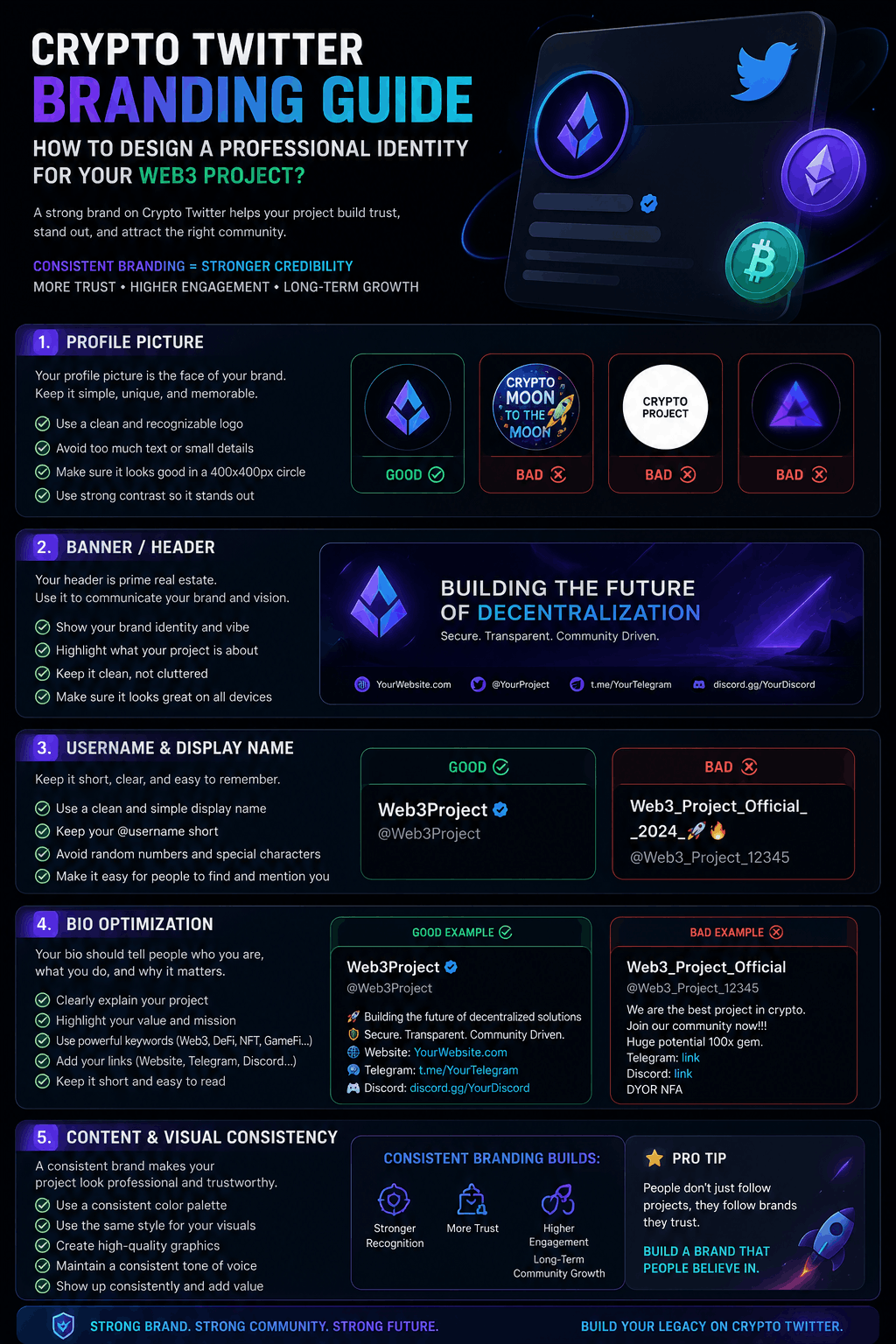
Visual identity translates strategy into immediate perception. On fast moving platforms, users evaluate professionalism before reading text. Strong crypto visual identity Twitter execution ensures that projects appear credible at first glance, increasing the likelihood of deeper engagement.
Logo design acts as the cornerstone of blockchain visual identity. Effective crypto logo design emphasizes simplicity, symbolism, and scalability. Overly complex logos lose clarity on small mobile screens, reducing recognition. Symbolic design elements that reflect protocol values enhance memorability. Scalability ensures consistent display across profile images, websites, token dashboards, and exchange listings.
Banner design provides an opportunity to communicate authority and ecosystem scope. Professional layouts incorporate visual hierarchy, ensuring key messages remain readable across devices. Trust oriented color palettes play a psychological role. Blues and greens often signal stability and growth, while aggressive neon combinations may suggest speculative hype. Effective banners integrate concise positioning statements, ecosystem visuals, and subtle credibility markers without overwhelming viewers.
Profile aesthetics require coherence across posts and media assets. Consistent typography, color palettes, and layout styles strengthen recognition. Random visual experimentation may appear creative but weakens professional perception. Structured crypto content consistency signals operational discipline, which investors subconsciously associate with project reliability.
Cultural integration also matters within digital native communities. NFT aesthetics, meme literacy, and crypto native humor influence relatability. However, balance is essential. Excessive meme culture can undermine professional crypto presence, while overly formal communication may appear disconnected from community norms. Blending cultural awareness with professional standards strengthens decentralized brand building.
Strong visual identity systems include:
• Unified color palette aligned with brand psychology
• Typography standards for educational and promotional content
• Consistent iconography and design motifs
• Templates for announcements, threads, and updates
• Visual guidelines for partners and ambassadors
These systems transform fragmented visuals into cohesive brand ecosystems that reinforce crypto reputation management and strengthen audience trust.
Optimizing Twitter Profile for Professional Crypto Presence
Profile optimization functions as a digital storefront. When users discover a project through retweets or discussions, they evaluate profile credibility before engaging further. Structured Twitter profile optimization crypto strategies ensure that projects communicate professionalism immediately.
The bio acts as a condensed brand statement. Strong bios integrate mission clarity, value positioning, and credibility signals. Instead of vague slogans, effective bios explain what the protocol does and why it matters. Including ecosystem roles, technology focus, and impact goals strengthens blockchain project trust building.
Strategic link placement enhances verification pathways. Directing users to official websites, documentation hubs, and community portals creates transparency. Verified resources reduce skepticism and support crypto credibility signals. A structured link ecosystem also reinforces crypto user acquisition strategy by guiding visitors toward deeper engagement layers.
Pinned posts serve as brand anchors. These posts should highlight vision threads, milestone achievements, or product demonstrations. When visitors explore profiles, pinned content shapes first impressions and communicates project maturity. Effective pinned strategies support crypto brand positioning by reinforcing narrative themes.
Profile authority also depends on visual coherence and messaging alignment. Mismatched graphics, inconsistent terminology, and outdated information damage crypto reputation management. Regular audits ensure that visual identity, bio messaging, and links remain synchronized with ecosystem developments.
Trust enhancing profile elements include:
• Concise mission focused bio
• Transparent links to official resources
• Pinned posts highlighting achievements
• Consistent visual identity across media
• Regular updates reflecting active development
Well optimized profiles function as credibility hubs that strengthen social proof in crypto marketing and improve conversion efficiency within the Web3 marketing funnel.
Content Strategy That Reinforces Brand Authority
Content builds authority through demonstrated expertise and transparent communication. Random posting may create noise but rarely strengthens reputation. Structured crypto Twitter marketing strategies align content with blockchain brand strategy goals to reinforce trust and recognition.
Educational threads position projects as knowledge leaders. Explaining technical concepts, ecosystem mechanisms, and industry developments demonstrates competence. Authority driven content supports crypto investor trust factors by showing that teams understand their domain deeply.
Transparency threads strengthen credibility. Sharing roadmap updates, development milestones, and security practices reduces uncertainty. Honest communication about challenges fosters authentic relationships and strengthens crypto reputation management.
Founder visibility contributes to trust building. When leaders communicate insights and strategic direction, communities perceive stronger accountability. Thought leadership content humanizes projects while reinforcing expertise.
Community recognition content amplifies loyalty. Highlighting contributors, ambassadors, and ecosystem builders reinforces participation incentives. Recognition systems strengthen build loyal token community dynamics and encourage advocacy.
Narrative based campaigns integrate storytelling with ecosystem growth milestones. Structured narratives create anticipation and improve engagement continuity. Effective storytelling supports attract crypto investors strategies by connecting technology with opportunity.
A balanced authority content mix includes educational posts, transparency updates, leadership insights, and community recognition. This combination strengthens crypto audience targeting precision while reinforcing professional identity.
Continuing seamlessly.
Social Proof and Credibility Signals That Strengthen Brand Trust
Strong crypto Twitter branding is reinforced by visible credibility indicators that validate legitimacy. In decentralized markets where anonymity is common and rug pulls are frequent, users rely on trust shortcuts before engaging with any project. These shortcuts appear in the form of endorsements, partnerships, investor recognition, exchange listings, and community validation metrics.
Social proof operates as psychological verification. When reputable builders, analysts, or organizations engage with a project, observers interpret that attention as implicit approval. Strategic collaboration announcements, ecosystem integrations, and public acknowledgments strengthen crypto credibility signals and reduce perceived risk barriers for newcomers.
Partnership positioning plays a major role in blockchain brand strategy. Projects that highlight integrations with infrastructure providers, tooling ecosystems, or reputable protocols demonstrate network embeddedness. This suggests that the project operates within trusted circles rather than isolation. However, credibility depends on authenticity. Inflating minor collaborations or exaggerating partnerships can permanently damage crypto reputation management.
Verification layers also improve perception. Transparent documentation, audit disclosures, and publicly visible development activity contribute to blockchain project trust building. When communities can independently verify claims, brand trust compounds organically.
Community scale contributes to perceived legitimacy, but raw numbers alone are insufficient. Engagement quality, discussion depth, and community participation reflect authentic growth. High follower counts with low interaction often signal artificial inflation. Sustainable crypto social media presence focuses on meaningful engagement that supports long term decentralized brand building.
Media mentions further strengthen brand authority. Coverage from respected research platforms and industry commentators signals relevance and external validation. Thought leadership contributions and interviews position founders as credible voices, reinforcing professional crypto presence.
Trust signals that strengthen brand authority include:
• Public partnerships with recognized ecosystems
• Transparent audit disclosures
• Verified exchange listings
• Active developer contributions
• Meaningful engagement ratios
• Media features and expert commentary
When integrated strategically, these elements reinforce crypto brand positioning and strengthen investor confidence across market cycles.
Maintaining Brand Consistency Across the Entire Ecosystem
Brand strength depends on consistency across every interaction layer. Many projects build strong Twitter identities but neglect visual and messaging alignment across websites, Discord communities, documentation portals, and product interfaces. Fragmentation weakens recognition and reduces crypto brand image cohesion.
Consistency creates familiarity. When audiences encounter uniform design language, terminology, and communication tone across platforms, trust deepens naturally. A cohesive Web3 brand identity ensures that users feel continuity regardless of where engagement occurs.
Visual consistency requires structured design systems. Color palettes, typography standards, graphic styles, and iconography must remain aligned across marketing materials, dashboards, NFT collections, and ecosystem announcements. This unified presentation strengthens crypto visual identity Twitter impact while reinforcing broader blockchain visual identity coherence.
Messaging consistency is equally important. Mission statements, value propositions, and technical explanations should remain stable across channels. Frequent narrative shifts confuse audiences and weaken token brand image clarity. When terminology differs between platforms, users may question organizational maturity.
Community management tone also influences brand perception. Support interactions, moderation styles, and announcement formats should reflect a unified crypto brand voice. A professional yet approachable tone reinforces credibility while maintaining accessibility.
Operational consistency demonstrates discipline. Reliable posting schedules, timely updates, and synchronized communication during major announcements reflect organizational professionalism. This supports crypto reputation management and signals long term commitment.
Cross platform consistency components include:
• Unified visual guidelines
• Standardized messaging frameworks
• Synchronized announcement strategies
• Consistent tone across community channels
• Coordinated ecosystem branding for partners
Projects that maintain ecosystem wide coherence strengthen recognition loops and enhance professional crypto presence across investor and community segments.
Common Branding Mistakes That Undermine Crypto Credibility
Many promising projects damage their growth potential through preventable branding mistakes. Weak crypto Twitter branding often stems from strategic misalignment rather than lack of effort.
Overhyped messaging is a frequent problem. Exaggerated claims, unrealistic projections, and aggressive promotional language create skepticism. Experienced participants interpret hype driven messaging as warning signals. Sustainable crypto brand positioning prioritizes clarity and transparency over sensationalism.
Inconsistent visual presentation weakens recognition. Frequently changing logos, mismatched color palettes, and inconsistent graphic styles create fragmentation. Without stable crypto visual identity Twitter systems, audiences struggle to associate content with the project.
Neglecting storytelling also reduces impact. Listing technical features without contextual narratives limits emotional engagement. Effective token storytelling strategy connects infrastructure with real user benefits and ecosystem transformation.
Ignoring community perception damages crypto reputation management. Failing to respond to feedback, address concerns, or acknowledge contributors weakens trust relationships. Communities value transparency and responsiveness more than perfection.
Short term trend chasing creates identity confusion. Jumping between meme culture, formal corporate tone, and influencer mimicry dilutes Web3 brand messaging coherence. Projects must maintain authentic voices aligned with their mission.
Branding pitfalls to avoid:
• Excessive hype without substantiated proof
• Frequent visual identity changes
• Technical messaging without storytelling
• Ignoring community concerns
• Copying competitor positioning
• Inconsistent communication tone
Avoiding these mistakes strengthens blockchain brand strategy execution and supports long term credibility accumulation.
Advanced Positioning Strategies for Competitive Differentiation
As the Web3 landscape grows increasingly competitive, advanced positioning becomes essential for recognition. Strong crypto Twitter branding must move beyond basic professionalism toward distinctive identity frameworks.
Category ownership is a powerful strategy. Instead of competing broadly, projects can position themselves as leaders within specific niches such as scalability infrastructure, privacy layers, gaming ecosystems, or cross chain liquidity solutions. Clear specialization sharpens crypto audience targeting precision.
Narrative differentiation further strengthens crypto brand positioning. Competing projects often describe themselves using identical terminology. Developing unique metaphors, conceptual frameworks, and ecosystem narratives helps audiences remember brand identity.
Founder positioning also influences perception. Visionary leadership communication builds authority and strengthens crypto investor trust factors. Founders who articulate industry perspectives, technological philosophy, and ecosystem direction enhance brand depth.
Cultural alignment enhances relatability. Participating in industry discussions, supporting open source initiatives, and collaborating with respected communities demonstrate ecosystem integration. Authentic participation strengthens decentralized brand building.
Innovation storytelling supports premium perception. Highlighting research breakthroughs, technical architecture advantages, and future development pipelines reinforces expertise driven professional crypto presence.
Advanced differentiation strategies include:
• Niche category leadership positioning
• Unique narrative frameworks
• Thought leadership from founders
• Cultural integration within crypto communities
• Research driven authority communication
These approaches elevate token brand image beyond generic marketing and establish distinctive ecosystem roles.
Investor Trust Through Strategic Brand Authority
Investor confidence depends heavily on perception management. Strong crypto Twitter branding influences how venture funds, angel investors, and retail participants evaluate project legitimacy.
Professional identity signals operational maturity. Investors associate structured communication, consistent visuals, and disciplined messaging with strong internal organization. This perception strengthens crypto credibility signals and reduces due diligence friction.
Transparent progress communication builds confidence. Regular updates, roadmap tracking, and milestone transparency reassure stakeholders. Open communication strengthens blockchain project trust building by reducing uncertainty.
Authority content also influences investor psychology. Technical deep dives, ecosystem research publications, and educational resources demonstrate domain mastery. Expertise based communication strengthens crypto investor trust factors.
Reputation compounding occurs when consistent professionalism persists across market cycles. Projects that maintain stable communication during volatility signal resilience. This strengthens long term crypto reputation management and investor loyalty.
Investor trust indicators include:
• Transparent roadmap communication
• Educational technical insights
• Consistent professional presentation
• Responsible market communication
• Long term narrative stability
Strategic brand authority transforms social presence into investment confidence infrastructure.
Branding Driven Community Growth and Loyalty Formation
Communities form stronger attachments to brands with clear identity systems. Strong crypto Twitter branding helps transform passive followers into emotionally invested participants.
Identity alignment encourages belonging. When brand narratives reflect community values, members feel represented. Shared vision strengthens build loyal token community dynamics and long term advocacy.
Recognition systems reinforce participation. Highlighting contributors, ambassadors, and active members creates positive feedback loops. Public acknowledgment strengthens emotional investment and supports crypto user acquisition strategy through referrals.
Consistent value delivery sustains engagement. Educational resources, transparent updates, and community events reinforce trust. Projects that prioritize value over promotion strengthen decentralized brand building foundations.
Emotional storytelling deepens attachment. Narratives that emphasize mission, innovation, and ecosystem impact create meaning beyond speculation. Meaning driven branding encourages long term loyalty.
Loyal communities amplify brand reach organically. Advocacy, content sharing, and word of mouth referrals strengthen crypto social media presence without artificial promotion.
Scale Your Brand Authority with Professional Crypto Twitter Growth Services
Building a powerful brand requires strategic coordination, creative infrastructure, and continuous optimization. Many teams struggle to execute comprehensive crypto Twitter marketing systems while simultaneously managing development, partnerships, and operations.
Professional growth partners like CryptoWeet specialize in designing structured blockchain brand strategy frameworks tailored for Web3 ecosystems. These systems align crypto project branding, authority content production, visual identity development, influencer coordination, ambassador programs, and analytics optimization into unified expansion engines.
Specialized teams understand crypto audience targeting, narrative architecture, and investor communication psychology. This expertise transforms inconsistent posting into strategic brand ecosystems that strengthen crypto credibility signals and long term recognition.
Outsourcing brand infrastructure allows internal teams to focus on protocol development while professionals manage visibility scaling. Structured support accelerates professional crypto presence development and reduces costly trial and error cycles.
Projects seeking faster trust accumulation, stronger investor perception, and scalable community growth benefit from integrated professional branding systems.
Conclusion
Strong crypto Twitter branding determines how Web3 projects are perceived before their technology is evaluated. Professional identity systems strengthen credibility, investor confidence, and community loyalty across decentralized ecosystems.
Projects that invest in cohesive Web3 brand identity, consistent messaging, visual coherence, and authority driven communication build durable reputations that compound over time. Those relying on fragmented marketing struggle to sustain trust and recognition.
Strategic branding transforms social presence into credibility infrastructure that supports adoption, partnerships, and token holder loyalty. For teams aiming to accelerate growth while maintaining professionalism, structured branding systems provide decisive competitive advantages.
Professional support from experienced crypto marketing specialists can further streamline this process, helping projects scale visibility, strengthen trust signals, and build recognizable identities that endure beyond market cycles.