
AI Automation for Twitter Marketing has become essential for crypto projects that need to scale visibility without expanding teams. Manual posting, replying, and engagement workflows cannot keep pace with the speed of Web3 narratives. However, careless automation introduces patterns that platform integrity systems detect quickly. When behavioral signals appear artificial, accounts lose reach, suffer visibility throttling, or face suspension. As competition intensifies, crypto teams must adopt intelligent automation infrastructures that simulate natural interaction flows while maintaining compliance and credibility.
This guide explains how AI powered Twitter automation, automated engagement systems, and machine learning driven content scaling can expand reach safely. Instead of relying on spam bots or repetitive scheduling tools, modern systems combine behavioral modeling, adaptive posting intervals, and human like interaction simulations. Readers will learn how to build algorithm safe automation frameworks, manage risk exposure, and scale crypto marketing operations sustainably while protecting reputation and account longevity.
Introduction to AI Automation in Twitter Marketing
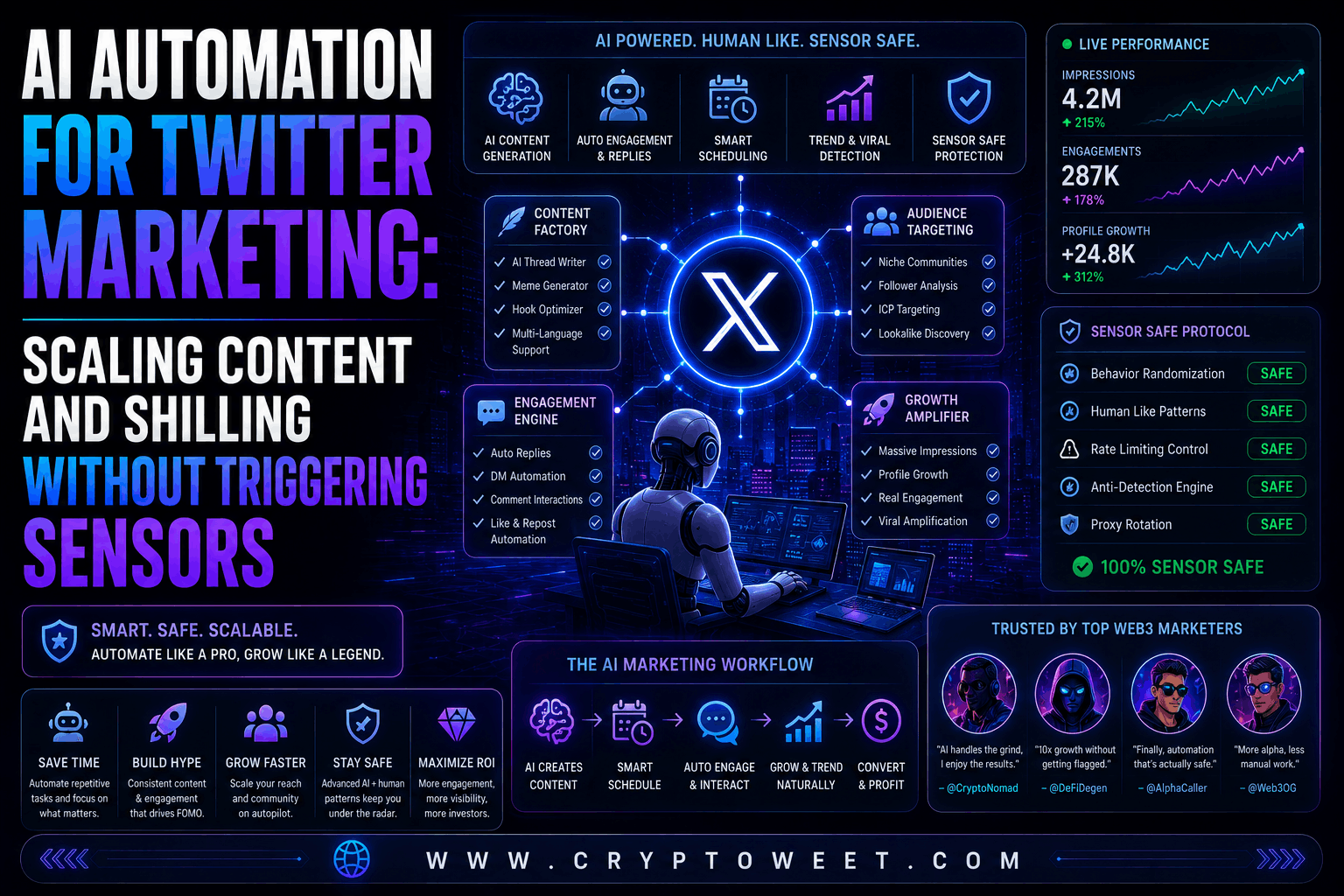
The evolution from manual social media management to AI driven automation systems reflects the increasing complexity of digital ecosystems. Crypto communities operate continuously across time zones, requiring persistent engagement to maintain narrative relevance. Traditional scheduling tools simply queue posts, but they lack contextual awareness and behavioral intelligence. As a result, repetitive posting patterns and unnatural engagement timing can trigger algorithmic scrutiny.
Modern AI Twitter automation incorporates machine learning models that analyze engagement probability, audience activity windows, and contextual relevance. These systems do not merely publish content. They predict interaction opportunities, adapt posting sequences dynamically, and simulate organic participation rhythms. This allows teams to maintain constant visibility without exposing accounts to pattern detection systems.
Automation demand is also driven by operational scale. Large crypto ecosystems often manage multiple accounts for founders, contributors, communities, and ecosystem updates. Coordinating content across these nodes manually introduces delays and inconsistencies. Intelligent systems synchronize messaging flows while preserving natural variance, ensuring narrative coherence without uniform behavior signals.
However, improper automation remains risky. Over reliance on low quality tools creates identifiable digital footprints. Platforms increasingly detect mass identical actions, synchronized engagement spikes, and bot like response intervals. Sustainable growth therefore depends on behavioral automation patterns that mirror real user behavior rather than mechanical execution.
How Twitter Detects Automation and Spam Behaviors?
Platform integrity systems rely on advanced detection models that analyze behavioral anomalies instead of simply scanning content. Understanding these mechanisms is essential for implementing algorithm safe automation.
Detection engines evaluate:
• Engagement velocity irregularities
• Repetitive interaction sequences
• Identical session activity patterns
• Coordinated network amplification signals
• Content duplication frequency
• Device environment inconsistencies
When accounts perform actions faster than human capability or replicate identical behavioral rhythms, they produce automation signatures. For example, posting at perfectly consistent intervals or generating uniform reply structures signals scripted execution. Even if content quality appears acceptable, behavioral uniformity exposes artificial control.
Another major signal involves network clustering. When multiple accounts repeatedly amplify each other in predictable patterns, algorithms identify coordinated behavior loops. This often affects projects using basic automation scripts or engagement pods.
Content analysis also plays a role. Low variability in linguistic structure, excessive hashtag stacking, and repetitive promotional phrasing create spam indicators. Machine learning models assess semantic uniqueness and conversational authenticity to identify generated patterns.
Most failed automation attempts stem from misunderstanding these systems. Teams often prioritize scale without behavioral diversity, resulting in visibility suppression rather than growth. Effective automation risk management requires aligning activity patterns with natural human unpredictability.
Foundations of AI Powered Twitter Marketing Systems
Strong AI powered marketing infrastructure combines multiple intelligence layers rather than relying on a single automation tool. Each layer performs a specialized function that contributes to safe scaling.
Content Intelligence Layer
Natural language models generate posts aligned with audience interests. Instead of repetitive templates, AI analyzes topic clusters, sentiment patterns, and community language preferences.
Engagement Prediction Layer
Machine learning predicts when specific audience segments are most responsive. This prevents posting during low activity windows that reduce visibility momentum.
Adaptive Scheduling Systems
Posting intervals vary dynamically based on engagement performance, preventing mechanical timing signatures.
Audience Segmentation Engines
AI categorizes followers by interest clusters, allowing personalized engagement flows that increase relevance.
Behavior Simulation Models
Systems introduce randomness in interactions, mimicking human browsing patterns and attention shifts.
Together, these layers create intelligent growth infrastructure capable of scaling without creating detectable footprints. Automation becomes a strategic enhancement rather than a blunt force tool.
Scaling Content Creation with AI Models
Content scale determines narrative dominance in crypto ecosystems. However, scaling manually leads to burnout and inconsistency. AI content generation systems enable continuous narrative presence while preserving strategic alignment.
Modern tools support:
• Automated thread structuring
• Long form narrative condensation
• Topic cluster expansion
• Sentiment adaptive rewriting
• Multi format content repurposing
For example, a single research update can transform into multiple posts, visual summaries, and threaded explanations tailored to different audience segments. AI models maintain thematic consistency while adjusting tone and complexity.
Brand voice preservation remains essential. Advanced systems analyze historical content to replicate linguistic identity, ensuring automation does not dilute personality. This is crucial for founder accounts where authenticity drives trust.
Content intelligence also supports authority building. Topic clustering tools identify recurring themes that reinforce niche expertise. Over time, consistent thematic signals strengthen algorithmic recognition and audience perception.
Effective scaling therefore depends on combining volume with narrative coherence rather than mass posting disconnected fragments.
Intelligent Engagement Automation Without Spam Signals
Engagement drives algorithmic visibility, but automation must replicate human conversational dynamics. Poorly designed systems generate shallow interactions that appear transactional.
Safe automated engagement systems focus on:
• Context aware replies
• Variable response timing
• Conversation branching patterns
• Interest aligned interactions
• Diverse engagement formats
Instead of replying instantly to every mention, intelligent systems introduce delay variations that mimic reading time. Responses adapt to conversation tone rather than using static templates.
Conversation tree mapping further enhances realism. AI tracks discussion flows and generates contextually relevant follow ups, preventing isolated reply clusters that resemble bots.
Another key factor involves engagement diversity. Humans interact through likes, replies, retweets, and passive browsing. Balanced interaction mixes avoid repetitive patterns that trigger detection engines.
Avoiding engagement pods is critical. Artificial reciprocity networks create synchronized interaction loops that algorithms identify easily. Sustainable engagement emerges from genuine community integration rather than forced amplification.
AI Driven Shilling Systems for Crypto Projects
Strategic promotion differs significantly from spam. AI driven shilling systems focus on narrative integration rather than aggressive advertisement bursts.
Effective systems emphasize:
• Contextual narrative insertion
• Community aligned messaging
• Authority amplification through discussion
• Influencer interaction modeling
• Sentiment sensitive promotion timing
Instead of flooding comment sections, AI identifies relevant discussions where project narratives add value. This positions promotion as contribution rather than intrusion.
Influencer modeling analyzes communication styles of respected accounts. AI adapts messaging tone to align with community expectations, increasing acceptance probability.
Sentiment analysis prevents promotion during negative market phases where audiences resist marketing. Timing alignment improves reception and reduces backlash risk.
Ethical promotion frameworks prioritize transparency and informational value. Sustainable credibility outweighs short term exposure spikes.
Behavioral Pattern Engineering for Safe Automation
As automation scale increases, behavioral realism becomes the primary factor separating safe systems from detectable bot networks. Platforms do not rely solely on content inspection. They evaluate digital behavior patterns that reveal whether an account is operated by a human or controlled through scripted systems. This is why behavioral pattern engineering is fundamental to safe AI Twitter automation.
Human activity is inconsistent by nature. People pause while reading, scroll unpredictably, switch attention between posts, and vary their reaction speeds. Automated systems that execute commands instantly or at perfectly timed intervals create unnatural footprints. Detection models are trained to identify such uniformity.
To simulate organic behavior, automation systems must introduce variability across multiple layers of interaction.
Session Simulation
Human users do not remain active for identical durations each time they log in. Some sessions are brief, others extend longer depending on interest levels. Intelligent systems replicate this by varying session length and distributing activities unevenly.
Interaction Rhythm Modeling
People engage differently depending on content type. A controversial post may trigger faster replies, while technical threads require longer reading time. Automation must adjust response timing dynamically instead of applying fixed delays.
Attention Shift Simulation
Humans rarely perform continuous actions without interruption. They scroll, pause, open profiles, read replies, and switch topics. Automation frameworks that include browsing simulation create realistic engagement flows.
Engagement Diversity
Natural users mix actions such as likes, replies, reposts, profile visits, and passive scrolling. Repetitive single action behavior, such as liking dozens of posts consecutively, creates suspicious patterns. AI systems should randomize action sequences.
Device and Environment Consistency
Frequent changes in device fingerprints, IP environments, and session origins raise platform suspicion. Safe automation maintains consistent operational environments that reflect real user setups.
Multi Account Behavioral Separation
One of the biggest detection triggers is identical behavior across multiple accounts. If ten accounts post, like, and reply using identical timing structures, clustering algorithms flag coordinated control. Each account should have its own behavioral signature and activity rhythm.
Gradual Scaling Protocols
Humans do not suddenly increase activity volume drastically overnight. Safe systems expand operational intensity progressively, allowing algorithms to interpret growth as natural momentum.
Behavioral engineering transforms automation from mechanical execution into intelligent digital simulation. Projects that ignore this layer often experience silent visibility throttling even if accounts are not immediately suspended.
Automation Risk Management and Compliance Frameworks
Even advanced AI powered automation systems carry operational risks. Detection models continuously evolve, meaning yesterday’s safe pattern could become tomorrow’s trigger. Sustainable scaling therefore depends on structured automation risk management frameworks.
Risk management begins with exposure assessment. Every automated action carries a probability of detection depending on intensity, frequency, and behavioral similarity. Mature systems assign dynamic risk scores to activities and adjust operations accordingly.
Detection Probability Scoring
AI systems monitor behavior against safe thresholds. When activity approaches suspicious levels, automation slows down automatically.
Engagement Throttling Systems
Instead of executing unlimited interactions, safe frameworks cap actions within human realistic ranges. This prevents abnormal engagement spikes.
Shadowban Monitoring
Visibility suppression often occurs before account suspension. Sudden reach drops, reduced impressions, or delayed indexing may indicate algorithmic restrictions. Early detection allows corrective adjustments.
Account Warming Sequences
New accounts face higher scrutiny. Gradual warming builds trust signals through progressive engagement, content posting, and interaction diversity. Rushing activity during early stages significantly increases suspension probability.
Crisis Containment Protocols
If one account is flagged, interconnected accounts may also face review. Segmented operational clusters reduce network wide exposure. Isolation mechanisms prevent system wide disruption.
Compliance Adaptation Loops
Automation systems must evolve alongside platform policy updates. Continuous monitoring of rule changes ensures behavior patterns remain within acceptable limits.
Risk management is not about avoiding automation. It is about maintaining sustainable growth without triggering platform defense systems.
Building an AI Automation Stack for Twitter Marketing
Effective AI Twitter automation relies on integrated technology stacks rather than standalone tools. Fragmented solutions create coordination gaps and inconsistent behavioral signals.
A complete stack includes multiple specialized layers working together.
Content Intelligence Layer
This layer generates posts, threads, and replies using AI content generation models trained on crypto narratives. It ensures messaging aligns with audience interests while preserving brand voice consistency.
Engagement Intelligence Layer
Machine learning predicts interaction opportunities and prioritizes high value engagement targets. Instead of random interactions, systems focus on conversations that improve authority perception.
Adaptive Scheduling Layer
Smart schedulers adjust posting intervals based on audience activity windows and engagement performance. This avoids mechanical timing patterns.
Behavioral Simulation Layer
Digital body language modeling introduces randomness across sessions, interaction sequences, and browsing flows to maintain authenticity.
Analytics and Feedback Systems
Performance dashboards monitor reach, engagement depth, and audience response quality. Feedback loops allow automation engines to refine strategies continuously.
Infrastructure Protection Layer
Security frameworks maintain device consistency, environment stability, and access protection. This prevents unauthorized activity and operational anomalies.
A synchronized automation stack improves efficiency while minimizing risk exposure. It transforms growth operations into structured infrastructures rather than experimental tactics.
Common Mistakes When Using AI for Twitter Growth
Despite access to powerful tools, many projects misuse social media automation systems and compromise credibility.
One common mistake is excessive automation. When every interaction is automated, accounts lose human spontaneity. Conversations become predictable and shallow.
Another error involves identical behavior footprints. Reusing templates, response formats, and engagement timing across multiple accounts creates pattern clusters detectable by algorithms.
Aggressive scaling is also dangerous. Sudden spikes in posting volume or engagement intensity resemble inorganic amplification attempts.
Low quality AI content further damages performance. Repetitive phrasing, generic commentary, and poor contextual relevance reduce engagement credibility.
Ignoring community interaction is equally harmful. Automation should support conversations, not replace them. Audiences value responsive and meaningful dialogue.
Avoiding these mistakes requires balancing automation efficiency with human oversight and strategic moderation.
The Future of AI in Social Media Growth Infrastructure
Advancements in AI driven marketing automation will reshape how crypto ecosystems scale digital presence.
Predictive engagement systems will analyze conversation trends to forecast viral opportunities before they peak. Autonomous marketing agents may coordinate multi account narratives dynamically.
Human AI hybrid models will likely dominate sustainable growth strategies. Automation handles scale while humans guide strategic messaging and community relations.
Decentralized marketing networks may also emerge, distributing promotion responsibilities across contributor ecosystems rather than central teams.
As technology evolves, safe infrastructure design will remain more important than raw automation power.
Professional Infrastructure and Foundational Growth Solutions by CryptoWeet
Scaling visibility through automation is powerful, but growth without credibility is fragile. Many crypto projects invest heavily in AI marketing systems, content automation, and distribution networks but still struggle to convert exposure into trust. When investors or users visit a profile, they immediately judge the strength of its social proof. Low quality followers, empty comment sections, and inconsistent engagement make even advanced marketing appear artificial. Without strong foundations, automation amplifies numbers but fails to build authority.
CryptoWeet focuses on building the credibility layer that makes growth sustainable. Instead of selling inflated metrics or bot driven engagement, CryptoWeet helps Web3 teams establish authentic social proof that supports long term ecosystem expansion.
The 1000 Foundation includes:
1,000 Genuine Crypto Followers
• Real users interested in crypto and Web3 topics
• Niche relevant audience aligned with your ecosystem
• Profiles that strengthen industry credibility
• Followers that improve organic engagement probability
• Audience composition that signals legitimacy to investors
These followers create the first visible layer of trust. When someone visits your profile, they see a community that fits your niche rather than random inactive accounts.
1,000 Likes and Views Distributed Naturally
• Engagement spread across up to 10 important posts
• Balanced interaction ratios that avoid artificial spikes
• Activity patterns that resemble organic audience behavior
• Improved algorithmic trust signals through consistent engagement
• Content history that looks active and community supported
Instead of one viral looking post surrounded by inactivity, your profile shows steady audience interaction across multiple posts.
1,000 Authentic Replies and Conversations
• Context relevant replies that match post content
• Natural discussion threads that build authority
• Community style interactions that look organic
• Conversations that attract additional real participants
• Strong trust signals for new visitors and investors
Replies create visible proof that people are actively discussing your project. This transforms posts from static announcements into living community spaces.
Why This Foundation Matters?
Without foundational credibility:
• Profiles look empty despite automation
• Engagement appears manipulated
• Visitors hesitate to trust the project
• Marketing campaigns convert poorly
With strong foundations:
• Growth appears organic and trustworthy
• Algorithms treat activity as community driven
• Visitors feel confident engaging and following
• Marketing performance improves across all campaigns
Automation works best when it amplifies real signals, not artificial ones.
Built for Projects Preparing to Scale
The 1000 Foundation is ideal for:
• New crypto projects launching tokens
• Early stage Web3 startups building presence
• Teams recovering from inactive periods
• Projects preparing for marketing pushes
• Founders establishing authority on Crypto Twitter
It creates a stable base that supports future scaling strategies.
Build Your First 1000 Genuine Crypto Connections
CryptoWeet does not sell fake hype. The goal is to provide the first structural credibility blocks that allow projects to grow safely and sustainably.
The 1000 Foundation helps you:
• Establish authentic social proof
• Strengthen algorithmic trust signals
• Improve investor perception
• Create active community environments
• Prepare safely for large scale marketing
Start with a real foundation. Then scale with confidence.
CryptoWeet builds the credibility layer your growth depends on.
Conclusion
AI Automation for Twitter Marketing enables scalable visibility and engagement for crypto ecosystems, but sustainable success depends on behavioral intelligence, risk management frameworks, and credibility foundations.
Projects seeking safer growth infrastructures can strengthen social proof through CryptoWeet’s The 1000 Foundation, ensuring automation operates on stable trust layers while maintaining compliance and long term ecosystem credibility.