X-Presale FOMO: Driving Funding and Closing Rounds via Social Proof (2026)

X-Presale FOMO: Driving Funding and Closing Rounds via Social Proof (2026)
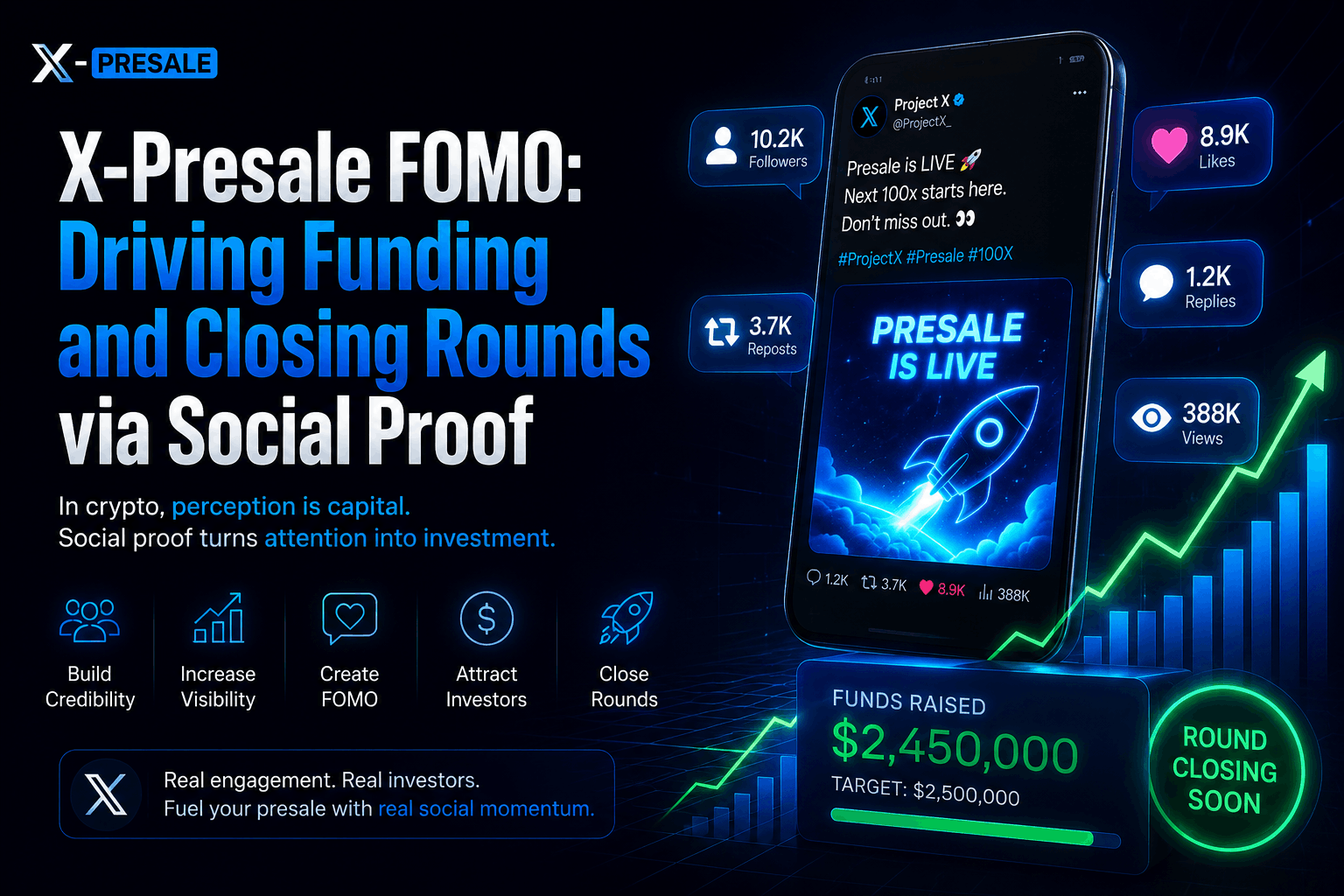
In the competitive landscape of Web3 fundraising, X-Presale FOMO has become one of the most powerful forces driving capital allocation. Investors rarely act based on logic alone. Instead, they respond to perceived demand, visible momentum, and social validation signals that suggest an opportunity is rapidly filling. Projects that successfully create token presale FOMO do not just attract attention. They accelerate funding velocity, shorten fundraising cycles, and increase overall capital inflow by making participation feel urgent and necessary.

This guide explores how crypto presale marketing leverages social proof crypto funding, behavioral psychology, and strategic communication to convert attention into capital. You will learn how to engineer demand perception, build credibility before launch, and structure campaigns that transform passive audiences into active participants. This article breaks down the exact frameworks used in Web3 fundraising strategy, combining investor psychology crypto, scarcity marketing crypto, and crypto launch hype strategy to help projects close rounds faster and more efficiently.

Why FOMO Drives Capital in Crypto Presales?

X-Presale FOMO: Driving Funding and Closing Rounds via Social Proof (2026)

In traditional markets, investment decisions are often slow, research driven, and influenced by institutional processes. In contrast, crypto markets operate at narrative speed. Information spreads rapidly, sentiment shifts quickly, and opportunities appear and disappear within short timeframes. This environment amplifies emotional decision making, making fear of missing out crypto a primary driver of capital movement.

FOMO works because it reduces hesitation. When investors perceive that others are already participating, they interpret this as validation. This is where social proof crypto funding becomes critical. Visible engagement, active discussions, and signs of early adoption signal that a project is gaining traction. This perception creates urgency, pushing individuals to act before allocations disappear.

Another key factor is perceived scarcity. Limited whitelist spots, capped allocations, and time sensitive participation windows trigger urgency responses. When combined with visible demand, scarcity transforms interest into immediate action. Investors begin to think in terms of opportunity cost rather than risk, shifting their mindset from evaluation to participation.

Visibility also plays a central role. A project that appears frequently across feeds, discussions, and influencer commentary feels more legitimate. Repetition strengthens familiarity, and familiarity reduces perceived risk. This is why X marketing for presale focuses heavily on distribution and narrative dominance.

Ultimately, FOMO is not manipulation when used correctly. It is the amplification of real demand signals, structured in a way that aligns with human decision making patterns. Projects that understand this dynamic gain a significant advantage in fundraising efficiency.

The Psychology Behind Presale FOMO in Crypto Markets

Understanding the psychological mechanisms behind token presale FOMO allows projects to design campaigns that resonate deeply with investor behavior.

Fear of Missing Out vs Rational Investing

Most investors believe they act rationally, but in fast moving environments, emotional triggers dominate. When users see others gaining access to early allocations, they begin to fear exclusion. This fear overrides analytical thinking, especially when combined with time pressure.

Herd Behavior and Crowd Validation

Humans naturally follow group behavior when uncertainty is high. In crypto, where information asymmetry is common, herd behavior investing becomes a shortcut for decision making. If a large number of users appear interested, individuals assume the opportunity has been validated.

Scarcity Perception and Urgency Triggers

Scarcity increases perceived value. Limited access suggests exclusivity, which enhances desirability. When projects communicate limited supply effectively, they create urgency loops that push users toward faster decisions.

Narrative Influence on Investor Decisions

Narratives shape perception more than raw data. A compelling story about innovation, disruption, or ecosystem growth can drive participation even before technical validation is complete. Strong narratives combined with visible demand create powerful FOMO loops.

Psychological alignment is what separates average campaigns from high performing presales. Projects that integrate behavioral insights into their strategy create more effective crypto presale marketing systems.

Understanding Social Proof in Web3 Fundraising

Social proof signals crypto function as the foundation of trust in decentralized environments. Unlike traditional finance, where institutions provide validation, Web3 relies heavily on community perception and visible activity.

Social proof can be divided into two categories. On chain signals include wallet activity, transaction volume, and participation data. These indicators provide measurable evidence of demand. Off chain signals include engagement metrics, influencer endorsements, and community discussions. These shape perception and narrative.

Community activity acts as a real time validation mechanism. When users observe active conversations, debates, and excitement, they interpret this as organic interest. This reduces skepticism and increases willingness to engage.

Influencer validation adds another layer. When respected figures support a project, their credibility transfers to the opportunity. This is why influencer endorsement crypto remains a key component of presale campaigns.

Perceived demand often matters more than actual numbers. Even moderate participation can appear significant when structured and communicated effectively. The goal is not to fabricate interest but to present real signals in a way that amplifies their impact.

Strong crypto social proof signals create a feedback loop. Visibility attracts attention, attention increases engagement, and engagement reinforces credibility.

Core Social Proof Signals That Drive Presale Demand

Different layers of social proof crypto funding do not influence investor behavior equally. Some signals create surface level awareness, while others directly impact trust, urgency, and capital allocation decisions. Understanding how each type of signal functions allows projects to structure perception strategically instead of relying on random engagement.

In crypto presale marketing, social proof is not just about showing activity. It is about shaping how that activity is interpreted. Investors rarely analyze raw numbers in isolation. They look for patterns that indicate legitimacy, momentum, and insider participation. The more structured and consistent these signals appear, the stronger the perceived demand becomes.

Community Engagement Signals

Among all signals, community engagement is the most visible and continuously evaluated. However, not all engagement is equal. Passive metrics such as likes provide minimal validation because they require little effort. In contrast, replies, debates, and ongoing conversations indicate genuine interest and cognitive involvement.

When users see active discussions under posts, they interpret this as organic traction. Multiple perspectives, questions, and arguments create the impression that the project is worth attention. This is especially important in early stage campaigns where hard data is limited.

Depth of conversation also matters. A thread with ten meaningful replies carries more weight than one with hundreds of low effort comments. The algorithm and human observers both prioritize quality over volume.

Another critical factor is consistency. Engagement that appears across multiple posts over time builds credibility. A single viral post is less convincing than sustained interaction patterns. This continuity signals that the community is not temporary but actively following the project’s development.

Strong community engagement signals act as the first layer of validation. They reduce skepticism and encourage new users to explore further, which increases the probability of conversion.

Influencer and KOL Validation

In Web3, trust is often transferred rather than built from scratch. This is where influencer endorsement crypto becomes highly effective. Influencers and KOLs act as credibility filters. Their audiences rely on their judgment to navigate a market filled with uncertainty and noise.

When a recognized figure interacts with a project, whether through a mention, reply, or dedicated post, it immediately elevates perceived legitimacy. This effect is amplified when the influencer has a track record of identifying quality opportunities.

However, not all influencer validation is equal. Audiences can distinguish between authentic interest and paid promotion. Genuine engagement tends to involve discussion, analysis, or repeated interaction. Paid promotions often appear isolated and lack depth.

Strategic alignment is also critical. Influencers should match the project’s niche and audience. A DeFi protocol benefits more from analysts and technical educators, while NFT projects may gain more from culture driven creators.

Layering multiple influencer interactions strengthens the signal. When several respected voices engage within a short timeframe, it creates a network effect. Observers interpret this as consensus rather than coincidence.

Effective use of crypto social proof signals through influencer validation accelerates trust building and expands reach simultaneously, making it a key component of presale demand generation.

Whale and Early Investor Signals

Few signals are as powerful as visible participation from large investors. Whale participation signals create immediate perception of informed confidence. Observers assume that individuals or entities allocating significant capital have conducted thorough research.

Even without direct communication, wallet activity alone can influence sentiment. Tracking known wallets, early allocations, or large contributions creates a narrative of “smart money” entering the project. This perception drives herd behavior and accelerates participation.

The psychological mechanism behind this is simple. Investors prefer not to act alone in uncertain environments. Seeing others commit capital reduces perceived risk and increases confidence in the decision.

Early investor signals also create momentum. When initial rounds fill quickly due to large allocations, smaller participants feel pressure to act before remaining slots disappear. This reinforces scarcity marketing crypto dynamics.

Transparency enhances the impact of these signals. Clearly communicating participation milestones, allocation progress, and funding stages makes demand visible. Hidden activity does not contribute to perception, while visible activity drives FOMO.

Whale signals are not about manipulation. They are about highlighting real participation in a structured way that influences investor psychology crypto and encourages broader engagement.

Platform and Ecosystem Credibility

Beyond individual signals, ecosystem context plays a crucial role in shaping perception. Platform credibility acts as an external validation layer that reduces uncertainty.

Launchpads, partnerships, and integrations signal that a project has undergone some level of evaluation. When a project is associated with a reputable platform, it inherits part of that platform’s trust.

This is particularly important for new teams without established track records. Instead of building credibility from zero, they leverage existing reputations within the ecosystem.

Partnership announcements also function as social proof. Collaborations with known protocols suggest alignment with established players. This reduces perceived isolation and increases confidence in long term viability.

Integration signals provide functional validation. When a project connects with existing infrastructure, it demonstrates practical utility rather than theoretical potential.

Ecosystem credibility is often underestimated, but it plays a significant role in crypto presale marketing. Investors consider not only the project itself but also its surrounding network.

Structured Breakdown of High Impact Signals

To better understand how these layers interact, the most effective campaigns combine multiple signals into a unified perception system:

• Active comment sections with meaningful discussions that demonstrate real community interest
• Recognized accounts interacting consistently across multiple posts, not just one time mentions
• Visible participation milestones such as funding progress and allocation updates
• Sustained engagement patterns that show long term attention rather than temporary spikes
• Clear and transparent communication of allocation status, reducing uncertainty for new participants

Each of these elements reinforces the others. Engagement supports influencer validation, influencer validation amplifies whale signals, and all of them are strengthened by ecosystem credibility.

Why Layering Social Proof Drives Presale Demand

Isolated signals rarely create strong impact. A single influencer mention without community engagement appears artificial. High engagement without credibility context may look like manipulation. Whale participation without visibility fails to influence perception.

Effective presale demand generation comes from layering signals in a way that creates a coherent narrative. Investors should see consistent evidence of interest from multiple sources. This reduces doubt and increases confidence.

When executed correctly, these layers create a powerful feedback loop:

Social proof increases trust
Trust increases participation
Participation increases visibility
Visibility reinforces social proof

This loop is the core mechanism behind X-Presale FOMO. It transforms scattered signals into a structured perception of demand, which ultimately drives funding and accelerates round closure.

Building Pre-Launch Hype Before Presale Starts

Successful presales begin long before funding opens. Pre launch phases focus on narrative construction and expectation building.

Narrative building establishes context. Projects must clearly communicate their purpose, innovation, and market relevance. Without a strong narrative, hype lacks direction and fails to convert.

Teasing strategies introduce controlled information. Instead of revealing everything at once, projects release insights gradually. This creates curiosity and anticipation.

Early alpha drops reward attention. Sharing limited insights with engaged users encourages deeper involvement and increases perceived exclusivity.

Waitlists and whitelist systems create structured entry points. These mechanisms allow projects to measure interest while building anticipation.

Controlled information release ensures sustained attention. Each update builds on previous communication, creating a continuous engagement loop.

Pre launch hype is not about noise. It is about structured storytelling that prepares audiences for participation.

Whitelist Strategy and Allocation Scarcity Engineering

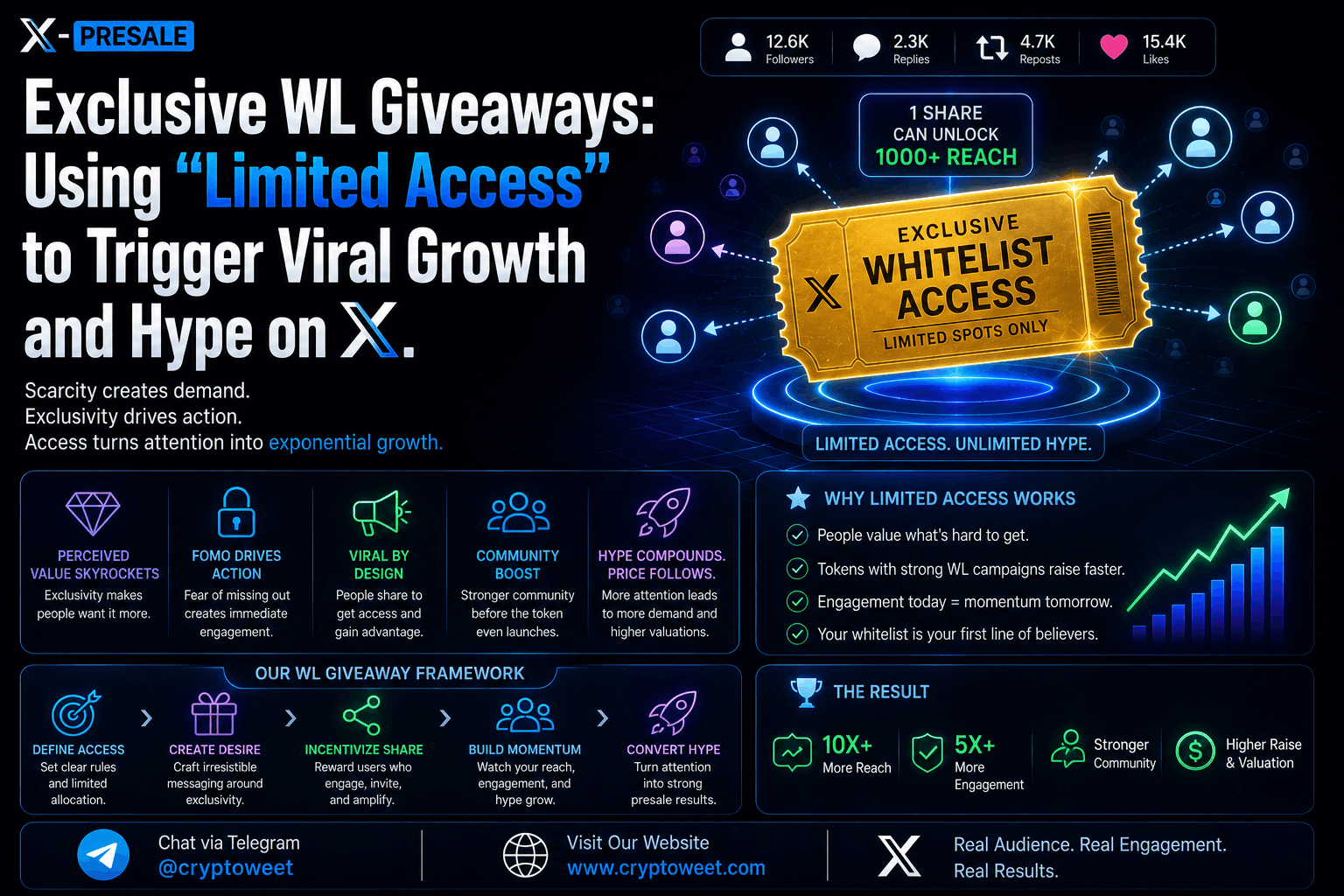
Whitelist systems are essential tools for managing demand and creating urgency. They transform passive interest into active competition.

Limited slots create exclusivity. When access is restricted, users perceive higher value. This triggers scarcity marketing crypto dynamics that increase participation rates.

Gamified entry systems enhance engagement. Tasks such as social sharing, content creation, and community participation encourage users to contribute actively.

Competition loops amplify visibility. Users compete for access, sharing content and inviting others to increase their chances. This expands reach organically.

Allocation structure also matters. Smaller individual allocations create broader participation, while larger allocations attract high value investors. Balancing these elements influences overall campaign dynamics.

Checklist for effective whitelist design:

• Clear entry requirements
• Transparent selection criteria
• Balanced allocation distribution
• Visible progress tracking
• Incentives for community participation

Effective whitelist strategies convert interest into commitment while reinforcing urgency triggers Web3.

Content Strategy for X-Presale FOMO Campaigns

Content drives perception, and perception drives funding. A strong crypto brand awareness strategy ensures consistent narrative delivery across all stages.

High impact tweets focus on momentum. Updates about milestones, partnerships, and progress create continuous signals of growth.

Thread strategies provide depth. Long form content explains token utility, roadmap details, and ecosystem value, increasing trust.

Visual content simplifies complexity. Tokenomics charts, dashboards, and infographics improve understanding and shareability.

Influencer amplification content extends reach. Collaborative posts introduce the project to new audiences.

Content must balance information and excitement. Too much hype reduces credibility, while too much technical detail reduces accessibility.

Consistency is critical. Repeated exposure reinforces legitimacy and strengthens crypto Twitter visibility.

Timing and Momentum: When FOMO Converts Best

Timing determines whether interest converts into action. Even strong campaigns can underperform if launched at the wrong moment.

Countdown phases build anticipation. Gradual progression toward launch increases emotional investment.

Announcement waves maintain visibility. Coordinated releases across channels ensure consistent exposure.

Market sentiment alignment improves conversion. Bullish environments favor aggressive messaging, while cautious markets require trust focused communication.

Peak hype windows occur when multiple signals align. High engagement, influencer activity, and narrative momentum create optimal conditions for funding.

Momentum must be managed carefully. Too early, and interest fades. Too late, and opportunities are missed.

Strategic timing ensures that presale conversion tactics operate at maximum efficiency.

Viral Loops and Community Driven Amplification

Once initial attention is captured, the next phase of X-Presale FOMO is amplification. Visibility alone is not enough. Campaigns must evolve into self expanding systems where the community actively participates in distribution. This is where viral loops crypto Twitter and community driven engagement become critical components of presale demand generation.

A viral loop begins when one participant brings in another. In the context of crypto presale marketing, this often takes the form of referral incentives, whitelist sharing, or social participation tasks. Each user becomes a distribution node, expanding reach without increasing direct marketing costs. This structure allows projects to scale awareness exponentially rather than linearly.

Ambassador programs are particularly effective in this phase. Early supporters are given roles, recognition, and sometimes allocation advantages. This creates alignment between project success and individual incentives. When users feel ownership, they naturally promote the project more aggressively and authentically.

Meme culture also plays a role in amplification. Memes reduce friction in content sharing, allowing narratives to spread faster across different audience segments. While technical threads build authority, memes expand reach. A balanced mix ensures both credibility and virality.

Another powerful loop is competition based sharing. Users are encouraged to invite others, complete tasks, and increase their chances of receiving allocations. This transforms passive audiences into active promoters. The key is structuring incentives so that participation feels rewarding rather than forced.

Community driven amplification strengthens social proof signals crypto. As more users engage, reply, and share, the perception of demand increases. This perception feeds back into the system, attracting even more participants and reinforcing the fear of missing out crypto dynamic.

Converting Attention Into Funding

Attention without conversion has limited value. The core objective of Web3 fundraising strategy is to transform visibility into capital inflow. This requires a structured funnel that guides users from awareness to participation.

At the top of the funnel, content creates interest. Threads, announcements, and influencer posts introduce the project and generate curiosity. At this stage, clarity is more important than complexity. Users must quickly understand what the project offers and why it matters.

Mid funnel strategies focus on education and trust building. Detailed threads explaining token utility, roadmap, and ecosystem value help users evaluate the opportunity. This stage reduces uncertainty and increases confidence.

The bottom of the funnel is where conversion happens. Users must be guided toward clear actions such as joining the whitelist, connecting wallets, or participating in the presale. Friction at this stage reduces conversion rates significantly.

A simple conversion framework includes:

• Clear call to action in every key post
• Easy to navigate landing pages
• Transparent participation steps
• Minimal technical barriers
• Immediate confirmation of successful actions

Reducing friction is essential. Complex processes discourage participation, especially when competing opportunities are available. The smoother the experience, the higher the presale conversion tactics efficiency.

Another important factor is reinforcement. Users need multiple signals before committing capital. Repeated exposure, consistent messaging, and visible participation from others strengthen decision confidence.

When structured correctly, the funnel aligns attention → trust → action, turning crypto social proof signals into measurable funding outcomes.

Closing Rounds Faster with Strategic Social Proof

The final stage of a presale campaign is where urgency must peak. At this point, the goal is not awareness but acceleration. Closing funding rounds crypto requires precise communication that reinforces scarcity and demand simultaneously.

One of the most effective tactics is real time progress updates. Announcing that a round is partially filled creates momentum. As percentages increase, urgency intensifies. Phrases such as “80 percent filled” or “final allocations remaining” trigger immediate action.

“Almost sold out” psychology is particularly powerful. When users believe they are among the last to gain access, hesitation decreases significantly. This is where scarcity marketing crypto reaches maximum impact.

Another technique is time based urgency. Limited windows for participation create clear deadlines. Countdown mechanisms increase emotional pressure and encourage faster decisions.

Strategic messaging during this phase should focus on:

• Remaining allocation visibility
• Participation milestones
• Increased demand signals
• Final opportunity framing
• Reinforcement of project value

It is important to maintain authenticity. False scarcity damages trust and long term reputation. Real demand signals, when communicated effectively, are sufficient to create urgency.

Strong closing strategies ensure that capital inflow acceleration happens efficiently, allowing projects to complete fundraising cycles with maximum effectiveness.

Avoiding Fake Hype and Reputation Damage

While crypto launch hype strategy is essential, misuse can lead to long term consequences. Artificial hype may generate short term attention but often results in credibility loss.

Fake engagement is one of the most damaging practices. Buying likes, replies, or followers creates unnatural patterns that both users and algorithms can detect. This reduces trust and limits organic reach.

Over exaggerated claims also harm reputation. Promising unrealistic outcomes creates expectations that cannot be met. When results fall short, community trust declines rapidly.

Ignoring community feedback weakens relationships. Projects that treat audiences as numbers rather than participants fail to build loyalty.

Inconsistent messaging confuses positioning. Shifting narratives make it difficult for users to understand the project’s value.

Ethical growth practices focus on transparency, value creation, and authentic engagement. Sustainable success depends on long term trust rather than short term hype.

Projects that prioritize credibility build stronger communities, attract better investors, and maintain positive reputation across market cycles.

Measuring Presale Performance Metrics That Matter

Data driven analysis is essential for optimizing crypto presale marketing campaigns. Without measurement, it is impossible to understand what drives results.

Engagement metrics provide insight into audience interest. High interaction rates indicate strong resonance with content.

Conversion rate is one of the most important indicators. It measures how effectively attention turns into participation.

Engagement to funding ratio shows efficiency. This metric reveals how much interaction is required to generate capital inflow.

Follower growth velocity indicates expanding reach. Rapid growth often correlates with successful campaigns.

Sentiment analysis tracks perception trends. Positive sentiment supports conversion, while negative sentiment signals potential issues.

Key metrics to monitor:

• Conversion rate from social to presale participation
• Cost per investor acquisition
• Engagement to funding ratio
• Capital inflow speed
• Community growth rate

Continuous analysis allows teams to refine strategies and improve performance over time.

Professional Infrastructure for Presale Growth and Social Proof

Most teams understand the importance of X-Presale FOMO, but struggle with execution. Creating consistent visibility, credible engagement, and structured demand requires more than basic marketing efforts. Without strong foundations, even well planned campaigns fail to generate meaningful results.

This is where professional infrastructure becomes critical. Effective crypto marketing systems combine narrative strategy, distribution networks, and credibility layers into a unified growth engine. Instead of relying on isolated tactics, successful projects build integrated systems that support every stage of the funnel.

CryptoWeet provides specialized infrastructure designed for Web3 fundraising strategy. The focus is on building authentic social proof crypto funding signals before scaling visibility. This ensures that when campaigns launch, audiences perceive real demand rather than artificial hype.

The 1000 Foundation

A core component of this infrastructure is The 1000 Foundation, which establishes the first layer of credibility required for successful presale campaigns.

This system includes:

1,000 genuine crypto aligned followers who create an immediate baseline of legitimacy
1,000 distributed likes and views across key posts to build visible engagement history
1,000 authentic replies and conversations that demonstrate active community participation

These elements work together to strengthen crypto social proof signals. When new users discover the project, they see an active and engaged community rather than an empty profile. This reduces skepticism and increases trust.

The impact extends beyond perception. Strong engagement history improves algorithm visibility, allowing content to reach larger audiences. This creates a compounding effect where credibility enhances distribution, and distribution reinforces credibility.

Projects preparing for token launches, whitelist campaigns, and funding rounds benefit significantly from these foundations. With established trust layers, presale demand generation becomes more efficient, and conversion rates improve.

Professional infrastructure transforms marketing from guesswork into a predictable system. Instead of chasing attention, projects build environments where attention converts naturally into participation and funding.

Conclusion

Mastering X-Presale FOMO requires more than creating hype. It involves understanding investor psychology crypto, structuring crypto presale marketing systems, and building strong social proof crypto funding signals that drive real demand.

Successful projects align narrative, community, and timing to create urgency without sacrificing credibility. They focus on authentic engagement, clear communication, and consistent visibility to guide users from awareness to participation.

FOMO becomes truly powerful when combined with trust. Without credibility, urgency fails to convert. With strong foundations, even simple campaigns can generate significant results.

For teams aiming to accelerate fundraising and close rounds efficiently, building structured growth systems is essential. Professional infrastructure, combined with strategic execution, transforms visibility into capital and positions projects for long term success in the Web3 ecosystem.

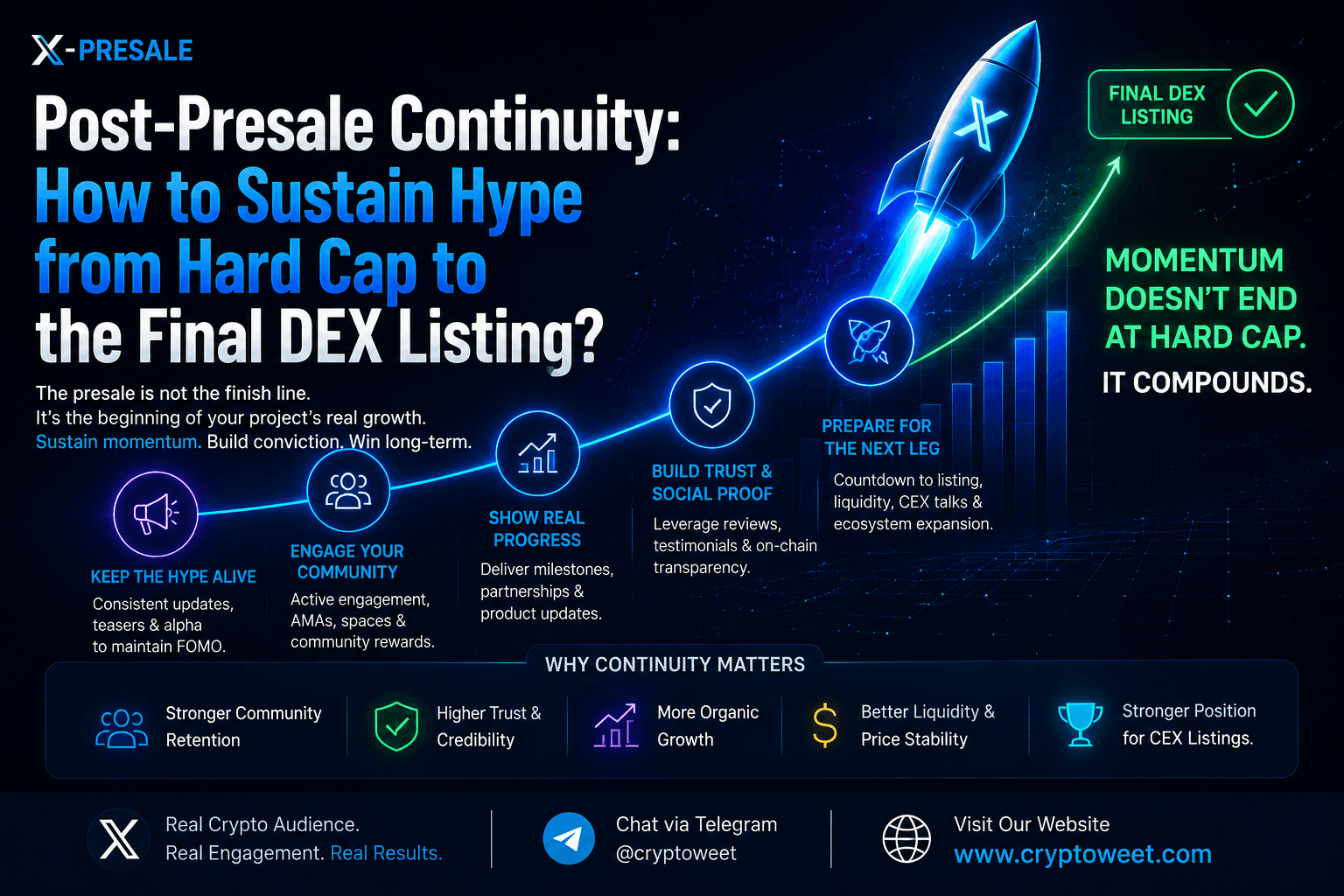
Post-Presale Continuity: How to Sustain Hype from Hard Cap to the Final DEX Listing?

Post-Presale Continuity: How to Sustain Hype from Hard Cap to the Final DEX Listing?

The moment a project reaches hard cap is often misunderstood as the finish line, when in reality it marks the beginning of a far more critical phase. Post-Presale Continuity determines whether a project transitions into long term success or fades into irrelevance. Many teams focus heavily on crypto presale marketing, only to lose momentum immediately after fundraising ends. Attention drops, engagement slows, and communities begin to disengage. This decline is not caused by lack of interest, but by the absence of structured post presale engagement crypto strategies that sustain visibility and narrative strength.

This guide explains how to maintain momentum after hard cap and build a structured crypto post presale strategy that bridges the gap between fundraising and listing. You will learn how to manage crypto hype cycle management, maintain investor sentiment management, and design systems that prevent attention decay. This article explores how to align token launch continuity plan, community retention crypto, and post presale social proof into a cohesive framework that sustains demand and prepares projects for a successful DEX listing.

Why Most Crypto Projects Lose Momentum After Hard Cap?

Reaching hard cap creates a temporary peak in attention. During presale, projects benefit from urgency, scarcity, and fear of missing out crypto dynamics. However, once funding closes, these triggers disappear. Without immediate continuation strategies, momentum declines rapidly.

The primary issue is attention decay. In Web3, attention shifts quickly between narratives. New projects launch daily, and audiences continuously seek fresh opportunities. When a project becomes silent after fundraising, it is quickly replaced in the collective focus.

Another factor is misaligned expectations. Many teams assume that investors will remain engaged automatically after contributing. In reality, participation does not guarantee long term interest. Without consistent updates and engagement, early supporters lose emotional connection.

Perception also changes after presale. Before funding, projects are evaluated based on potential. After funding, they are evaluated based on execution. This shift increases scrutiny and requires stronger credibility maintenance crypto strategies.

The gap between presale and listing is often the most vulnerable phase. If communication weakens, trust erodes. If engagement drops, post presale social proof weakens. If narrative continuity is broken, hype collapses.

Projects that understand this dynamic treat post presale as an active phase rather than a passive waiting period. Maintaining momentum requires deliberate strategy, not assumption.

The Post-Presale Gap: Understanding Attention Decay in Web3

Post-Presale Continuity: How to Sustain Hype from Hard Cap to the Final DEX Listing?

The post presale gap is the period between fundraising completion and token listing. This phase is characterized by reduced urgency and shifting audience focus. Without intervention, attention naturally declines.

One of the main causes is the absence of immediate incentives. During presale, users are motivated by allocation opportunities. After funding, that incentive disappears, reducing participation.

Investor psychology also changes. Once capital is committed, users shift from acquisition mode to observation mode. They expect updates, progress, and validation that their decision was correct. If these signals are missing, confidence weakens.

Market dynamics further contribute to attention decay. New narratives emerge constantly. Projects that fail to maintain visibility are quickly overshadowed.

Narrative gaps are particularly damaging. When communication pauses, the story stops progressing. Without new information, audiences disengage. This creates a negative loop where reduced engagement leads to lower visibility, which further reduces engagement.

Understanding attention decay crypto is essential for designing effective post presale engagement crypto systems. Projects must actively counteract this decline by maintaining consistent communication and engagement.

The Importance of Post-Presale Continuity Strategy

A structured Post-Presale Continuity strategy ensures that momentum does not collapse after fundraising. Instead, it transforms initial hype into sustained engagement and long term trust.

Maintaining narrative dominance is critical. Projects must continue telling their story, evolving it as development progresses. This keeps audiences invested and prevents attention loss.

Reinforcing trust signals is equally important. After funding, credibility becomes the primary driver of engagement. Transparent updates, visible progress, and consistent communication strengthen confidence.

Preparing for listing impact requires sustained visibility. The more attention a project maintains before listing, the stronger its debut performance is likely to be.

Avoiding dead periods is essential. Silence signals inactivity, even if development is ongoing. Continuous communication ensures that progress remains visible.

Sustaining community retention crypto requires active participation systems. Users must feel involved, not just informed.

A strong continuity strategy bridges the gap between presale excitement and long term growth. It ensures that post fundraising marketing crypto efforts build on existing momentum rather than starting from zero.

Core Pillars of Sustaining Hype After Hard Cap

Effective crypto hype cycle management relies on multiple interconnected pillars that maintain engagement and perception.

Narrative Continuity

The story must evolve. Each update should build on previous communication, creating a sense of progression.

Social Proof Reinforcement

Engagement must remain visible. Continued interaction signals ongoing interest and strengthens post presale social proof.

Community Activation

Users should be encouraged to participate actively. Passive audiences disengage quickly.

Transparency and Updates

Clear communication builds trust. Investors need to see progress and understand next steps.

Event Driven Communication

Milestones create natural engagement points. Announcements, releases, and updates maintain attention.

These pillars work together to sustain momentum. Removing one weakens the entire system.

Narrative Engineering Between Presale and Listing

Narrative continuity is the backbone of token launch continuity plan. Without a clear and evolving story, engagement declines regardless of technical progress.

Story progression ensures that each update adds value. Instead of repeating information, projects should introduce new insights, developments, or perspectives.

Controlled information release maintains curiosity. Revealing everything at once reduces long term engagement potential. Gradual disclosure keeps audiences interested.

Teasing future milestones creates anticipation. When users know that more updates are coming, they remain engaged.

Avoiding information drought is critical. Long periods without updates create uncertainty and reduce trust.

Narrative engineering transforms communication into a continuous experience rather than isolated announcements.

Social Proof After Presale: Keeping Demand Visible

Maintaining post presale social proof is essential for sustaining perceived demand. Without visible engagement, interest appears to decline even if actual sentiment remains positive.

Continued interaction signals are necessary. Replies, discussions, and engagement should remain active across posts.

Highlighting participation milestones reinforces credibility. Even after presale, showcasing community growth and activity maintains momentum.

Influencer follow ups extend validation. Continued interaction from recognized figures strengthens trust.

Whale holding signals also contribute. Demonstrating that early participants remain committed reinforces confidence.

Visibility is key. Social proof must be communicated clearly to influence perception.

Community Retention and Activation Systems

Retention is more challenging than acquisition. After presale, users need reasons to remain engaged.

Gamification strategies encourage participation. Tasks, rewards, and recognition create incentives.

Ambassador programs build deeper involvement. Active members contribute to growth and engagement.

Cross platform integration strengthens community. Combining Twitter, Discord, and other channels creates a cohesive ecosystem.

Recognition plays a significant role. Highlighting active contributors increases motivation.

Checklist for community activation:

• Regular engagement opportunities
• Clear reward structures
• Recognition systems
• Consistent communication
• Inclusive participation models

Strong community retention crypto systems transform investors into long term supporters.

Content Strategy for Post-Presale Momentum

Content remains the primary driver of visibility. A structured crypto Twitter strategy post launch ensures consistent engagement.

Progress updates keep audiences informed. Development milestones reinforce credibility.

Transparency builds trust. Sharing challenges and solutions demonstrates authenticity.

Educational threads provide value. Explaining technical aspects increases understanding and confidence.

Community highlights strengthen connection. Featuring users creates a sense of belonging.

Market positioning content reinforces relevance. Connecting the project to broader trends maintains interest.

Content should balance information and engagement. Too much technical detail reduces accessibility, while too little reduces credibility.

Consistency is critical. Regular posting maintains visibility and supports maintain momentum crypto project objectives.

Token Event Synchronization: Preparing for DEX Listing

The transition from post presale to listing is not a passive waiting period. It is a critical phase where token launch continuity plan must align narrative, timing, and market psychology to maximize impact. Projects that treat listing as a single event often underperform. In reality, listing success is determined by how well momentum is sustained and amplified before the event occurs.

DEX listing preparation begins with synchronization of communication and market expectations. Listing announcements should not appear suddenly without buildup. Instead, they must be preceded by structured anticipation phases. Teasing liquidity deployment, hinting at partnerships, and gradually revealing listing timelines create a narrative arc that maintains engagement.

Timing is equally important. Launching into weak market sentiment reduces visibility and conversion potential. Aligning listing with broader bullish narratives increases receptivity. This is where crypto hype cycle management intersects with macro awareness.

Another critical element is liquidity perception. Users need confidence that trading conditions will be stable. Communicating liquidity plans, allocation structure, and token distribution details reduces uncertainty and strengthens trust.

Coordinated announcement waves amplify impact. Instead of a single post, successful projects deploy synchronized updates across Twitter, Discord, influencers, and ecosystem partners. This creates a surge of visibility that signals importance.

Pre listing FOMO is the final layer. When audiences perceive that a token is about to become publicly accessible, urgency returns. This reactivates fear of missing out crypto, even for those who missed the presale.

Effective synchronization ensures that listing is not an isolated moment, but the peak of a continuous narrative built throughout the post presale engagement crypto phase.

Maintaining Investor Confidence After Fundraising

After capital is raised, expectations shift dramatically. Investors no longer evaluate based on potential alone. They expect execution, transparency, and consistency. Maintaining investor sentiment management becomes one of the most important aspects of crypto post presale strategy.

Communication consistency is the foundation. Regular updates reassure investors that progress is ongoing. Silence creates uncertainty, and uncertainty weakens confidence. Even minor updates can maintain engagement if delivered consistently.

Transparency strengthens credibility. Sharing both progress and challenges demonstrates authenticity. Projects that only communicate positive developments risk appearing unrealistic. Balanced communication builds long term trust.

Handling delays is another critical factor. Delays are common in development, but how they are communicated determines their impact. Clear explanations and revised timelines maintain confidence, while vague communication damages trust.

Expectation management prevents disappointment. Overpromising during presale creates pressure during execution. Aligning messaging with realistic outcomes ensures that progress meets expectations.

Reinforcing long term vision keeps investors aligned. Short term fluctuations should be contextualized within broader goals. This shifts focus from immediate results to sustained growth.

Strong credibility maintenance crypto systems ensure that early supporters remain confident and engaged, reducing churn and strengthening community stability.

Avoiding the Dead Zone That Kills Projects

The “dead zone” is one of the most dangerous phases in the Web3 lifecycle. It occurs when projects become inactive after presale, creating a perception of stagnation. This phase destroys post presale social proof and weakens community retention crypto.

Silence is the primary cause. When projects stop communicating, audiences assume inactivity. Even if development continues, lack of visibility leads to negative perception.

Lack of updates accelerates disengagement. Without new information, users lose interest and shift attention to other opportunities.

Broken promises damage credibility. Failing to deliver on announced milestones creates distrust that is difficult to recover from.

Disappearing teams create fear. When founders and core contributors reduce their presence, communities interpret this as abandonment.

Inconsistent messaging adds confusion. Changing direction without clear explanation weakens narrative continuity.

Avoiding the dead zone requires proactive communication and structured engagement systems. Projects must treat visibility as an ongoing responsibility rather than a temporary campaign.

The difference between successful projects and failed ones often lies in how they handle this phase. Sustained activity signals commitment, while silence signals risk.

Measuring Post-Presale Performance Metrics

Optimization requires measurement. Without data, post presale engagement crypto strategies cannot be refined effectively.

Engagement retention is one of the most important indicators. It measures how well the project maintains interaction levels after presale. Declining engagement signals attention loss.

Community growth stability shows whether new users continue joining. Consistent growth indicates sustained interest, while stagnation suggests weakening momentum.

Sentiment tracking provides insight into perception. Positive sentiment supports long term engagement, while negative sentiment highlights areas that require attention.

Content performance reveals which formats resonate most. Threads, updates, and community posts may perform differently depending on audience preferences.

Activity consistency measures communication frequency. Regular updates support visibility, while irregular patterns reduce algorithmic reach.

A structured measurement framework includes:

• Engagement retention rate over time
• Community growth trends
• Sentiment analysis across platforms
• Content performance by format
• Posting consistency metrics

Data driven optimization ensures that maintain momentum crypto project strategies remain effective throughout the post presale phase.

Professional Infrastructure for Sustained Growth and Credibility

Most projects understand the need for Post-Presale Continuity, but execution is where they fail. Maintaining consistent engagement, visible post presale social proof, and strong narrative progression requires structured systems that many teams do not have.

The challenge is not just content creation. It is the combination of credibility, distribution, and engagement working together. Without strong foundations, even high quality updates struggle to generate interaction because audiences evaluate trust before engaging.

This is where professional infrastructure becomes essential. Instead of relying on fragmented efforts, successful projects build integrated systems that support post fundraising marketing crypto and long term growth.

CryptoWeet provides specialized infrastructure designed to maintain momentum after presale. The focus is on sustaining visibility, reinforcing trust signals, and ensuring that engagement remains active throughout the gap before listing.

The 1000 Foundation

At the core of this system is The 1000 Foundation, which establishes the baseline credibility required for sustained growth.

This foundation includes:

1,000 genuine crypto aligned followers who create immediate social presence and legitimacy
1,000 distributed likes and views across key posts to build engagement history that supports algorithm visibility
1,000 authentic replies and conversations that demonstrate real community activity and interaction depth

These elements are not vanity metrics. They function as crypto social proof signals that influence how new users perceive the project. When audiences encounter an active profile with visible engagement, they are more likely to trust and participate.

The impact extends beyond perception. Strong engagement history improves visibility across platforms, allowing content to reach wider audiences. This creates a compounding effect where credibility enhances distribution, and distribution reinforces credibility.

For projects entering the post presale phase, this foundation ensures that momentum does not collapse. Instead, it provides the necessary structure to maintain community retention crypto, strengthen investor sentiment management, and support continued growth.

Professional infrastructure transforms continuity from a challenge into a predictable system.

Conclusion

Post-Presale Continuity is the defining factor between short lived hype and sustainable success in Web3. Reaching hard cap is only the beginning. What follows determines whether a project maintains relevance or fades into the background.

Sustaining hype requires more than frequent updates. It demands structured crypto post presale strategy, consistent narrative progression, and strong post presale social proof that reinforces trust and engagement. Projects that actively manage crypto hype cycle management and maintain visibility build stronger communities and achieve more impactful listings.

The transition from presale to DEX listing is an opportunity, not a waiting period. Teams that use this phase effectively create momentum that carries into launch and beyond.

For projects aiming to maintain growth, strengthen credibility, and maximize listing impact, combining strategic execution with professional infrastructure provides a clear advantage. Building strong foundations ensures that hype evolves into trust, and trust evolves into long term ecosystem success.

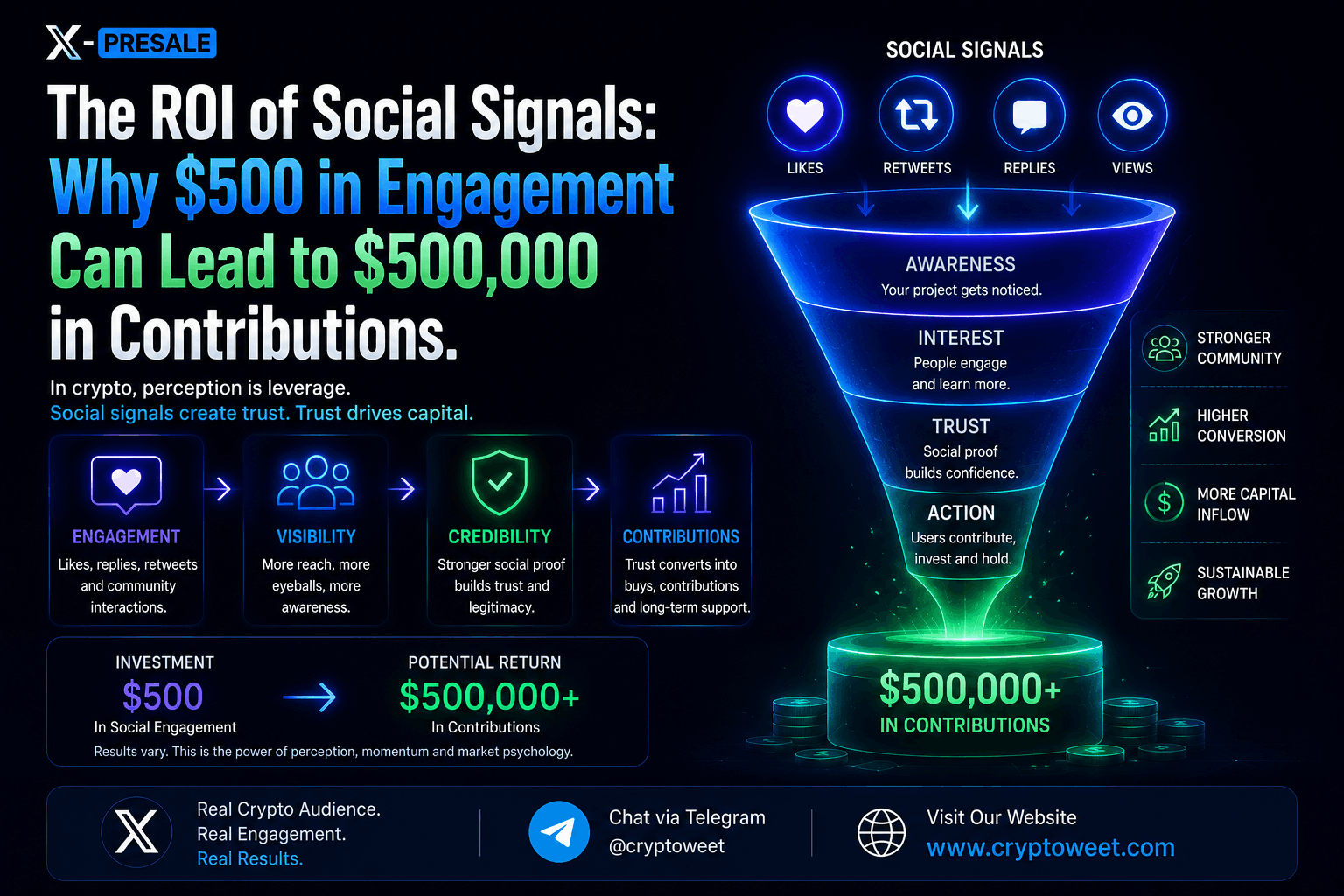
The ROI of Social Signals: Why $500 in Engagement Can Lead to $500,000 in Contributions.

The ROI of Social Signals: Why $500 in Engagement Can Lead to $500,000 in Contributions.

Most founders misunderstand marketing as a cost center rather than a leverage system. In reality, the ROI of Social Signals in Web3 operates on exponential dynamics, not linear equations. A relatively small investment in social signals crypto such as engagement, replies, and visibility can dramatically shift perception, which directly impacts capital inflow. What looks like $500 spent on engagement can trigger a cascade of trust, validation, and attention that leads to hundreds of thousands in contributions. This is not coincidence, but a structural feature of crypto marketing ROI in attention driven markets.

This guide explains how engagement to funding conversion works in practice, breaking down the mechanics behind Web3 fundraising ROI and why crypto social proof value is often underestimated. This article explores the relationship between investor psychology crypto, perceived demand vs real demand, and FOMO driven investing. By understanding how engagement signals crypto translate into credibility and capital, projects can design more efficient strategies that maximize output while minimizing cost.

Why Traditional Marketing ROI Models Fail in Crypto?

The ROI of Social Signals: Why $500 in Engagement Can Lead to $500,000 in Contributions.

Traditional marketing assumes predictable cause and effect relationships. Spend increases reach, reach increases conversions, and conversions generate revenue. This linear model works in stable industries where behavior is relatively consistent. However, crypto marketing ROI operates under entirely different conditions.

Web3 markets are driven by attention, narrative, and perception rather than purely rational evaluation. This creates non linear outcomes where small inputs can produce disproportionately large outputs. A single viral post or well timed engagement spike can shift an entire funding trajectory.

The first limitation of traditional models is their inability to account for attention economy crypto dynamics. Visibility is not evenly distributed. Instead, it concentrates around narratives that capture collective interest. Once a project enters this attention stream, its exposure multiplies rapidly.

The second limitation is the absence of network effects. In crypto, every interaction has amplification potential. Likes, replies, and retweets are not isolated actions. They signal validation, which attracts more users, creating a feedback loop.

Narrative dominance is another factor. Projects that control the narrative attract more attention regardless of underlying fundamentals. This does not mean fundamentals are irrelevant, but perception often precedes evaluation.

Linear thinking assumes proportional returns. Web3 reality is exponential. Understanding this shift is essential for leveraging low cost high ROI marketing strategies effectively.

Understanding Social Signals in Crypto Ecosystems

To understand ROI of Social Signals, it is necessary to define what social signals crypto actually represent. These signals are indicators of activity, interest, and validation within a community.

They include likes, replies, retweets, quote tweets, and discussion threads. However, their value lies not in quantity alone, but in interpretation. Investors do not evaluate these signals objectively. They interpret them as evidence of demand.

Different types of engagement carry different weights. Replies and conversations indicate deeper interest than passive likes. Influencer interactions carry more credibility than anonymous engagement. Consistent activity across posts signals sustained attention.

There is also a distinction between on chain and off chain perception. On chain data shows actual transactions, while off chain signals shape expectations. In early stages, perception often precedes on chain activity.

Investors use these signals as shortcuts. Instead of analyzing every project in depth, they rely on visible indicators to filter opportunities. This makes social validation signals a critical component of crypto brand perception.

Another important aspect is visibility. Signals only influence behavior when they are seen. Hidden engagement does not contribute to perception. Therefore, distribution is as important as engagement itself.

Understanding how crypto community engagement functions allows projects to design systems that maximize perceived demand rather than just raw activity.

The Psychology Behind Engagement to Funding Conversion

At the core of engagement to funding conversion lies human psychology. Investors do not operate purely on logic. They rely on heuristics that simplify decision making in uncertain environments.

One of the most important concepts is perceived demand vs real demand. When users see active engagement, they assume that interest is high. This perception reduces uncertainty and increases confidence.

Herd behavior plays a significant role. Individuals prefer to follow collective signals rather than act independently. When multiple users engage with a project, it creates a sense of consensus.

Trust formation is closely tied to visibility. Repeated exposure to engagement builds familiarity. Familiarity reduces perceived risk, making participation more likely.

FOMO driven investing amplifies these effects. When users believe that others are entering early, they feel pressure to act quickly. This urgency accelerates conversion.

Another psychological factor is validation. People seek confirmation that their decisions are correct. Social signals provide that confirmation, reinforcing participation.

These mechanisms explain why small investments in engagement can produce large funding outcomes. The effect is not direct, but mediated through perception and behavior.

Breaking Down the ROI of Social Signals

To fully understand crypto marketing ROI, it is necessary to break down how engagement translates into capital.

The first stage is visibility. Engagement increases distribution, allowing content to reach a wider audience. This expands the top of the funnel.

The second stage is perception. As users encounter engagement, they interpret it as validation. This shifts perception from unknown to credible.

The third stage is trust. Repeated exposure to positive signals builds confidence. Users begin to consider participation.

The fourth stage is conversion. Once trust reaches a threshold, users allocate capital.

The cost of engagement is relatively low compared to the potential inflow of capital. This creates a high leverage system where small inputs generate large outputs.

Amplification effects further increase ROI. Each interaction can trigger additional interactions, creating exponential growth.

Compounding visibility ensures that early engagement continues to generate returns over time. Unlike ads that stop when spending stops, organic signals persist.

Conversion funnels in crypto are shorter but more volatile. Strong signals can accelerate users through the funnel rapidly.

This is why cost efficiency crypto marketing is significantly higher when strategies focus on engagement signals crypto rather than pure advertising spend.

Case Framework: How $500 in Engagement Scales to $500,000

To illustrate ROI social media crypto, consider a structured framework that explains how a small investment can scale into significant funding.

Visibility Phase

Initial engagement boosts distribution. Posts reach a larger audience, increasing awareness. This stage focuses on entering the attention stream.

Trust Building Phase

As users encounter engagement, they begin to perceive credibility. Discussions, replies, and interactions reinforce legitimacy.

FOMO Activation Phase

Visible activity creates urgency. Users believe that others are participating, triggering FOMO driven investing.

Conversion Phase

Users move from observation to action. Contributions increase rapidly as momentum builds.

This framework demonstrates how engagement functions as a catalyst rather than a direct conversion tool. Its primary role is to shape perception, which drives behavior.

High ROI Social Signals That Matter Most

Not all signals contribute equally to Web3 fundraising ROI. Some have significantly higher impact due to their influence on perception.

Replies and conversation depth are among the strongest indicators. They show active interest and cognitive engagement.

Influencer interaction provides credibility transfer. When recognized figures engage, their audience interprets it as validation.

Community activity creates a sense of belonging. Active communities attract more users and reinforce trust.

Whale visibility signals informed participation. Large investors influence perception through their actions.

Consistent engagement patterns indicate sustainability. One time spikes are less convincing than ongoing activity.

Projects should prioritize signals that influence perception rather than focusing on volume alone.

Building Low Cost High Impact Engagement Systems

Sustainable low cost high ROI marketing requires structured systems rather than random actions.

Organic growth loops ensure continuous engagement. Content attracts users, who then contribute to further engagement.

Ambassador programs extend reach. Active members promote the project within their networks.

Content strategies should focus on value. Educational threads, updates, and insights increase engagement quality.

Viral amplification mechanisms increase visibility. Strategic timing and distribution maximize reach.

Retention systems maintain engagement. Keeping existing users active is more efficient than constantly acquiring new ones.

Checklist for building engagement systems:

• Consistent content publishing
• Community participation incentives
• Influencer collaboration strategies
• Engagement optimization techniques
• Retention focused communication

Structured systems ensure that engagement remains active and continues to generate returns.

Ok, đây là PART 2
• Nối mạch PART 1
• Có heading điều hướng + CryptoWeet + The 1000 Foundation (viết sâu)
• Có conclusion duy nhất ở cuối
• Đảm bảo EEAT + full semantic

Measuring Social Signal ROI Accurately

Understanding ROI of Social Signals requires more than surface level metrics. Many projects misinterpret engagement as success without connecting it to actual outcomes. To build a high performing crypto marketing ROI system, teams must measure how engagement signals crypto translate into capital inflow.

The first layer is engagement efficiency. This includes likes, replies, retweets, and impressions. However, these metrics alone are not enough. They must be evaluated relative to audience size and growth rate to determine whether content is truly resonating.

The second layer is conversion tracking. This is where engagement to funding conversion becomes measurable. Projects need to identify how many users move from interaction to participation. This can be tracked through wallet activity, whitelist signups, or direct contribution flows.

Customer acquisition cost is another critical metric. In Web3, CAC crypto projects can vary significantly depending on strategy. Projects that rely heavily on paid advertising often have higher acquisition costs, while those leveraging organic growth crypto systems benefit from lower costs and higher retention.

Attribution remains one of the biggest challenges. Unlike traditional funnels, crypto journeys are fragmented across platforms. A user may see a tweet, join Discord, observe discussions, and only later contribute. This makes it difficult to assign direct value to individual interactions.

Despite these challenges, patterns emerge over time. Projects that maintain strong crypto community engagement consistently show higher conversion rates. This reinforces the importance of focusing on perception and trust rather than isolated metrics.

A structured measurement framework should include:

• Engagement rate relative to follower base
• Conversion rate from interaction to contribution
• Cost per investor acquisition
• Retention rate of participants
• Sentiment trends across platforms

Accurate measurement transforms ROI social media crypto from assumption into strategy, allowing teams to optimize for maximum impact.

Common Mistakes That Kill ROI in Crypto Marketing

While the potential of low cost high ROI marketing is significant, many projects fail to capture it due to avoidable mistakes. These errors reduce efficiency, weaken trust, and limit conversion potential.

One of the most common issues is reliance on fake engagement. Artificial signals may inflate numbers, but they do not influence investor psychology crypto in a meaningful way. Experienced participants can easily distinguish between real and manipulated activity, leading to credibility loss.

Over spending on ads is another problem. Paid reach without strong social validation signals creates exposure without trust. Users may see the project, but without visible engagement, they hesitate to participate.

Poor targeting reduces efficiency. Broadcasting content to broad audiences without relevance lowers engagement quality. Effective strategies focus on attracting aligned communities rather than maximizing reach.

Weak narrative positioning limits impact. Without a clear story, engagement lacks context, making it less persuasive. Narrative is the framework that gives meaning to crypto social proof value.

Inconsistent communication disrupts momentum. Sporadic posting patterns reduce visibility and weaken algorithmic performance.

Ignoring community feedback is also damaging. Engagement is a two way process. Projects that do not respond to their audience lose trust and participation.

Avoiding these mistakes is essential for maximizing Web3 fundraising ROI and ensuring that engagement translates into meaningful outcomes.

Ethical Growth and Sustainable ROI in Web3

Sustainable ROI of Social Signals depends on ethical execution. While manipulation tactics may produce short term results, they undermine long term trust and brand value.

Authenticity is the foundation of credibility building crypto. Real engagement reflects genuine interest, which is far more valuable than inflated metrics. Projects that prioritize authentic interaction build stronger communities.

Transparency strengthens trust signals Web3. Clear communication about progress, challenges, and expectations reduces uncertainty and builds confidence among investors.

Value driven communication ensures that engagement is meaningful. Educational content, insights, and updates provide utility beyond promotion, increasing retention and loyalty.

Avoiding manipulation is critical. Strategies that attempt to artificially inflate perception may backfire, especially in communities that value decentralization and openness.

Ethical frameworks align with long term goals. Projects that build trust consistently are more likely to sustain growth, attract partnerships, and maintain investor confidence.

In Web3, reputation compounds over time. Ethical practices ensure that crypto brand perception remains strong, supporting continuous growth and higher ROI.

Professional Infrastructure for High ROI Growth Systems

Executing a high performance crypto marketing ROI strategy requires more than understanding principles. It requires infrastructure that consistently produces engagement signals crypto, maintains visibility, and reinforces crypto social proof value at scale.

Most internal teams struggle with this because they lack time, systems, and distribution networks. Content may be well written, but without initial traction, it fails to reach the audience needed to trigger engagement to funding conversion.

The challenge is not just generating engagement. It is creating the right type of engagement that influences investor psychology crypto. This includes visible discussions, consistent interaction patterns, and credible activity that signals demand.

Professional infrastructure solves this by integrating multiple layers:

• Content production systems
• Distribution and amplification channels
• Engagement engineering frameworks
• Community management processes
• Data monitoring and optimization

These systems work together to transform isolated posts into continuous growth engines. Instead of relying on chance, projects operate with predictable outcomes.

This is particularly important during fundraising phases, where timing and perception directly impact capital inflow. Without structured systems, even strong projects may fail to capture attention at critical moments.

The 1000 Foundation: Turning Small Signals Into Large Capital

At the core of high performance ROI of Social Signals lies a simple principle. Before scaling, a project must establish baseline credibility. Without this, even significant marketing efforts produce limited results.

This is where The 1000 Foundation becomes critical.

The concept is straightforward but powerful. It focuses on building an initial layer of visible, authentic engagement that transforms how a project is perceived.

This includes:

1,000 real crypto aligned followers to establish immediate presence
1,000 distributed engagement signals such as likes and impressions to create activity history
1,000 authentic replies and discussions that demonstrate real community interaction

These elements function as foundational social validation signals. When new users encounter the project, they do not see an empty profile. They see activity, discussion, and participation.

This changes perception instantly. Instead of questioning legitimacy, users assume that the project already has traction. This reduces friction and accelerates engagement to funding conversion.

The impact of this foundation is not limited to perception. It also improves algorithmic visibility. Platforms prioritize content that already shows engagement, allowing posts to reach larger audiences organically.

This creates a compounding effect:

Engagement → visibility → more engagement → stronger perception → increased trust → higher conversion.

With this loop in place, the difference between $500 and $500,000 becomes understandable. The initial investment activates a system that multiplies its impact through network effects and psychology.

CryptoWeet builds this foundation as part of a broader growth infrastructure designed for Web3 projects. Instead of chasing vanity metrics, the focus is on creating real signals that influence behavior and drive capital inflow.

For projects entering presale or scaling fundraising efforts, establishing this foundation can dramatically improve efficiency and outcomes.

Conclusion

The ROI of Social Signals reveals a fundamental truth about Web3 markets. Capital does not flow purely based on fundamentals. It flows based on perception, trust, and collective behavior.

Small investments in engagement signals crypto can produce massive outcomes because they influence how investors interpret demand. Through investor psychology crypto, FOMO driven investing, and social validation signals, engagement becomes a leverage tool rather than a simple metric.

Projects that understand this dynamic design strategies that prioritize perception, credibility, and visibility. Instead of focusing on cost, they focus on impact. Instead of chasing volume, they build systems that generate trust.

The difference between inefficient spending and high performance crypto marketing ROI lies in structure. Without systems, engagement is random. With systems, it becomes predictable and scalable.

For teams looking to maximize Web3 fundraising ROI, building a strong foundation is the first step. Leveraging professional infrastructure and frameworks like The 1000 Foundation ensures that even small inputs generate significant outputs.

When executed correctly, social signals become one of the most powerful growth levers in crypto, transforming minimal investment into substantial capital and long term ecosystem success.

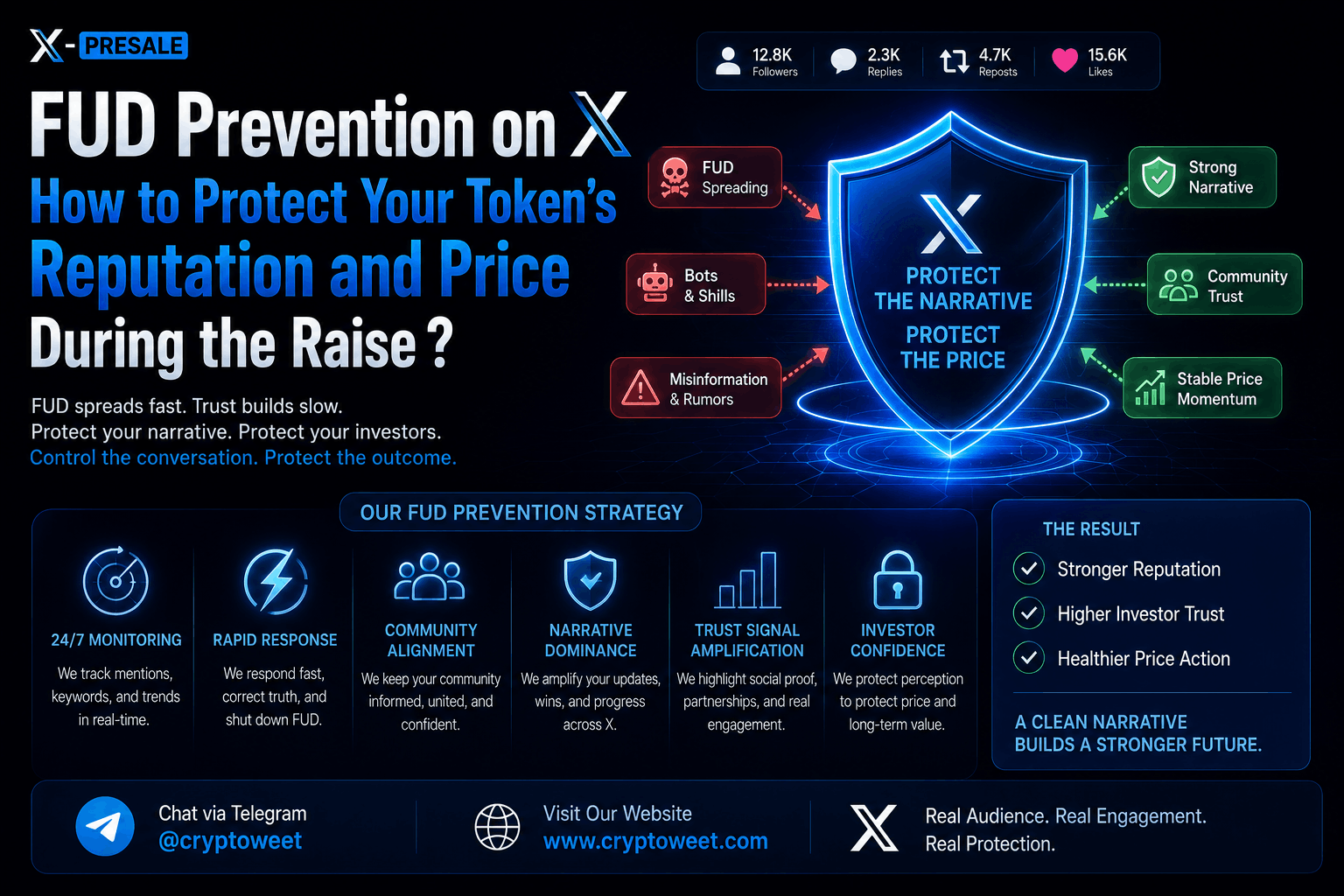
FUD Prevention on X: How to Protect Your Token’s Reputation and Price During the Raise ?

FUD Prevention on X: How to Protect Your Token’s Reputation and Price During the Raise ?

In Web3, momentum can collapse faster than it builds. A single wave of negative sentiment can trigger panic, weaken trust, and directly impact capital inflow. This is why FUD Prevention on X is not optional, but a core component of any serious fundraising strategy. crypto FUD management is no longer about reacting to problems, but about controlling perception before it spirals. When fear uncertainty doubt crypto narratives gain traction, they do not just affect sentiment. They influence investor decisions, reduce conversions, and can destabilize token reputation management and price expectations within hours.

This guide explains how to systematically approach prevent FUD crypto strategies using structured frameworks rooted in crypto crisis management and FUD control Web3 principles. This article explores how investor sentiment crypto, panic selling behavior, and trust erosion Web3 interact during fundraising phases. By understanding Twitter narrative control, negative social signals crypto, and real time response systems, projects can build resilient communication structures that protect both reputation and price stability crypto during critical funding windows.

Why FUD Can Destroy Fundraising Momentum Overnight?

FUD Prevention on X: How to Protect Your Token’s Reputation and Price During the Raise ?

The speed of information flow in Web3 creates a fragile environment where perception changes faster than fundamentals. A project can spend weeks building trust, only to see it weakened within hours due to fear uncertainty doubt crypto narratives spreading across X.

Unlike traditional markets, crypto operates in a highly reactive environment. Investors monitor social channels constantly, and decisions are often influenced by real time sentiment rather than long term analysis. This makes crypto FUD management essential for maintaining momentum.

Trust is the primary currency during fundraising. When trust is stable, users are willing to allocate capital. When trust is shaken, hesitation increases, and conversion rates drop. This is why token reputation management is directly linked to funding outcomes.

Another critical factor is amplification. Negative information spreads faster than positive updates. Controversial posts, accusations, or doubts trigger engagement, which increases visibility. This creates a feedback loop where negative social signals crypto gain traction quickly.

Price expectations are also affected. Even before a token is publicly traded, perceived risk influences valuation assumptions. If FUD spreads, participants may delay contributions or reduce allocation size.

The combination of speed, amplification, and psychological impact makes FUD one of the most dangerous threats during fundraising. Preventing it requires proactive systems rather than reactive responses.

Understanding FUD in Crypto Markets

To effectively implement prevent FUD crypto strategies, it is necessary to understand the structure of FUD itself. In Web3, FUD is not just misinformation. It is any narrative that introduces doubt, reduces confidence, or creates uncertainty about a project.

There are multiple types of FUD, each with different origins and impacts.

Organic FUD emerges naturally from community concerns. Users may question tokenomics, roadmap feasibility, or team credibility. While not malicious, it can still spread rapidly if left unaddressed.

Competitor driven FUD is more strategic. Competing projects or aligned communities may attempt to weaken perception by highlighting risks or spreading negative narratives.

Influencer triggered FUD carries significant weight. When recognized figures express doubt, their audience often adopts the same perspective. This amplifies rumor spread dynamics dramatically.

Internal miscommunication is another common source. Inconsistent messaging, unclear updates, or delayed announcements can create confusion that evolves into FUD.

The way FUD spreads on X follows predictable patterns. A single post gains traction, replies amplify the narrative, and quote tweets introduce additional interpretations. As engagement increases, visibility expands, accelerating the spread.

Crypto markets are particularly vulnerable because information asymmetry is high. Most participants lack complete data, so they rely on visible signals to make decisions. This makes social listening crypto and early detection critical.

Understanding these dynamics allows projects to design targeted FUD response strategy systems rather than applying generic solutions.

The Impact of FUD on Token Reputation and Price

The consequences of FUD extend beyond temporary sentiment shifts. They directly affect token reputation management, funding efficiency, and long term brand perception.

The first impact is trust erosion. Once doubts are introduced, users begin to question the project’s credibility. Even if the information is inaccurate, the perception of risk increases.

Investor hesitation follows. Potential contributors delay decisions, waiting for clarity. This slows down fundraising momentum and reduces conversion rates.

Existing participants may reconsider their involvement. This leads to reduced engagement and weaker crypto community engagement, which further amplifies negative perception.

Panic selling behavior becomes relevant when tokens are already tradable or when expectations of future value decline. Users anticipate lower prices and adjust their actions accordingly.

Liquidity perception is also affected. If FUD suggests instability, participants may assume that liquidity will be weak, reducing confidence in future trading conditions.

Another critical factor is long term brand damage. Even after FUD is addressed, residual doubt may remain. This affects future campaigns, partnerships, and overall crypto brand perception.

These impacts highlight why protect token price strategies must include strong FUD control Web3 systems. Preventing perception collapse is more efficient than attempting recovery after damage occurs.

Investor Psychology During FUD Events

Understanding investor psychology crypto is essential for managing FUD effectively. Reactions are driven by emotional and cognitive shortcuts rather than purely rational analysis.

Fear amplification loops are one of the most powerful mechanisms. When users see negative information, they interpret it as a warning. This triggers defensive thinking, leading to further attention on negative signals.

Herd behavior accelerates the process. Individuals observe how others react and adjust their own behavior accordingly. If multiple users express concern, it creates a perception of consensus.

Information asymmetry increases uncertainty. Most participants do not have access to complete data, so they rely on visible signals. This makes negative social signals crypto highly influential.

Trust collapse dynamics occur when multiple doubts accumulate. A single issue may not be significant, but combined signals create a stronger perception of risk.

Another important factor is loss aversion. Users are more sensitive to potential losses than gains. This means that negative narratives have a stronger impact than positive updates.

During fundraising, these psychological factors directly affect conversion. Users who might have contributed hesitate or withdraw entirely.

Effective crypto crisis management must account for these behaviors, focusing on perception and emotional response rather than just factual correction.

Early Detection Systems for FUD

Preventing FUD requires early identification. Once narratives gain traction, they become significantly harder to control. This makes social listening crypto and monitoring systems essential.

Projects need to track sentiment across multiple channels, including X, Discord, and community forums. Monitoring tools can identify spikes in negative mentions, keyword frequency, and engagement patterns.

Sentiment analysis helps quantify perception. By evaluating the ratio of positive to negative interactions, teams can detect shifts before they escalate.

Keyword tracking is another important component. Monitoring terms related to risk, scams, or concerns allows early identification of emerging narratives.

Anomaly detection focuses on sudden changes. Unexpected increases in negative replies or unusual influencer mentions often indicate the start of a FUD wave.

Key signals to monitor include:

• Sudden increase in negative replies
• Unusual activity from influential accounts
• Rapid spread of specific narratives
• Changes in community tone
• Increased questioning or skepticism

Early detection enables faster response, reducing the impact of FUD. Without these systems, projects operate reactively, which significantly lowers effectiveness.

Narrative Control: The First Line of Defense

Once FUD is detected, controlling the narrative becomes the priority. Twitter narrative control determines whether negative signals expand or are contained.

The first principle is proactivity. Projects should communicate before speculation fills the gap. Silence creates uncertainty, which allows FUD to grow.

Consistency is critical. Messaging must remain aligned across all channels. Conflicting statements create confusion and weaken credibility.

Clarity reduces misinterpretation. Complex explanations should be simplified to ensure that audiences understand the message quickly.

Timing also plays a major role. Delayed responses allow narratives to solidify. Quick but accurate communication limits spread.

Transparency strengthens trust signals Web3. Providing clear information, including potential risks, builds credibility even during negative situations.

Narrative framing influences perception. Presenting challenges as part of a broader development process reduces panic and maintains confidence.

Effective reputation signals management ensures that positive narratives remain dominant, even when negative information appears.

Strategic FUD Response Framework

Responding to FUD requires structured decision making rather than emotional reactions. Not all situations require the same approach.

The first decision is whether to respond or ignore. Minor comments may not require attention, while widespread narratives demand immediate action.

Speed must be balanced with accuracy. Responding quickly is important, but incorrect information can worsen the situation.

Tone is another critical factor. Defensive or aggressive responses damage credibility. Professional, calm communication maintains trust.

Centralized communication ensures consistency. Multiple voices delivering different messages create confusion.

Decentralized support from the community can amplify responses. Encouraging informed discussions helps distribute accurate information.

A strong FUD response strategy integrates these elements into a cohesive system that adapts to different scenarios.

Community as a Defense Mechanism

Communities play a crucial role in FUD control Web3. A strong, engaged community can counter negative narratives organically.

Loyal supporters often defend projects when they feel aligned with the vision. This creates decentralized protection that extends beyond official communication.

Ambassador programs strengthen this effect. Active members who understand the project can respond to concerns within their networks.

Organic defense narratives emerge when communities are informed and engaged. These narratives carry more credibility than official statements alone.

Trust loops develop over time. Consistent positive interactions build loyalty, making communities more resilient to external negativity.

Building a strong community before crises occur is essential. Reactive efforts are less effective without existing engagement.

Community driven defense systems enhance crypto reputation management and reduce reliance on centralized responses.

Content Strategy During Crisis

Content plays a key role in managing perception during FUD events. Strategic communication can stabilize sentiment and reinforce trust.

Transparency posts address concerns directly. Clear explanations reduce uncertainty and provide context.

FAQ threads organize information. Answering common questions in a structured format improves clarity.

Myth busting content counters misinformation. Presenting facts in a simple format helps correct narratives.

Proof based communication increases credibility. Sharing data, progress updates, and verifiable information strengthens trust.

Consistency ensures visibility. Regular updates prevent information gaps that allow FUD to grow.

Effective content strategy transforms crypto crisis management into an opportunity to reinforce credibility and strengthen relationships.

Maintaining Price Stability During FUD

During a FUD event, perception does not just affect reputation. It directly impacts expectations around value, which is why price stability crypto must be actively managed even before a token is publicly traded. In fundraising phases, price is psychological. It exists as an expectation of future value rather than a current market reality. When fear uncertainty doubt crypto narratives spread, that expectation weakens, and with it, contribution confidence.

The first layer of protect token price strategy is communication around fundamentals. Projects must continuously reinforce utility, roadmap progress, and long term vision. When users understand the underlying value, they are less reactive to short term narratives.

Liquidity perception is another critical factor. Even if liquidity is not yet deployed, communicating plans clearly reduces uncertainty. Users need to feel that exit options will exist and that the market will be supported.

Whale confidence signals also play a role. When larger participants remain active or continue engaging, it signals stability. This reduces panic and counters negative assumptions.

Avoiding panic triggers is essential. Sudden changes in communication tone, disappearing updates, or defensive reactions amplify fear. Consistency and calm messaging stabilize sentiment.

Reinforcing community strength helps maintain confidence. Active crypto community engagement signals that interest remains strong despite external narratives.

Price stability is not controlled directly. It is influenced through perception, trust, and visible confidence. Managing these elements ensures that token reputation management remains intact even under pressure.

Common Mistakes That Amplify FUD

While many teams attempt crypto FUD management, their actions often unintentionally strengthen the very narratives they aim to control. Understanding these mistakes is critical for effective FUD control Web3.

Silence is one of the most damaging responses. When projects do not communicate, users fill the gap with speculation. This accelerates rumor spread dynamics and amplifies uncertainty.

Defensive aggression is equally harmful. Responding emotionally or attacking critics reduces credibility. It shifts focus from facts to conflict, which increases engagement around negative narratives.

Inconsistent messaging creates confusion. If different team members provide conflicting information, trust erodes quickly. Consistency is essential for maintaining reputation signals.

Deleting criticism is another mistake. Attempting to hide negative feedback often backfires, as it signals lack of transparency. Communities value openness, even during difficult situations.

Overreaction can also amplify FUD. Addressing minor issues with excessive urgency may give them more importance than they deserve.

Ignoring valid concerns weakens trust. Not all criticism is malicious. Addressing legitimate questions strengthens credibility and reduces uncertainty.

Avoiding these mistakes ensures that prevent FUD crypto strategies remain effective and do not unintentionally escalate the situation.

Ethical Crisis Management and Long Term Trust

Sustainable crypto crisis management is built on ethical principles. Short term suppression of FUD may provide temporary relief, but long term success depends on trust.

Transparency is the foundation of trust signals Web3. Projects that communicate openly build stronger relationships with their community. This includes sharing both progress and challenges.

Accountability strengthens credibility. Acknowledging mistakes rather than avoiding them demonstrates professionalism and integrity.

Honesty reduces speculation. Clear, accurate information prevents the spread of misinformation and supports informed decision making.

Consistency reinforces trust over time. Regular communication creates familiarity, which reduces uncertainty during crisis events.

Value driven engagement ensures that interactions remain meaningful. Providing insights, updates, and education keeps the community aligned with the project’s vision.

Ethical growth aligns with decentralized principles. Communities expect openness and authenticity, and projects that meet these expectations are more resilient to FUD.

Long term crypto brand perception is shaped by how projects handle difficult moments. Ethical frameworks ensure that reputation strengthens rather than weakens under pressure.

Professional Infrastructure for FUD Prevention and Reputation Protection

Most projects approach FUD as a reactive problem. They wait until negative narratives appear before taking action. This approach is fundamentally flawed because by the time FUD is visible, perception has already started shifting.

Effective FUD Prevention on X requires proactive systems that establish strong social validation signals before any crisis occurs. Without this foundation, even accurate responses struggle to gain traction because audiences evaluate credibility before accepting information.

The challenge lies in scale and consistency. Maintaining crypto community engagement, monitoring sentiment, controlling narratives, and responding in real time requires structured infrastructure. Internal teams often lack the resources to manage all these layers simultaneously.

Professional systems integrate multiple components:

• Continuous social listening crypto and sentiment tracking
• Structured communication pipelines for rapid response
• Engagement engineering to maintain visible activity
• Community management frameworks that support organic defense
• Data driven optimization for ongoing improvement

These systems transform FUD prevention from a reactive task into a controlled process. Instead of chasing narratives, projects shape them.

The 1000 Foundation: Building Pre-FUD Immunity

Before a crisis happens, perception is already forming. This is why The 1000 Foundation functions as a pre FUD shield rather than a recovery tool.

The concept focuses on establishing baseline credibility that influences how audiences interpret information. When a project already displays strong engagement, active discussions, and visible community support, negative narratives encounter resistance.

The foundation includes:

1,000 real crypto aligned followers who create immediate legitimacy
1,000 distributed engagement signals that establish activity history
1,000 authentic replies and discussions that demonstrate real interaction

These are not superficial metrics. They are social validation signals that shape first impressions. When users encounter a project with visible engagement, they assume that others have already evaluated and trusted it.

This changes how FUD is processed. Instead of accepting negative narratives immediately, users question them. Existing engagement acts as counter evidence.

The effect extends to algorithmic behavior. Content with existing engagement is more likely to be distributed, allowing positive narratives to compete effectively against negative ones.

This creates a defensive loop:

Strong signals → higher trust → reduced susceptibility to FUD → stable perception → sustained engagement.

CryptoWeet integrates The 1000 Foundation into broader token reputation management systems. By building credibility before crises occur, projects reduce the probability and impact of FUD events.

Instead of reacting to threats, they operate from a position of strength.

Conclusion

FUD Prevention on X is not about controlling every narrative. It is about controlling perception, trust, and visibility in an environment where information spreads rapidly and emotions drive decisions.

FUD impacts more than sentiment. It affects token reputation management, reduces Web3 fundraising ROI, and destabilizes price stability crypto expectations. Projects that ignore this reality risk losing momentum at critical stages.

Effective crypto FUD management combines early detection, narrative control, community strength, and structured response systems. It requires understanding investor psychology crypto, anticipating panic selling behavior, and maintaining consistent trust signals Web3.

The difference between projects that collapse under pressure and those that remain stable lies in preparation. Building strong foundations before crises occur ensures resilience when challenges arise.

For teams seeking to protect reputation, maintain momentum, and secure successful fundraising outcomes, investing in professional infrastructure provides a clear advantage. Systems like The 1000 Foundation transform perception into a defensive asset, allowing projects to withstand FUD and continue growing with confidence.

In Web3, trust is fragile but powerful. Those who protect it effectively turn potential threats into opportunities for stronger credibility and long term success.

Exclusive WL Giveaways: Using “Limited Access” to Trigger Viral Growth and Hype on X.

Exclusive WL Giveaways: Using "Limited Access" to Trigger Viral Growth and Hype on X.

In Web3, attention is currency, but access is power. The most successful projects do not simply attract users. They control who gets in, when, and under what conditions. This is why Exclusive WL Giveaways have become one of the most effective tools in whitelist giveaway crypto strategies. By leveraging limited access marketing and engineered scarcity, projects can transform simple campaigns into high impact growth engines. When executed correctly, these campaigns do not just generate engagement. They create demand, trigger FOMO crypto marketing, and significantly amplify viral growth crypto Twitter dynamics.

This guide explores how exclusive access crypto mechanics drive engagement loops Twitter, convert attention into qualified participants, and ultimately increase funding outcomes. This article breaks down the psychology behind scarcity marketing crypto, the structure of high converting WL campaign strategy, and how social proof loops influence user behavior. By understanding how to design, optimize, and scale crypto giveaway marketing, projects can build sustainable hype that translates into real community growth and presale success.

Why Scarcity Drives Explosive Growth in Web3?

Exclusive WL Giveaways: Using "Limited Access" to Trigger Viral Growth and Hype on X.

Scarcity is one of the most powerful forces in human decision making, and in crypto, it becomes amplified by speed and visibility. Scarcity marketing crypto works because it transforms access into value. When something is limited, people assume it is important. This perception increases demand even before utility is fully understood.

In Web3, where thousands of projects compete for attention, exclusive access crypto acts as a filter. It separates passive observers from active participants. Instead of offering open access, projects create barriers that signal value. This is the foundation of limited access marketing.

Hype is not created by availability. It is created by restriction. When users see that only a small number of whitelist spots are available, they interpret it as an opportunity that others are competing for. This activates FOMO crypto marketing, which accelerates engagement.

Another critical factor is visibility. Scarcity alone is not enough. It must be visible to be effective. Public campaigns that highlight limited spots, countdowns, and participation metrics amplify perceived demand.

Scarcity also increases perceived fairness. When access is limited and structured, users feel that there is a system in place. This reduces skepticism compared to open promotions that appear uncontrolled.

In fundraising contexts, whitelist marketing Web3 becomes a pre selection mechanism. It identifies early supporters and builds a base of engaged users who are more likely to convert into contributors.

Understanding how scarcity influences behavior is essential for designing exclusive WL giveaways that generate both hype and meaningful growth.

Understanding Exclusive WL Giveaways in Crypto

To implement an effective WL campaign strategy, it is necessary to define what whitelist giveaway crypto campaigns actually represent. A whitelist giveaway is a structured process where users compete or qualify for early access to a project, often tied to token launches, NFT mints, or presales.

The key difference between standard giveaways and exclusive WL giveaways lies in perceived value. Standard giveaways distribute rewards broadly, often attracting low intent participants. In contrast, whitelist campaigns restrict access, which increases desirability.

Whitelist access represents opportunity. It signals early participation, potential profit, and insider positioning. This makes it more valuable than generic rewards.

There are two primary models:

Open campaigns allow anyone to participate with minimal requirements. While they generate high volume, they often result in low quality engagement.

Exclusive campaigns require effort. Users must complete actions such as engaging with content, tagging others, or contributing to discussions. This creates reward driven engagement and filters for more committed participants.

The role of whitelist campaigns in early stage growth is significant. They act as both acquisition and qualification mechanisms. Users who invest time and effort are more likely to remain engaged.

Another important aspect is narrative. Projects must communicate why whitelist access matters. Without context, scarcity loses meaning.

Effective crypto giveaway marketing aligns incentives with project goals. Instead of focusing on quantity, it prioritizes quality and conversion potential.

The Psychology Behind Limited Access and FOMO

The effectiveness of exclusive WL giveaways is rooted in psychology. Understanding these mechanisms allows projects to design campaigns that naturally drive engagement and conversion.

The scarcity principle is the foundation. When resources are limited, perceived value increases. Users assign higher importance to opportunities that are not easily accessible.

Urgency amplifies this effect. Time limited campaigns create pressure to act quickly. This reduces overthinking and increases participation rates.

FOMO crypto marketing operates as a multiplier. When users believe that others are gaining access, they feel compelled to join. This creates a feedback loop where participation drives more participation.

Social proof plays a critical role. Visible engagement signals that the campaign is popular. Users interpret this as validation, which increases trust and interest.

Perceived exclusivity enhances identity. Being part of a limited group creates a sense of belonging and status. This motivates users to compete for access.

Another important factor is reward anticipation. The possibility of future gains increases current engagement. Even if outcomes are uncertain, the perception of opportunity drives action.

These psychological drivers explain why limited access marketing is more effective than open distribution. It leverages human behavior to create organic growth.

How WL Giveaways Create Viral Growth on X?

The mechanics of viral growth crypto Twitter are closely tied to how engagement is structured. Exclusive WL giveaways are particularly effective because they naturally create amplification loops.

Retweet requirements increase distribution. Each participant shares the campaign with their network, expanding reach.

Comment based entry mechanisms generate visible activity. This increases engagement loops Twitter and signals popularity.

Tagging systems extend reach further. When users tag others, they introduce new participants into the campaign.

Algorithmic amplification follows engagement. Posts with higher interaction rates are prioritized, increasing visibility.

These elements combine to create social amplification loops where each action leads to additional actions.

The structure of these loops is important. Poorly designed campaigns may generate engagement without conversion. Effective campaigns align engagement with qualification criteria.

Another key factor is consistency. Multiple posts, updates, and reminders maintain momentum and prevent drop off.

Community involvement strengthens amplification. Active members promote campaigns organically, increasing credibility.

By designing campaigns that leverage these mechanisms, projects can achieve scalable growth without relying solely on paid promotion.

Designing a High Converting WL Giveaway Campaign

Creating a successful WL campaign strategy requires careful planning. Every element of the campaign should contribute to both engagement and conversion.

The first component is structure. Campaigns must clearly define entry requirements, deadlines, and rewards. Clarity reduces friction and increases participation.

Entry mechanics should balance accessibility and effort. Too easy, and quality drops. Too difficult, and participation decreases.

Reward design is critical. Whitelist spots must be positioned as valuable opportunities. This requires strong narrative and clear benefits.

Participation incentives should align with growth goals. Actions such as retweets, replies, and tagging should contribute to visibility and engagement.

A strong campaign typically includes:

• Clear value proposition for whitelist access
• Defined participation steps
• Visible progress indicators
• Consistent communication updates
• Fair selection process

Another important factor is pacing. Campaigns should maintain momentum through staged announcements and updates.

Effective giveaway funnel crypto design ensures that participants move from awareness to action smoothly.

By focusing on structure, incentives, and communication, projects can maximize both engagement and conversion.

Building Viral Loops Through Engagement Engineering

Sustainable viral loops marketing does not happen by chance. It is engineered through deliberate interaction design.

Reply prompts encourage discussion. Questions and prompts increase participation and extend conversation chains.

Tagging incentives expand reach. Encouraging users to involve others introduces new participants continuously.

Referral systems create compounding growth. Users bring in additional users, increasing campaign scale.

Community activation enhances engagement. Loyal members contribute actively, strengthening social proof loops.

Another important element is content variation. Using threads, updates, and reminders keeps the campaign visible.

Engagement engineering focuses on quality as well as quantity. Meaningful interactions are more valuable than passive actions.

By designing systems that encourage participation, projects create self sustaining growth loops that amplify reach and impact.

Conversion Strategy: From Engagement to Whitelist to Funding

Generating engagement is only the first step. The real objective of Exclusive WL Giveaways is to convert attention into qualified participants and eventually into capital contributors. Without a structured giveaway funnel crypto, campaigns risk becoming vanity growth exercises that fail to produce meaningful results.

The first stage of the funnel is awareness. Users discover the campaign through retweets, replies, and tagging networks. This is where viral growth crypto Twitter mechanisms operate most effectively. However, awareness alone does not guarantee conversion.

The second stage is qualification. This is where WL campaign strategy becomes critical. Projects must design entry requirements that filter for intent. Actions such as following, engaging with multiple posts, or joining community channels help identify users who are more likely to participate long term.

The third stage is retention. Once users enter the whitelist pool, maintaining engagement becomes essential. Many projects lose momentum because they fail to nurture participants after initial entry. Continuous communication, updates, and involvement opportunities ensure that users remain interested.

The final stage is conversion to funding. This is where whitelist marketing Web3 directly impacts outcomes. Users who have already invested time and effort are more likely to allocate capital, especially when FOMO crypto marketing and scarcity signals remain active.

A high performance funnel aligns all stages:

• Awareness driven by social amplification loops
• Qualification through structured participation
• Retention via consistent engagement
• Conversion supported by trust and urgency

When executed properly, exclusive WL giveaways become a bridge between engagement and revenue, transforming social activity into measurable growth.

Optimizing WL Campaign Performance

To maximize the effectiveness of crypto giveaway marketing, continuous optimization is required. Campaigns should not be treated as one time events but as evolving systems that improve with data.

The most important metric is engagement quality. High numbers of likes or retweets are less valuable if they do not lead to meaningful actions. Measuring engagement rate giveaway relative to follower base provides insight into content resonance.

Conversion rate is the next critical metric. Tracking how many participants move from engagement to whitelist qualification helps evaluate funnel efficiency. This is where conversion rate whitelist becomes a key indicator.

Follower growth should also be analyzed carefully. Rapid increases may indicate successful reach, but quality must be assessed. Low quality followers reduce long term value.

The viral coefficient crypto measures how effectively users bring in additional users. High referral rates indicate strong campaign mechanics.

Iteration is essential. Testing different formats, messaging styles, and incentives allows teams to refine their approach.

Scaling strategies should be applied only after validation. Expanding campaigns without proven effectiveness leads to wasted resources.

Optimization transforms engagement loops Twitter into efficient growth engines, ensuring that campaigns produce consistent and scalable results.

Common Mistakes That Kill WL Campaign Effectiveness

Despite the potential of exclusive WL giveaways, many campaigns fail due to avoidable mistakes. These errors reduce effectiveness and damage crypto brand perception.

One of the most common issues is fake scarcity. Claiming limited access without real restrictions undermines trust. Users quickly recognize when scarcity is artificial, which weakens social proof loops.

Attracting low quality audiences is another problem. Overly simple entry requirements bring in participants who have no real interest in the project. This reduces conversion rates and long term engagement.

Unclear rewards create confusion. If users do not understand the value of whitelist access, they are less motivated to participate.

Poor follow up is a major weakness. Many projects focus on initial engagement but fail to maintain communication. This leads to drop off before conversion.

Over farming engagement can also backfire. Excessive requirements may discourage participation and create fatigue.

Inconsistent messaging reduces credibility. Campaigns must align with overall project narrative and positioning.

Avoiding these mistakes ensures that WL campaign strategy remains effective and supports sustainable growth rather than short term spikes.

Ethical Giveaway Strategies and Trust Building

Long term success in crypto giveaway marketing depends on trust. Ethical execution ensures that campaigns strengthen rather than damage credibility.

Transparency is essential. Clearly communicating rules, selection processes, and timelines builds confidence. Users are more likely to participate when they trust the system.

Fair selection reinforces legitimacy. Random or merit based distribution should be explained and consistently applied.

Avoiding manipulation is critical. Artificial engagement tactics may produce short term results but harm credibility building crypto in the long run.

Value driven campaigns prioritize user experience. Providing meaningful opportunities rather than exploiting attention creates stronger relationships.

Consistency across campaigns strengthens reputation. Reliable processes reduce uncertainty and increase participation rates over time.

Ethical frameworks align with trust based marketing, ensuring that growth remains sustainable and aligned with community expectations.

Professional Infrastructure for Viral WL Campaigns

Most teams underestimate the complexity of scaling exclusive WL giveaways. While the concept appears simple, executing high performance campaigns requires coordination across multiple layers, including content, distribution, engagement, and analytics.

Internal teams often struggle because they lack structured systems. Campaigns are launched without consistent processes, leading to unpredictable results. This is why many projects experience short bursts of engagement without sustained growth.

Professional infrastructure addresses these challenges by integrating:

• Structured WL campaign strategy frameworks
• Continuous content production pipelines
• Engagement engineering systems for social amplification loops
• Community management processes for retention
• Data monitoring for real time optimization

These components transform isolated campaigns into scalable growth systems. Instead of relying on luck, projects operate with predictable outcomes.

Professional execution also improves efficiency. Resources are allocated strategically, reducing waste and maximizing impact.

For projects aiming to dominate attention and convert effectively, infrastructure is not optional. It is the foundation of sustainable viral growth crypto Twitter strategies.

The 1000 Foundation: Turning Scarcity Into Conversion Power

Before scaling any exclusive WL giveaways, a project must establish baseline credibility. Without this, even the best designed campaigns struggle to convert because users evaluate trust before taking action.

This is where The 1000 Foundation becomes critical.

The principle is simple but powerful. It focuses on building initial social validation signals that shape perception. Instead of launching campaigns from an empty profile, projects start with visible engagement and activity.

The foundation includes:

1,000 real crypto aligned followers to establish presence
1,000 distributed engagement signals creating visible activity
1,000 authentic replies and discussions demonstrating community interaction

These elements transform how campaigns are perceived. When users encounter a giveaway backed by strong engagement, they assume legitimacy and demand.

This directly enhances FOMO crypto marketing. Scarcity becomes more believable when supported by visible participation.

It also improves algorithmic performance. Posts with existing engagement are more likely to be distributed, increasing reach and efficiency.

The impact on conversion is significant. Users are more willing to participate when they see others already engaged. This strengthens reward driven engagement and increases whitelist qualification rates.

CryptoWeet integrates The 1000 Foundation into broader growth systems, ensuring that campaigns launch from a position of strength. Instead of building trust during the campaign, projects start with it.

This transforms limited access marketing into a high performance conversion engine rather than a risky experiment.

Conclusion

Exclusive WL Giveaways are more than promotional tools. They are strategic systems that combine scarcity marketing crypto, FOMO crypto marketing, and social amplification loops to drive growth, engagement, and conversion.

By leveraging limited access marketing, projects increase perceived value and attract high intent participants. When combined with strong WL campaign strategy, these campaigns move users through a structured funnel from awareness to funding.

The key to success lies in execution. Designing effective mechanics, optimizing performance, and avoiding common mistakes ensures that campaigns produce meaningful results.

However, the most critical factor is foundation. Without strong social validation signals, even the best campaigns struggle to gain traction. Systems like The 1000 Foundation ensure that projects start with credibility, enabling higher engagement and conversion.

For teams looking to scale efficiently, professional infrastructure provides a clear advantage. By combining strategy, systems, and execution, projects can transform crypto giveaway marketing into a powerful engine for growth and fundraising success.

In a competitive Web3 landscape, those who control access control demand. And those who control demand control outcomes.

🚀 Build Your First 1000 Genuine Crypto Connections, Chat via Telegram @cryptoweet