
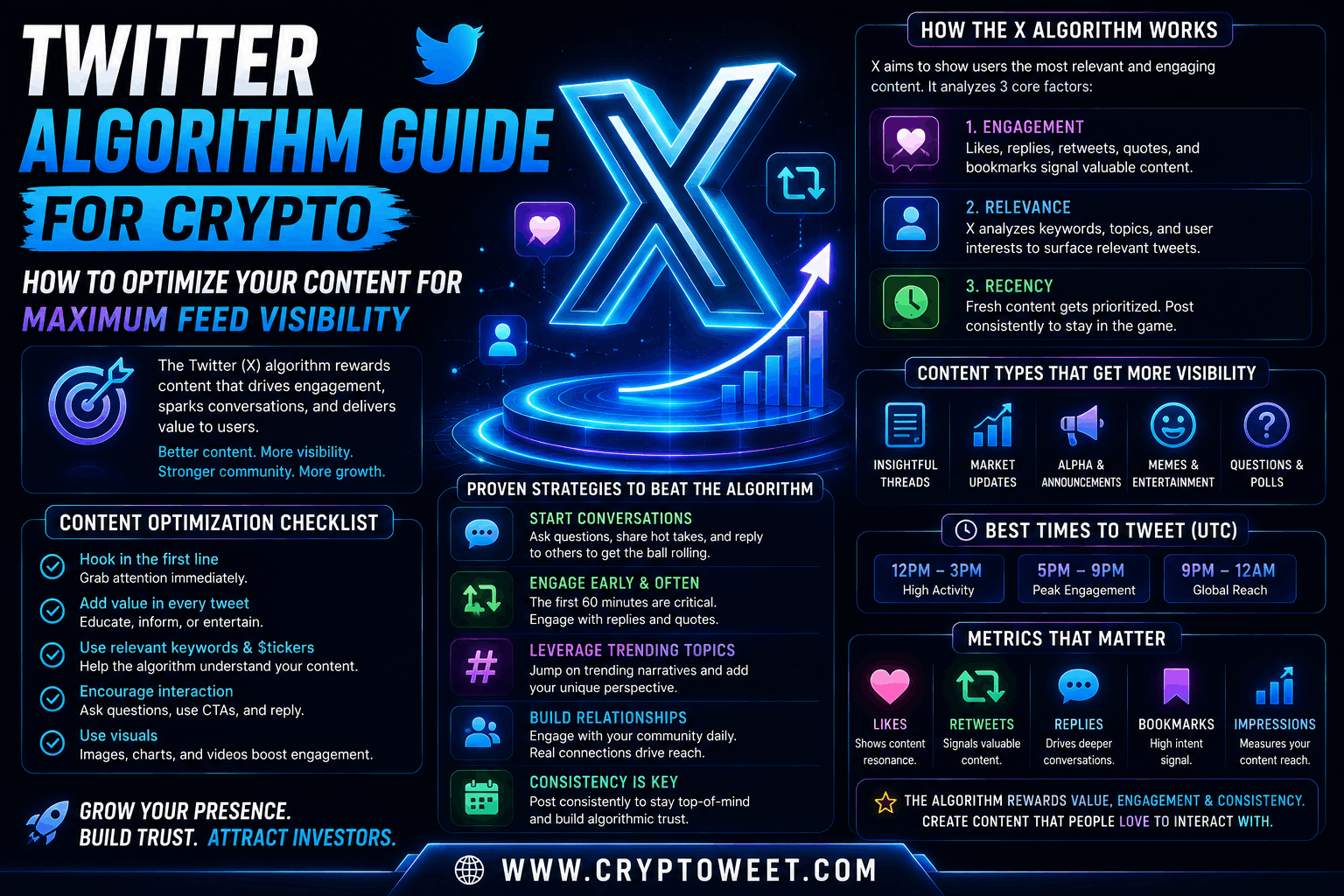
The Twitter Algorithm Guide for Crypto is no longer optional knowledge for Web3 teams competing in the attention economy. Every day, thousands of blockchain startups, DeFi protocols, NFT ecosystems, and infrastructure projects publish content, yet only a small fraction achieve meaningful reach. Visibility is not random. Distribution is governed by the crypto Twitter algorithm, a complex ranking system that determines which posts appear in feeds, recommendation modules, and trending discussions. Projects that fail to understand algorithm mechanics waste resources producing content that never reaches investors, traders, or communities.
This guide explains how the Twitter algorithm works for crypto, what ranking signals influence feed placement, and how Web3 teams can engineer content for consistent exposure. You will learn how engagement signals, content structure, account authority, and behavioral patterns interact with the platform’s ranking system. More importantly, this article breaks down practical optimization frameworks that transform ordinary posts into algorithm friendly content for crypto, helping projects improve crypto Twitter visibility, strengthen social proof, and build sustainable digital authority.
Why Understanding the Twitter Algorithm Is Critical for Crypto Projects?
Crypto markets move at narrative speed. Attention determines legitimacy, and legitimacy influences capital flow. When users repeatedly encounter a project across their feeds, perceived authority increases. This psychological familiarity strengthens investor confidence and community trust. The Twitter feed ranking system plays a decisive role in shaping these perceptions by filtering what audiences see and what remains invisible.
For crypto startups, algorithm literacy directly impacts growth efficiency. Marketing budgets often disappear into poorly distributed posts that generate minimal interaction. Teams misinterpret low reach as audience disinterest when the real issue lies in ignoring X algorithm ranking factors. Without optimization, even technically brilliant updates fail to gain traction.
Another critical factor is competition intensity. Major ecosystems coordinate announcement waves, influencer interactions, and engagement surges that signal relevance to the algorithm. Smaller teams posting without strategy are outranked regardless of content quality. Understanding algorithm mechanics allows projects to compete structurally rather than financially.
Algorithm knowledge also protects reputation. Spammy tactics, artificial amplification, and low quality engagement may produce temporary spikes but trigger visibility suppression later. Sustainable growth depends on mastering organic reach optimization and maintaining credible behavioral patterns.
Ultimately, the algorithm acts as a gatekeeper between projects and audiences. Teams that learn its logic gain control over distribution pipelines. Those who ignore it remain dependent on chance visibility, inconsistent reach, and unstable growth cycles.
How the Twitter Algorithm Actually Works?
The algorithm evaluates content through layered ranking systems combining engagement analysis, personalization modeling, and authority scoring. Each layer filters posts before distribution expands.
Core Ranking Signals
The first layer measures immediate interaction quality. Engagement velocity is one of the strongest indicators. Posts receiving rapid likes, replies, and reposts signal relevance. Early momentum acts as a credibility trigger, prompting broader exposure.
Reply velocity carries more weight than passive reactions. Meaningful discussions indicate that content stimulates thought rather than superficial scrolling. The algorithm interprets active conversations as indicators of value.
Dwell time tweets measure how long users remain on a post. Long threads and informative content increase reading duration, which signals depth. This metric discourages low effort posting and rewards informative storytelling.
Retweet cascade effect expands distribution networks. When influential accounts repost content, exposure multiplies across adjacent audience clusters. This network amplification increases ranking priority.
Personalization Layers
The second layer focuses on relevance to individual users. The algorithm analyzes interest graphs built from past interactions. Users engaging with DeFi analytics, NFT research, or trading commentary are more likely to see similar content.
Following behavior also influences ranking. Posts from accounts frequently interacted with receive preferential placement. This reinforces the importance of community building.
Content preference patterns further refine recommendations. Users who read long threads are shown more educational posts, while meme focused users receive lighter content.
Authority and Trust Weighting
The final layer assesses Twitter account authority crypto signals. Profiles demonstrating consistent activity, credible engagement, and niche expertise gain algorithmic trust.
Follower quality vs quantity is critical. Accounts followed by reputable users receive stronger trust weighting than those inflated with inactive profiles.
Historical performance influences future reach. Accounts with strong engagement records experience easier distribution compared to inconsistent publishers.
Consistency signals also matter. Stable posting rhythms and thematic coherence strengthen credibility modeling, improving ranking probability.
Key Algorithm Ranking Factors Crypto Teams Must Optimize
Understanding ranking components allows projects to prioritize optimization efforts that produce measurable results.
Engagement Signals That Drive Distribution
Not all interactions carry equal value. Replies typically outweigh likes because they indicate deeper cognitive engagement. Conversations expand content lifespan and create additional visibility through reply chains.
Bookmarks function as private endorsements. Saving content signals informational value, boosting algorithm confidence.
Shares and reposts extend reach beyond immediate audiences. Multi layer sharing networks generate compounding visibility effects.
Conversation depth Twitter metrics analyze thread length and discussion complexity. Posts inspiring thoughtful debates receive preferential ranking.
Content Quality Indicators
Algorithms evaluate substance beyond surface metrics. Information density determines how much value users gain per scroll. Educational posts outperform vague promotional messages.
Original insights differentiate content from repetitive commentary. Unique data interpretations and technical explanations enhance algorithm favorability.
Media enrichment improves retention. Charts, infographics, and visuals increase dwell time and interaction probability.
Algorithm friendly storytelling balances clarity with engagement hooks. Structured narratives outperform fragmented updates.
Negative Signals That Suppress Reach
Artificial engagement tactics create suspicious patterns. Engagement pods generate reciprocal interactions lacking authenticity.
Spam behaviors such as repetitive posts, excessive tagging, or automated replies trigger distribution penalties.
Low quality interactions reduce credibility. Generic comments and bot responses weaken trust scoring.
Misaligned targeting also harms reach. Content irrelevant to followers results in muted engagement, signaling poor relevance.
Avoiding suppression signals is as important as optimizing positive ones.
Optimizing Tweet Formats for Algorithm Performance
Content structure influences how users interact with posts. Different formats produce distinct behavioral responses.
Short form updates deliver quick insights suitable for fast consumption. These posts perform well when presenting sharp market observations or concise announcements. However, they rely heavily on immediate engagement.
Long form threads enhance crypto thread optimization by increasing dwell time and establishing authority. Multi tweet educational content encourages sustained reading and bookmarking.
Visual tweets leverage cognitive preference for images. Infographics simplify complex tokenomics, increasing shareability.
Poll driven posts generate low effort interactions. Participation increases engagement volume while encouraging community expression.
Quote tweet strategies attach commentary to trending discussions. This method piggybacks on existing attention streams, improving discoverability.
Selecting formats strategically ensures alignment between content purpose and audience behavior.
Thread Optimization Strategies for Crypto Projects
Threads function as educational funnels and authority building tools. Their structure significantly influences algorithm performance.
Hook engineering determines initial retention. Strong openings promise value, provoking curiosity that sustains reading.
Open loops create information gaps encouraging continuation. Readers remain engaged seeking resolution.
Curiosity gaps enhance cognitive engagement by presenting incomplete narratives that invite exploration.
Structured storytelling organizes complex ideas into digestible segments. Logical progression reduces reader fatigue.
Technical authority positioning demonstrates expertise through data interpretation and conceptual clarity.
Strategic calls to action guide readers toward discussion, increasing replies and conversation depth.
Well optimized threads consistently outperform isolated tweets in educational niches.
Timing, Frequency, and Behavioral Consistency
Distribution probability depends on when and how consistently content is published.
Global crypto audiences operate across time zones. Posting during overlapping activity windows increases early engagement probability.
Excessive posting triggers spam signals. Controlled frequency maintains visibility without oversaturation.
Behavioral pattern consistency strengthens algorithm trust. Regular posting schedules indicate reliability.
Irregular bursts resemble automation abuse and reduce credibility weighting.
Gradual scaling maintains authenticity. Sudden activity spikes often trigger detection systems.
Consistent behavioral rhythms support long term algorithm favorability.
Building Account Authority That Boosts Algorithm Preference
Authority functions as a multiplier across ranking systems. Trusted accounts receive broader distribution for identical content.
Aged accounts advantage demonstrates historical legitimacy. Long standing profiles appear more credible than newly created accounts.
Profile trust signals include professional branding, transparent team information, and consistent messaging.
Social proof layers such as meaningful engagement, respected followers, and credible partnerships enhance authority perception.
Niche specialization strengthens topical relevance. Focused accounts build stronger identity signals.
Community credibility emerges from transparent interaction and value driven communication.
Authority accumulation requires discipline but delivers compounding algorithm benefits.
Engagement Engineering for Algorithmic Momentum
Optimizing for the algorithm is not only about what you post but how you stimulate interaction loops after publishing. Engagement engineering focuses on designing posts that naturally encourage users to participate rather than passively scroll. The algorithm favors content that generates multi layer interactions because these signals indicate conversational value and community relevance.
Reply driven posts are powerful momentum triggers. When crypto projects ask thoughtful questions about market trends, governance proposals, or ecosystem decisions, audiences feel invited to contribute. Each reply extends visibility through reply chains, allowing posts to resurface repeatedly across feeds. This continuous resurfacing effect amplifies distribution without additional publishing.
Conversation scaffolding further enhances performance. Instead of making standalone statements, skilled teams create dialogue sequences. A tweet may introduce an insight, followed by clarifications, data visuals, and community prompts. These structures simulate live discussions, which the algorithm interprets as organic engagement clusters.
Poll based interactions reduce friction. Users can participate instantly without composing replies, increasing interaction rates. Polls about market sentiment, roadmap priorities, or feature preferences encourage involvement and provide community intelligence simultaneously.
Open loop techniques maintain curiosity. Posts that hint at valuable insights but promise deeper explanations in subsequent tweets encourage users to follow threads and stay engaged longer. This increases dwell time and improves ranking probability.
Ethical amplification also plays a role. Coordinated support from team members, ambassadors, and partners provides early momentum that signals relevance. When executed responsibly, this creates authentic velocity without triggering spam detection.
Engagement engineering transforms content into interaction systems. Projects that design posts for conversation, curiosity, and participation create algorithmic momentum that compounds reach over time.
Hashtag, Keyword, and Discoverability Structuring
The algorithm relies heavily on contextual signals to categorize content. Strategic keyword optimization for crypto Twitter improves discoverability within interest clusters and recommendation streams.
Hashtag layering helps connect posts to broader conversations. Using a combination of niche tags such as DeFiAnalytics or NFTUtility and broader tags like CryptoNews or Web3Development increases exposure across audience tiers. However, excessive tagging appears spammy and reduces credibility.
Keyword placement inside the tweet body also influences indexing. Natural integration of semantic phrases such as blockchain adoption, tokenomics analysis, or on chain governance improves contextual relevance. These terms help the algorithm understand topic alignment and recommend posts to interested users.
Trending topic alignment further expands reach. When projects contribute meaningful commentary to active discussions, their posts integrate into high visibility streams. This piggybacking effect allows smaller accounts to benefit from larger narrative waves.
Content clustering enhances thematic authority. Publishing multiple posts around a central topic within short intervals signals expertise. The algorithm recognizes subject matter consistency and strengthens topical association.
Alt text optimization for images also contributes to discoverability. Descriptive captions help indexing systems understand visual content, improving visibility in relevant searches.
Effective discoverability structuring ensures posts reach users actively interested in related subjects rather than random audiences. This alignment improves engagement quality and strengthens algorithmic trust.
Analytics Systems for Continuous Optimization
Sustainable growth depends on measurement systems that translate performance data into strategic improvements. Crypto Twitter analytics strategy frameworks allow teams to identify strengths, weaknesses, and optimization opportunities.
Engagement rate analysis reveals how effectively content resonates. Higher ratios indicate strong audience relevance, while low ratios suggest misalignment between message and follower interests.
Impression to interaction ratios show content efficiency. Posts receiving high visibility but minimal engagement require stronger hooks or clearer value propositions.
Follower growth attribution helps identify which content formats drive audience expansion. Educational threads, market insights, and community discussions may contribute differently to growth.
Conversation mapping evaluates discussion quality. Meaningful debates indicate deeper interest and stronger community bonds compared to shallow reactions.
Sentiment tracking measures perception trends. Positive conversations strengthen brand positioning, while negative signals indicate communication gaps.
Retention metrics assess whether audiences remain active over time. Consistent interaction patterns signal sustainable engagement rather than temporary spikes.
Analytics driven refinement transforms posting into a performance optimized system. Continuous evaluation ensures strategies evolve alongside audience preferences and algorithm updates.
Common Algorithm Mistakes Crypto Projects Must Avoid
Many projects unintentionally reduce visibility through preventable behaviors. Recognizing these errors protects reach and preserves credibility.
Over posting is a common issue. Flooding feeds overwhelms audiences and triggers spam filters. Balanced frequency maintains presence without fatigue.
Repetitive messaging weakens interest. Constant promotional content reduces perceived value and lowers interaction rates.
Artificial engagement tactics create suspicious patterns. Buying interactions or participating in low quality engagement groups damages algorithmic trust.
Ignoring replies signals indifference. Lack of community interaction reduces conversation depth and weakens engagement loops.
Inconsistent branding confuses audiences. Shifting narratives dilute identity and reduce topical authority signals.
Misaligned targeting also harms performance. Posting advanced technical content to general audiences results in poor engagement.
Algorithm optimization requires discipline. Avoiding harmful behaviors is essential for maintaining stable visibility and long term credibility.
Future Trends in Algorithmic Distribution for Web3
Algorithm systems continue evolving toward authenticity and value prioritization. Predicting these shifts helps projects stay competitive.
AI driven personalization will refine recommendation accuracy. Content tailored to user interests will receive stronger visibility advantages.
Community interaction signals will likely gain more weight. Platforms increasingly prioritize meaningful discussions over passive reactions.
Authority verification mechanisms may expand. Accounts demonstrating verified expertise and credible networks could receive ranking benefits.
Multimedia integration will strengthen retention metrics. Interactive formats such as live sessions and visual explainers may outperform static posts.
Decentralized identity systems may influence trust modeling. Verified on chain reputations could enhance credibility scoring.
Projects that adapt early to algorithmic evolution maintain strategic advantages in visibility and audience growth.
Professional Growth Infrastructure by CryptoWeet
Understanding the algorithm is powerful, but execution requires resources, consistency, and credibility infrastructure that many teams lack. Without strong foundations, even well optimized posts struggle to gain traction because audiences evaluate social proof before engaging.
CryptoWeet provides professional growth infrastructure designed specifically for Web3 projects seeking sustainable expansion. Instead of relying on vanity metrics or artificial amplification, the focus remains on authentic audience development and trust signaling.
The The 1000 Foundation establishes essential credibility layers that improve algorithm performance and investor perception. This foundational system includes:
• 1,000 genuine crypto native followers aligned with Web3 interests
• 1,000 distributed likes and views across important posts to strengthen engagement history
• 1,000 authentic replies and conversations that build visible community interaction
These elements create strong social proof signals that improve perceived authority and increase engagement probability. When algorithm optimized content is supported by credible interaction history, distribution becomes more stable and sustainable.
CryptoWeet infrastructure is particularly valuable for projects preparing token launches, ecosystem expansions, and investor awareness campaigns. Strong foundations amplify algorithmic strategies and convert visibility into trust.
Conclusion
Mastering the Twitter Algorithm Guide for Crypto enables projects to control visibility rather than relying on unpredictable exposure. Understanding ranking signals, engagement engineering, content structuring, and authority building transforms posting into a strategic distribution system.
Sustainable growth emerges when optimization aligns with authentic communication, community value, and consistent behavioral patterns. Projects that respect algorithm logic while prioritizing audience trust achieve stable expansion and stronger investor perception.
For teams seeking faster and more reliable growth, combining algorithm expertise with professional credibility infrastructure provides significant advantages. Structured foundations allow content strategies to perform at their highest potential and convert visibility into long term ecosystem strength.