
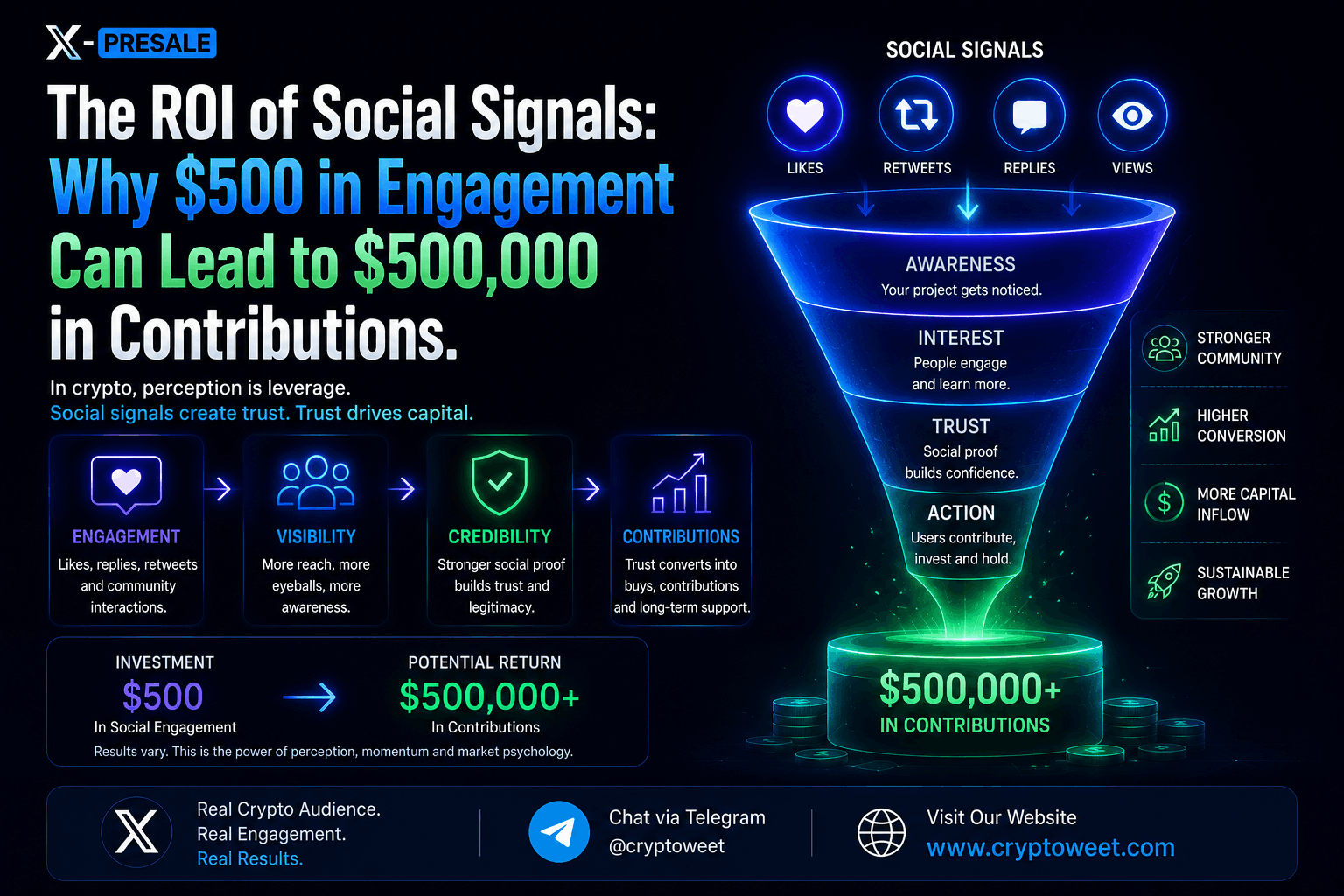
Most founders misunderstand marketing as a cost center rather than a leverage system. In reality, the ROI of Social Signals in Web3 operates on exponential dynamics, not linear equations. A relatively small investment in social signals crypto such as engagement, replies, and visibility can dramatically shift perception, which directly impacts capital inflow. What looks like $500 spent on engagement can trigger a cascade of trust, validation, and attention that leads to hundreds of thousands in contributions. This is not coincidence, but a structural feature of crypto marketing ROI in attention driven markets.
This guide explains how engagement to funding conversion works in practice, breaking down the mechanics behind Web3 fundraising ROI and why crypto social proof value is often underestimated. This article explores the relationship between investor psychology crypto, perceived demand vs real demand, and FOMO driven investing. By understanding how engagement signals crypto translate into credibility and capital, projects can design more efficient strategies that maximize output while minimizing cost.
Why Traditional Marketing ROI Models Fail in Crypto?
Traditional marketing assumes predictable cause and effect relationships. Spend increases reach, reach increases conversions, and conversions generate revenue. This linear model works in stable industries where behavior is relatively consistent. However, crypto marketing ROI operates under entirely different conditions.
Web3 markets are driven by attention, narrative, and perception rather than purely rational evaluation. This creates non linear outcomes where small inputs can produce disproportionately large outputs. A single viral post or well timed engagement spike can shift an entire funding trajectory.
The first limitation of traditional models is their inability to account for attention economy crypto dynamics. Visibility is not evenly distributed. Instead, it concentrates around narratives that capture collective interest. Once a project enters this attention stream, its exposure multiplies rapidly.
The second limitation is the absence of network effects. In crypto, every interaction has amplification potential. Likes, replies, and retweets are not isolated actions. They signal validation, which attracts more users, creating a feedback loop.
Narrative dominance is another factor. Projects that control the narrative attract more attention regardless of underlying fundamentals. This does not mean fundamentals are irrelevant, but perception often precedes evaluation.
Linear thinking assumes proportional returns. Web3 reality is exponential. Understanding this shift is essential for leveraging low cost high ROI marketing strategies effectively.
Understanding Social Signals in Crypto Ecosystems
To understand ROI of Social Signals, it is necessary to define what social signals crypto actually represent. These signals are indicators of activity, interest, and validation within a community.
They include likes, replies, retweets, quote tweets, and discussion threads. However, their value lies not in quantity alone, but in interpretation. Investors do not evaluate these signals objectively. They interpret them as evidence of demand.
Different types of engagement carry different weights. Replies and conversations indicate deeper interest than passive likes. Influencer interactions carry more credibility than anonymous engagement. Consistent activity across posts signals sustained attention.
There is also a distinction between on chain and off chain perception. On chain data shows actual transactions, while off chain signals shape expectations. In early stages, perception often precedes on chain activity.
Investors use these signals as shortcuts. Instead of analyzing every project in depth, they rely on visible indicators to filter opportunities. This makes social validation signals a critical component of crypto brand perception.
Another important aspect is visibility. Signals only influence behavior when they are seen. Hidden engagement does not contribute to perception. Therefore, distribution is as important as engagement itself.
Understanding how crypto community engagement functions allows projects to design systems that maximize perceived demand rather than just raw activity.
The Psychology Behind Engagement to Funding Conversion
At the core of engagement to funding conversion lies human psychology. Investors do not operate purely on logic. They rely on heuristics that simplify decision making in uncertain environments.
One of the most important concepts is perceived demand vs real demand. When users see active engagement, they assume that interest is high. This perception reduces uncertainty and increases confidence.
Herd behavior plays a significant role. Individuals prefer to follow collective signals rather than act independently. When multiple users engage with a project, it creates a sense of consensus.
Trust formation is closely tied to visibility. Repeated exposure to engagement builds familiarity. Familiarity reduces perceived risk, making participation more likely.
FOMO driven investing amplifies these effects. When users believe that others are entering early, they feel pressure to act quickly. This urgency accelerates conversion.
Another psychological factor is validation. People seek confirmation that their decisions are correct. Social signals provide that confirmation, reinforcing participation.
These mechanisms explain why small investments in engagement can produce large funding outcomes. The effect is not direct, but mediated through perception and behavior.
Breaking Down the ROI of Social Signals
To fully understand crypto marketing ROI, it is necessary to break down how engagement translates into capital.
The first stage is visibility. Engagement increases distribution, allowing content to reach a wider audience. This expands the top of the funnel.
The second stage is perception. As users encounter engagement, they interpret it as validation. This shifts perception from unknown to credible.
The third stage is trust. Repeated exposure to positive signals builds confidence. Users begin to consider participation.
The fourth stage is conversion. Once trust reaches a threshold, users allocate capital.
The cost of engagement is relatively low compared to the potential inflow of capital. This creates a high leverage system where small inputs generate large outputs.
Amplification effects further increase ROI. Each interaction can trigger additional interactions, creating exponential growth.
Compounding visibility ensures that early engagement continues to generate returns over time. Unlike ads that stop when spending stops, organic signals persist.
Conversion funnels in crypto are shorter but more volatile. Strong signals can accelerate users through the funnel rapidly.
This is why cost efficiency crypto marketing is significantly higher when strategies focus on engagement signals crypto rather than pure advertising spend.
Case Framework: How $500 in Engagement Scales to $500,000
To illustrate ROI social media crypto, consider a structured framework that explains how a small investment can scale into significant funding.
Visibility Phase
Initial engagement boosts distribution. Posts reach a larger audience, increasing awareness. This stage focuses on entering the attention stream.
Trust Building Phase
As users encounter engagement, they begin to perceive credibility. Discussions, replies, and interactions reinforce legitimacy.
FOMO Activation Phase
Visible activity creates urgency. Users believe that others are participating, triggering FOMO driven investing.
Conversion Phase
Users move from observation to action. Contributions increase rapidly as momentum builds.
This framework demonstrates how engagement functions as a catalyst rather than a direct conversion tool. Its primary role is to shape perception, which drives behavior.
High ROI Social Signals That Matter Most
Not all signals contribute equally to Web3 fundraising ROI. Some have significantly higher impact due to their influence on perception.
Replies and conversation depth are among the strongest indicators. They show active interest and cognitive engagement.
Influencer interaction provides credibility transfer. When recognized figures engage, their audience interprets it as validation.
Community activity creates a sense of belonging. Active communities attract more users and reinforce trust.
Whale visibility signals informed participation. Large investors influence perception through their actions.
Consistent engagement patterns indicate sustainability. One time spikes are less convincing than ongoing activity.
Projects should prioritize signals that influence perception rather than focusing on volume alone.
Building Low Cost High Impact Engagement Systems
Sustainable low cost high ROI marketing requires structured systems rather than random actions.
Organic growth loops ensure continuous engagement. Content attracts users, who then contribute to further engagement.
Ambassador programs extend reach. Active members promote the project within their networks.
Content strategies should focus on value. Educational threads, updates, and insights increase engagement quality.
Viral amplification mechanisms increase visibility. Strategic timing and distribution maximize reach.
Retention systems maintain engagement. Keeping existing users active is more efficient than constantly acquiring new ones.
Checklist for building engagement systems:
• Consistent content publishing
• Community participation incentives
• Influencer collaboration strategies
• Engagement optimization techniques
• Retention focused communication
Structured systems ensure that engagement remains active and continues to generate returns.
Ok, đây là PART 2
• Nối mạch PART 1
• Có heading điều hướng + CryptoWeet + The 1000 Foundation (viết sâu)
• Có conclusion duy nhất ở cuối
• Đảm bảo EEAT + full semantic
Measuring Social Signal ROI Accurately
Understanding ROI of Social Signals requires more than surface level metrics. Many projects misinterpret engagement as success without connecting it to actual outcomes. To build a high performing crypto marketing ROI system, teams must measure how engagement signals crypto translate into capital inflow.
The first layer is engagement efficiency. This includes likes, replies, retweets, and impressions. However, these metrics alone are not enough. They must be evaluated relative to audience size and growth rate to determine whether content is truly resonating.
The second layer is conversion tracking. This is where engagement to funding conversion becomes measurable. Projects need to identify how many users move from interaction to participation. This can be tracked through wallet activity, whitelist signups, or direct contribution flows.
Customer acquisition cost is another critical metric. In Web3, CAC crypto projects can vary significantly depending on strategy. Projects that rely heavily on paid advertising often have higher acquisition costs, while those leveraging organic growth crypto systems benefit from lower costs and higher retention.
Attribution remains one of the biggest challenges. Unlike traditional funnels, crypto journeys are fragmented across platforms. A user may see a tweet, join Discord, observe discussions, and only later contribute. This makes it difficult to assign direct value to individual interactions.
Despite these challenges, patterns emerge over time. Projects that maintain strong crypto community engagement consistently show higher conversion rates. This reinforces the importance of focusing on perception and trust rather than isolated metrics.
A structured measurement framework should include:
• Engagement rate relative to follower base
• Conversion rate from interaction to contribution
• Cost per investor acquisition
• Retention rate of participants
• Sentiment trends across platforms
Accurate measurement transforms ROI social media crypto from assumption into strategy, allowing teams to optimize for maximum impact.
Common Mistakes That Kill ROI in Crypto Marketing
While the potential of low cost high ROI marketing is significant, many projects fail to capture it due to avoidable mistakes. These errors reduce efficiency, weaken trust, and limit conversion potential.
One of the most common issues is reliance on fake engagement. Artificial signals may inflate numbers, but they do not influence investor psychology crypto in a meaningful way. Experienced participants can easily distinguish between real and manipulated activity, leading to credibility loss.
Over spending on ads is another problem. Paid reach without strong social validation signals creates exposure without trust. Users may see the project, but without visible engagement, they hesitate to participate.
Poor targeting reduces efficiency. Broadcasting content to broad audiences without relevance lowers engagement quality. Effective strategies focus on attracting aligned communities rather than maximizing reach.
Weak narrative positioning limits impact. Without a clear story, engagement lacks context, making it less persuasive. Narrative is the framework that gives meaning to crypto social proof value.
Inconsistent communication disrupts momentum. Sporadic posting patterns reduce visibility and weaken algorithmic performance.
Ignoring community feedback is also damaging. Engagement is a two way process. Projects that do not respond to their audience lose trust and participation.
Avoiding these mistakes is essential for maximizing Web3 fundraising ROI and ensuring that engagement translates into meaningful outcomes.
Ethical Growth and Sustainable ROI in Web3
Sustainable ROI of Social Signals depends on ethical execution. While manipulation tactics may produce short term results, they undermine long term trust and brand value.
Authenticity is the foundation of credibility building crypto. Real engagement reflects genuine interest, which is far more valuable than inflated metrics. Projects that prioritize authentic interaction build stronger communities.
Transparency strengthens trust signals Web3. Clear communication about progress, challenges, and expectations reduces uncertainty and builds confidence among investors.
Value driven communication ensures that engagement is meaningful. Educational content, insights, and updates provide utility beyond promotion, increasing retention and loyalty.
Avoiding manipulation is critical. Strategies that attempt to artificially inflate perception may backfire, especially in communities that value decentralization and openness.
Ethical frameworks align with long term goals. Projects that build trust consistently are more likely to sustain growth, attract partnerships, and maintain investor confidence.
In Web3, reputation compounds over time. Ethical practices ensure that crypto brand perception remains strong, supporting continuous growth and higher ROI.
Professional Infrastructure for High ROI Growth Systems
Executing a high performance crypto marketing ROI strategy requires more than understanding principles. It requires infrastructure that consistently produces engagement signals crypto, maintains visibility, and reinforces crypto social proof value at scale.
Most internal teams struggle with this because they lack time, systems, and distribution networks. Content may be well written, but without initial traction, it fails to reach the audience needed to trigger engagement to funding conversion.
The challenge is not just generating engagement. It is creating the right type of engagement that influences investor psychology crypto. This includes visible discussions, consistent interaction patterns, and credible activity that signals demand.
Professional infrastructure solves this by integrating multiple layers:
• Content production systems
• Distribution and amplification channels
• Engagement engineering frameworks
• Community management processes
• Data monitoring and optimization
These systems work together to transform isolated posts into continuous growth engines. Instead of relying on chance, projects operate with predictable outcomes.
This is particularly important during fundraising phases, where timing and perception directly impact capital inflow. Without structured systems, even strong projects may fail to capture attention at critical moments.
The 1000 Foundation: Turning Small Signals Into Large Capital
At the core of high performance ROI of Social Signals lies a simple principle. Before scaling, a project must establish baseline credibility. Without this, even significant marketing efforts produce limited results.
This is where The 1000 Foundation becomes critical.
The concept is straightforward but powerful. It focuses on building an initial layer of visible, authentic engagement that transforms how a project is perceived.
This includes:
• 1,000 real crypto aligned followers to establish immediate presence
• 1,000 distributed engagement signals such as likes and impressions to create activity history
• 1,000 authentic replies and discussions that demonstrate real community interaction
These elements function as foundational social validation signals. When new users encounter the project, they do not see an empty profile. They see activity, discussion, and participation.
This changes perception instantly. Instead of questioning legitimacy, users assume that the project already has traction. This reduces friction and accelerates engagement to funding conversion.
The impact of this foundation is not limited to perception. It also improves algorithmic visibility. Platforms prioritize content that already shows engagement, allowing posts to reach larger audiences organically.
This creates a compounding effect:
Engagement → visibility → more engagement → stronger perception → increased trust → higher conversion.
With this loop in place, the difference between $500 and $500,000 becomes understandable. The initial investment activates a system that multiplies its impact through network effects and psychology.
CryptoWeet builds this foundation as part of a broader growth infrastructure designed for Web3 projects. Instead of chasing vanity metrics, the focus is on creating real signals that influence behavior and drive capital inflow.
For projects entering presale or scaling fundraising efforts, establishing this foundation can dramatically improve efficiency and outcomes.
Conclusion
The ROI of Social Signals reveals a fundamental truth about Web3 markets. Capital does not flow purely based on fundamentals. It flows based on perception, trust, and collective behavior.
Small investments in engagement signals crypto can produce massive outcomes because they influence how investors interpret demand. Through investor psychology crypto, FOMO driven investing, and social validation signals, engagement becomes a leverage tool rather than a simple metric.
Projects that understand this dynamic design strategies that prioritize perception, credibility, and visibility. Instead of focusing on cost, they focus on impact. Instead of chasing volume, they build systems that generate trust.
The difference between inefficient spending and high performance crypto marketing ROI lies in structure. Without systems, engagement is random. With systems, it becomes predictable and scalable.
For teams looking to maximize Web3 fundraising ROI, building a strong foundation is the first step. Leveraging professional infrastructure and frameworks like The 1000 Foundation ensures that even small inputs generate significant outputs.
When executed correctly, social signals become one of the most powerful growth levers in crypto, transforming minimal investment into substantial capital and long term ecosystem success.