Crypto Twitter posting frequency is one of the most misunderstood elements in Web3 marketing. Many projects assume that higher activity automatically translates to better visibility, stronger engagement, and faster community growth. In reality, excessive tweeting can reduce engagement rate, overwhelm followers, trigger timeline saturation, and send negative algorithm signals that suppress distribution. On the other hand, posting too infrequently weakens audience familiarity, lowers organic visibility, and causes content to decay before it reaches meaningful interaction thresholds. Finding the right posting cadence is not about volume but about strategic rhythm aligned with crypto audience behavior.
This guide explains how professional teams design a sustainable crypto Twitter content schedule that maximizes reach without damaging credibility. You will learn how the Twitter algorithm signals evaluate activity levels, how different project stages require different tweet frequency strategies, and how to balance content types without causing audience fatigue. The article also breaks down global timing considerations, event driven adjustments, and long term scheduling frameworks that support sustainable growth and stronger community trust.
Why Posting Frequency Matters in Crypto Twitter Marketing?
The crypto ecosystem operates in a hyper competitive information environment where thousands of projects compete for limited user attention. Every minute, timelines are flooded with token announcements, governance updates, influencer commentary, trading screenshots, and market speculation. In such an environment, crypto Twitter posting frequency becomes a visibility control mechanism.
Posting too rarely creates long silence gaps that weaken algorithm familiarity. Social platforms prioritize accounts that maintain consistent interaction patterns because they appear reliable and relevant. When a project tweets once every few days, the platform reduces distribution confidence, shrinking the visibility window of each post.
However, excessive posting produces the opposite effect. Frequent low value tweets trigger timeline saturation, pushing followers to mute accounts. This leads to declining engagement velocity, weaker early interaction signals, and eventual algorithmic deprioritization.
Crypto audiences behave differently from general social media users. Traders monitor feeds during active market sessions, investors scan for ecosystem updates, and researchers follow technical threads. If posting frequency misaligns with these behavior cycles, content loses strategic impact.
Effective frequency supports:
• Sustained organic visibility
• Stronger engagement depth
• Improved reputation management
• Better first impressions for investors
• Consistent authority positioning
Rather than treating frequency as a numeric target, professional teams treat it as a rhythm that supports narrative continuity while preventing audience fatigue.
Understanding How the Twitter Algorithm Evaluates Activity Levels
The platform does not reward raw posting volume. It evaluates behavioral patterns that indicate authentic participation and audience relevance. Understanding these mechanisms allows projects to optimize twitter posting strategy for crypto projects without triggering spam signals.
One critical factor is engagement velocity, which measures how quickly posts receive interactions after publication. Tweets that attract rapid likes, replies, and shares signal strong relevance. However, when accounts publish too frequently, audience interaction disperses across multiple posts, weakening performance signals.
Another factor is content lifespan. Every tweet has a limited exposure window. Posting new content too soon can cannibalize previous posts before they complete their engagement cycle. This reduces cumulative impressions and suppresses distribution efficiency.
Timeline saturation is also monitored. When users repeatedly scroll past content from the same account without interacting, the platform interprets it as reduced interest. This results in lower feed priority.
Consistency is rewarded more than bursts. Irregular posting patterns confuse algorithmic prediction systems. Predictable posting cadence improves trust in content relevance.
Signals influencing activity evaluation include:
• Interaction quality versus raw engagement
• Diversity of audience responding
• Time gaps between posts
• Ratio of original tweets to replies
• Content variety and format balance
For crypto projects, algorithm alignment determines whether updates reach investors during critical moments such as listings, partnerships, or product launches.
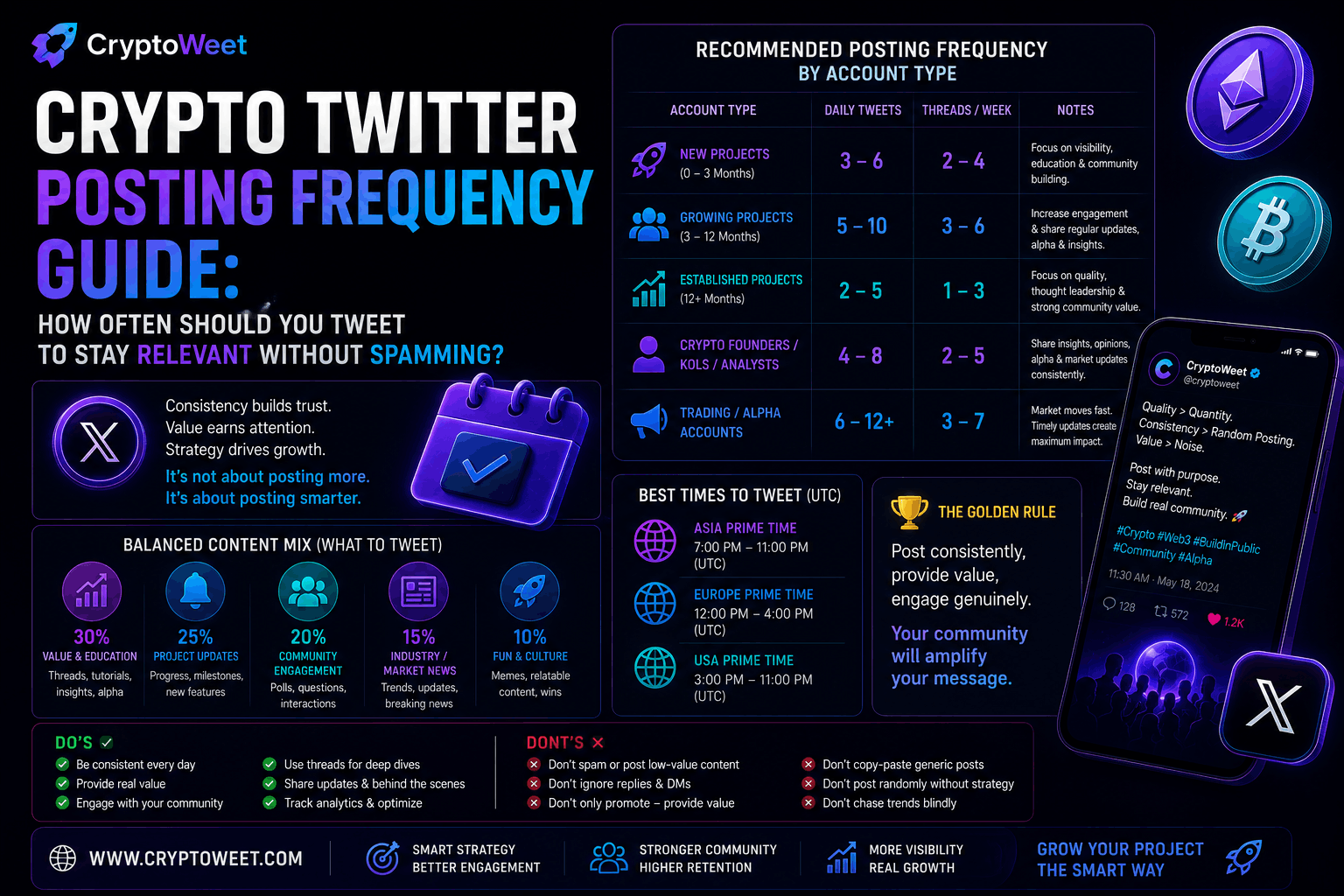
Ideal Tweet Frequency for Different Types of Crypto Projects
There is no universal answer to how often should crypto projects tweet because project maturity, audience size, and narrative complexity influence optimal activity levels.
Early Stage Projects
New projects must build recognition and maintain presence without overwhelming limited audiences. Excessive posting often appears desperate and reduces credibility.
Recommended rhythm:
• 2 to 4 tweets daily
• Focus on educational threads and progress updates
• Higher emphasis on replies and community interaction
This approach strengthens credibility signals while allowing each tweet to accumulate engagement.
Growth Stage Projects
Projects with expanding communities can increase output while maintaining interaction quality.
Effective cadence:
• 4 to 8 tweets daily
• Mix of announcements, ecosystem highlights, and discussions
• Strategic thread publishing
Growth stage audiences expect regular updates, but value remains critical to avoid audience fatigue.
Established Ecosystems
Large ecosystems operate as media networks with diverse content streams.
Typical activity range:
• 6 to 15 tweets daily
• Multiple content formats
• Regional community highlights
• Frequent governance and partnership updates
High activity works because audiences are segmented and deeply invested.
Influencers and Founders
Personal brands rely on authenticity and insight.
Optimal approach:
• 2 to 6 tweets daily
• High value commentary
• Educational threads
• Market analysis
Authority figures benefit more from thoughtful contributions than constant posting.
Matching frequency with project stage prevents overexposure while supporting sustainable growth.
Daily vs Weekly Posting Strategies for Web3 Teams
Operational structure affects posting frequency decisions. Teams must choose between real time daily publishing and structured weekly planning.
Daily strategies provide agility. Crypto markets move rapidly, and immediate reactions to news improve relevance. This method suits trading platforms, analytics services, and influencer brands.
Advantages include:
• Faster trend participation
• Real time community engagement
• Flexible narrative adaptation
However, daily publishing may lead to inconsistent quality and reactive messaging.
Weekly scheduling offers strategic control. Teams batch content production, maintain narrative arcs, and ensure balanced content distribution.
Benefits include:
• Higher production quality
• Coordinated announcements
• Reduced operational stress
• Improved storytelling continuity
Hybrid systems combine both models. Foundational content is scheduled weekly while reactive updates fill real time gaps.
Professional crypto twitter content schedule frameworks include planned slots for educational posts, announcements, engagement prompts, and community highlights. This ensures consistent visibility without chaotic posting patterns.
Signs You Are Tweeting Too Much and Hurting Engagement
Excessive tweeting often appears productive internally but damages external perception. Crypto audiences value signal over noise.
Warning patterns include declining engagement rate, where impressions grow but interactions drop. This suggests follower fatigue.
Reduced impressions per tweet indicate content cannibalization. When posts overlap, each receives weaker exposure.
Muted conversations reveal loss of community sentiment. Posts receive likes but fewer replies, signaling shallow interest.
Follower complaints and mute behavior show timeline overload. Algorithms detect repeated non interaction and reduce feed presence.
Another indicator is reduced conversation depth, where replies become generic or automated.
Overposting damages reputation management by creating the impression of artificial hype rather than genuine ecosystem development.
Strategic reduction often restores performance metrics by allowing content breathing space.
Signs You Are Tweeting Too Little and Losing Visibility
Underposting is equally harmful. Crypto markets evolve continuously, and silence suggests inactivity.
Low frequency reduces algorithm familiarity, weakening distribution priority.
Projects may experience declining follower growth rate because new visitors perceive stagnation.
Important announcements risk limited reach when audiences are not primed by regular activity.
Narrative gaps weaken authority positioning. Thought leadership requires consistent contribution to ecosystem discussions.
Sparse posting also reduces opportunities for engagement loops, where interactions compound across threads and discussions.
Sustainable presence requires steady participation aligned with audience attention cycles.
Content Type Frequency Balancing for Sustainable Engagement
Optimizing crypto twitter posting frequency is not only about how many tweets are published, but also about what types of content are distributed across that schedule. Different formats carry different engagement weights, lifespan durations, and algorithmic behaviors. When projects fail to balance content variety, even well timed posting cadences can trigger audience fatigue and reduce engagement velocity.
Threads, for example, carry longer content lifespan and generate deeper conversation depth. A single well structured thread can remain visible for hours as users interact across multiple replies. Because of this extended exposure window, threads should be spaced strategically rather than stacked closely together. Posting multiple threads within short intervals often causes internal competition, reducing cumulative impressions.
Short form tweets function differently. They support rapid updates, commentary, and real time reactions. These posts typically have shorter visibility windows, making them suitable for filling gaps between larger narrative pieces.
Educational posts contribute strongly to authority positioning. They require lower frequency but higher quality because their purpose is to build community trust and demonstrate expertise. Excessive educational content without variation can feel repetitive, while too little reduces perceived value.
Promotional posts require the most careful moderation. Frequent direct marketing messages quickly trigger spam perception and weaken reputation management. Audiences respond better when promotional content is surrounded by informative and engaging material.
A sustainable content balance often resembles:
• High value threads published occasionally
• Short updates distributed evenly
• Educational insights placed strategically
• Community conversations integrated naturally
• Promotional messages limited and contextual
This balanced approach supports organic visibility while protecting long term audience relationships.
Time Zone and Global Audience Considerations
Crypto communities operate across multiple continents, making global timing a critical factor in twitter posting strategy for crypto projects. Posting frequency that ignores regional activity cycles leads to wasted impressions and lower engagement rate.
Asian trading sessions often generate strong early day engagement driven by retail traders and regional communities. European audiences become active later, contributing analytical discussions and institutional commentary. North American sessions typically produce the highest interaction intensity due to market overlap, influencer activity, and project announcements.
If a project concentrates all tweets within a single regional window, large portions of the audience encounter content decay before becoming active. This reduces the effective visibility window and weakens performance metrics.
A rolling visibility strategy distributes posts across global activity cycles while avoiding timeline saturation. Instead of publishing large clusters, content is spaced to align with regional peaks.
Projects targeting global reach often:
• Schedule primary announcements for overlap hours
• Repurpose key updates across multiple time zones
• Maintain steady cadence rather than regional bursts
• Analyze engagement heatmaps for optimization
This approach improves impressions per tweet, strengthens audience familiarity, and supports consistent algorithm recognition.
Event Driven Frequency Adjustments in Crypto Markets
Static posting schedules cannot accommodate the dynamic nature of crypto markets. Major events create temporary engagement surges that require adaptive posting cadence.
Token launches, exchange listings, partnership announcements, and product releases justify temporary frequency increases. During these periods, higher activity signals momentum and reinforces credibility signals.
Market volatility also demands responsive communication. Rapid updates during price swings or ecosystem incidents strengthen community sentiment and demonstrate transparency.
However, event driven frequency must remain structured. Chaotic bursts reduce message clarity and increase timeline saturation. Strategic clustering ensures that each update maintains sufficient engagement velocity.
Effective event adjustments include:
• Pre scheduled announcement sequences
• Supporting educational threads
• Coordinated influencer amplification
• Follow up summaries for clarity
• Post event engagement prompts
After high intensity windows, returning to baseline cadence prevents audience exhaustion and preserves sustainable growth patterns.
Building a Sustainable Crypto Twitter Content Calendar
Long term success depends on systems rather than improvisation. A structured crypto twitter content schedule transforms posting frequency from guesswork into operational strategy.
Content calendars help teams coordinate narratives, balance formats, and maintain consistent presence without overwhelming followers.
Strategic scheduling frameworks often include:
Thematic segmentation
Different days serve different communication goals such as education, ecosystem updates, or community engagement.
Narrative arcs
Threads and updates build progressive storylines rather than isolated messages.
Engagement windows
Specific time slots are reserved for interactive posts to stimulate conversation depth.
Analytics feedback loops
Performance data informs frequency adjustments and format optimization.
Sustainability principles
Cadence must match team production capacity to avoid burnout and quality decline.
This systematic approach improves organic visibility, strengthens authority positioning, and stabilizes performance metrics over time.
Case Patterns from High Growth Crypto Twitter Accounts
Observing successful ecosystems reveals that growth rarely comes from random activity spikes. Instead, high performing accounts follow structured frequency patterns aligned with audience expectations.
Common patterns include steady daily cadence rather than erratic bursts. This consistency improves algorithm familiarity and strengthens trust signals.
Engagement clustering is another pattern. Instead of spreading content evenly without strategy, projects publish related posts that reinforce thematic narratives.
Narrative stacking strengthens authority positioning. Each thread builds upon previous discussions, forming knowledge sequences that audiences follow over time.
Audience segmentation allows varied posting intensity without timeline saturation. Different community groups engage with different content formats, reducing fatigue.
High growth accounts also monitor engagement rate, impressions per tweet, and follower growth rate to refine cadence continuously.
These patterns show that professional posting frequency is engineered rather than improvised.
Professional Growth Infrastructure by CryptoWeet
Optimizing crypto twitter posting frequency improves visibility, but sustainable growth also depends on foundational credibility. Without strong social proof, even well timed content struggles to convert impressions into trust.
CryptoWeet provides professional growth infrastructure that strengthens credibility before aggressive scaling begins.
At the core of this system is The 1000 Foundation, a structured framework designed to help projects establish their first layer of authentic market presence.
This foundation includes:
1,000 Genuine Crypto Native Followers
Followers are sourced from real users active in cryptocurrency discussions, trading communities, DeFi ecosystems, and Web3 networks. This builds immediate legitimacy and improves perceived ecosystem relevance.
1,000 Distributed Engagement Signals
Likes and views are strategically allocated across key posts such as announcements, product updates, technical threads, and ecosystem milestones. Distributed engagement creates natural interaction patterns that strengthen algorithmic trust evaluation.
1,000 Authentic Conversation Layers
Replies and discussions simulate real community participation, improving perceived activity and reinforcing credibility signals. Active conversations encourage additional organic interaction and support stronger community trust.
When projects combine optimized posting cadence with foundational credibility layers, automation and content strategies appear more organic, reducing reputational risk and improving long term sustainable growth.
Conclusion: Consistency Builds Authority Faster Than Volume
Effective crypto twitter posting frequency is a balance between visibility and credibility. Posting too frequently overwhelms audiences and weakens engagement depth, while infrequent activity reduces organic visibility and damages authority positioning.
Sustainable growth comes from structured cadence, content balance, algorithm alignment, and consistent community interaction. Projects that treat posting frequency as strategic infrastructure rather than random activity build stronger relationships and long term trust.
For teams seeking faster credibility and stronger foundations before scaling content operations, professional infrastructure support can significantly reduce growth friction.
CryptoWeet provides foundational systems that strengthen social proof, improve trust signals, and support long term expansion across the crypto ecosystem.