
Many crypto projects fail not because of weak technology, but because they fail to create demand before their token sale begins. The concept of a “sold out” narrative has become a defining factor in successful launches. When investors believe a presale will sell out quickly, they act faster, commit larger capital, and reduce hesitation. This perception, driven by strategic messaging, social proof, and scarcity signals, often determines whether a token sale struggles or reaches its hard cap rapidly. Understanding how to engineer this perception is essential for any Web3 team aiming to maximize fundraising outcomes.
This guide explores how to build a powerful sold out narrative using proven principles from investor psychology, scarcity marketing, and crypto-specific growth strategies. Instead of relying on chance, this article breaks down how to design demand before launch, structure whitelist campaigns, and layer social proof effectively. By aligning these elements into a cohesive system, projects can transform attention into high-conversion participation and create the conditions where selling out becomes an expected outcome rather than a surprising result.
What Is the Sold Out Narrative Crypto and Why It Matters?
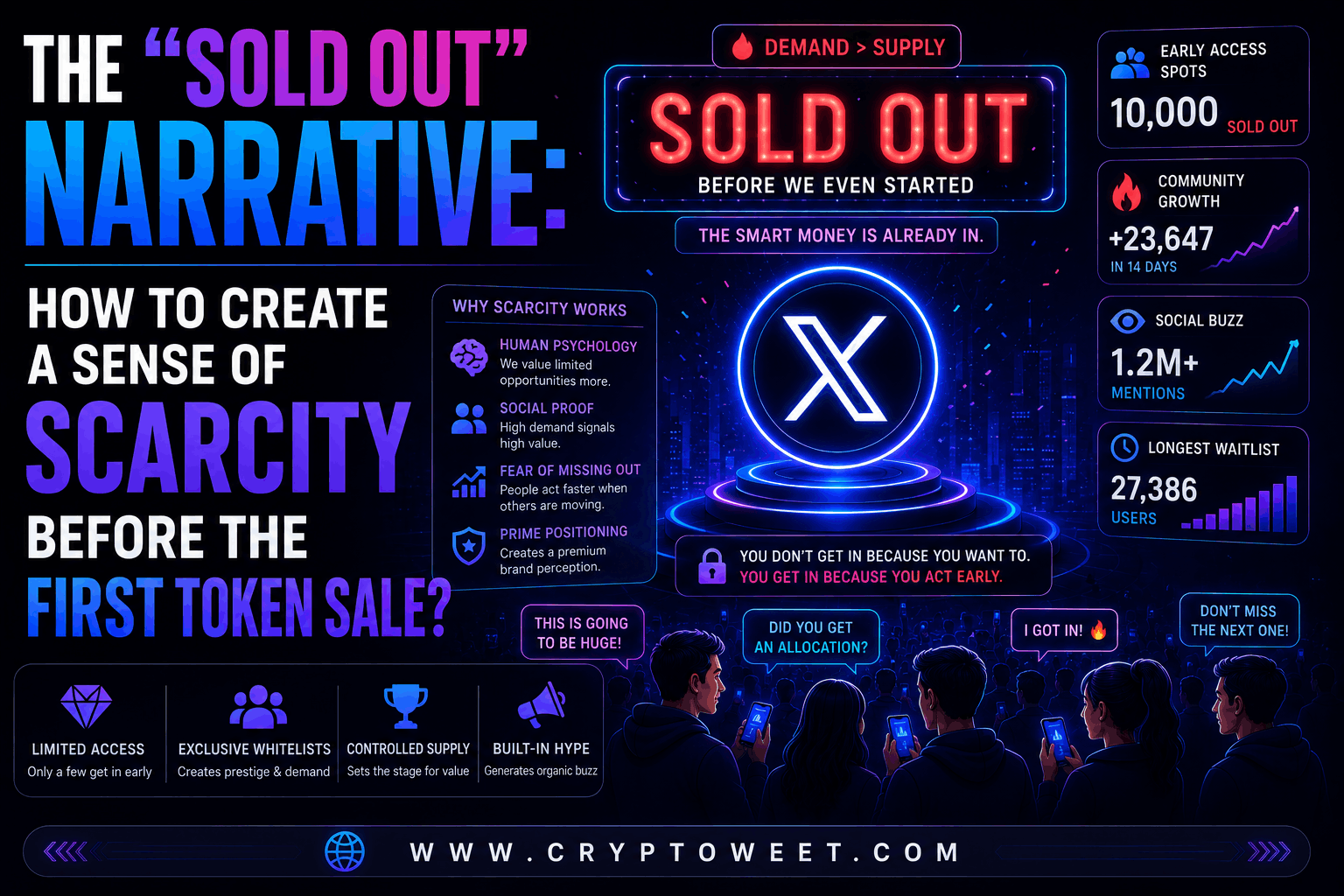
The sold out narrative crypto is not simply the outcome of a successful presale. It is a carefully constructed perception that demand will exceed supply before the token sale even begins. This perception shapes investor behavior long before any actual capital is committed. When potential participants believe that allocation is limited and competition is high, they shift from passive observers to active buyers.
A critical distinction exists between real demand and perceived demand. Real demand is based on actual participation, while perceived demand is built through visible signals such as community engagement, influencer validation, and allocation updates. In practice, perceived demand often drives early momentum, which then attracts real demand. This creates a feedback loop where perception and reality reinforce each other.
Investors rarely operate with complete information. Instead, they rely on signals to assess whether an opportunity is worth pursuing. A strong pre-launch hype crypto environment signals that others have already validated the project. This reduces perceived risk and increases urgency. As more participants act on this perception, the narrative strengthens, eventually becoming self-fulfilling.
The importance of this narrative becomes clear when comparing two scenarios. In one, a project opens its presale with no prior buildup, no visible engagement, and no scarcity signals. In the other, a project has already built anticipation, limited access, and visible demand. Even if both projects have similar fundamentals, the second is far more likely to sell out quickly because the psychological environment encourages faster action.
The Psychology Behind Scarcity Marketing Crypto and Pre-Sale Demand
At the core of the sold out narrative crypto lies the principle of scarcity. Scarcity is a well-documented psychological trigger that increases perceived value when availability is limited. In crypto, this effect is amplified because investors are constantly searching for early opportunities with high upside potential.
Scarcity marketing crypto leverages this principle by restricting access, limiting supply, and creating time-sensitive opportunities. When investors believe that an opportunity is scarce, they prioritize it over other options. This prioritization reduces analysis time and increases the likelihood of immediate action.
Another critical factor is loss aversion. Investors are more motivated to avoid missing out on gains than to pursue gains themselves. This means that the fear of missing a sold-out presale can be more powerful than the potential profit from participating. When combined with visible social proof, this fear intensifies, pushing investors toward faster decisions.
Herd behavior also plays a significant role. When individuals observe others participating, especially those perceived as knowledgeable, they interpret this as validation. This reduces uncertainty and increases confidence. In crypto, where information asymmetry is high, this behavior becomes even more pronounced.
The interaction between these psychological factors creates a powerful environment. Scarcity triggers urgency, social proof provides validation, and loss aversion accelerates decision-making. Projects that understand and align these elements can create conditions where investors feel compelled to act quickly, even before the token sale officially begins.
Building Demand Before Launch: The Crypto Marketing Strategy Funnel
Creating a sold out narrative crypto requires a structured approach to demand generation. This is where a well-designed crypto marketing strategy becomes essential. Instead of focusing solely on the moment of sale, successful projects build demand through a multi-stage funnel that gradually increases investor interest and commitment.
The first stage is awareness. At this stage, the goal is to introduce the project and establish initial visibility. Content focuses on storytelling, vision, and differentiation. This stage does not aim to convert, but to ensure that potential investors are familiar with the project before scarcity signals are introduced.
The second stage is interest. Here, projects begin to provide more detailed information about their ecosystem, token utility, and roadmap. Engagement becomes more important, as discussions and interactions signal that the project is gaining traction. This stage lays the foundation for future social proof.
The third stage is validation. Social proof becomes more visible, with influencer mentions, community growth, and early supporter activity. Investors begin to perceive that the project is being taken seriously by others. This perception reduces skepticism and increases trust.
The fourth stage is FOMO activation. Scarcity signals are introduced, such as limited whitelist spots and allocation caps. Messaging shifts toward urgency, highlighting that opportunities are becoming limited. Investors who have been following the project are now primed to act.
The final stage is conversion. At this point, the combination of awareness, validation, and scarcity leads to participation. Investors commit capital not only because of the project’s fundamentals, but because the environment signals that others are doing the same.
Whitelist Scarcity Strategy: Engineering Controlled Demand
The whitelist scarcity strategy is one of the most effective tools for creating a sold out narrative crypto. By controlling access to the presale, projects can shape how demand is perceived and distributed.
A well-designed whitelist does more than filter participants. It creates a sense of exclusivity. When access is limited, being part of the whitelist becomes a signal of status. This encourages more users to compete for entry, increasing overall engagement and visibility.
Tiered access is a common approach. Projects may divide participants into categories such as early supporters, active community members, and general applicants. Each tier has different levels of access and allocation. This structure not only rewards early engagement but also reinforces the perception that access is scarce and valuable.
Designing an effective whitelist requires balance. If it is too easy to join, scarcity is lost. If it is too difficult, participation drops. The goal is to create a level of challenge that encourages effort without discouraging participation. This balance ensures that demand remains high while maintaining accessibility.
Another important aspect is communication. Projects should clearly explain how the whitelist works, how participants are selected, and what benefits it provides. Transparency reduces confusion and builds trust, which is essential for maintaining credibility.
Social Proof Crypto Presale: Layering Signals Before Launch
Social proof crypto presale is the backbone of any successful sold out narrative. Without visible validation, scarcity signals lose their effectiveness. Investors need to see evidence that others are interested and participating.
There are multiple layers of social proof that can be combined to create a strong perception of demand. Community engagement is the most fundamental. Active discussions, replies, and debates signal that the project has captured attention. This type of engagement is more valuable than passive metrics because it reflects genuine interest.
Influencer validation adds another layer. When recognized figures mention or support a project, their credibility transfers to the project. This reduces perceived risk and increases trust. The impact is even stronger when multiple influencers provide consistent signals over time.
Whale participation is another powerful indicator. Large allocations from known wallets signal confidence from experienced investors. Observers interpret these actions as informed decisions, which encourages them to follow.
The key to effective social proof crypto presale is layering. Instead of relying on a single signal, projects should combine multiple types of validation. Each signal reinforces the others, creating a cohesive narrative that demand is strong and growing.
When these layers are visible before the token sale begins, they create an environment where investors expect the presale to sell out. This expectation drives behavior, turning perception into reality.
Content Strategy to Simulate “Sold Out Momentum”
Once the foundation of social proof crypto presale is established, the next step is to translate that demand into a visible, ongoing narrative. This is where content strategy becomes the execution layer of the sold out narrative crypto. Without consistent storytelling, even strong signals fade quickly and fail to compound.
The goal is not to announce that demand exists, but to show it repeatedly through evolving content. Investors are influenced by patterns, not single events. A single post about whitelist demand has limited impact, but a sequence of updates that reinforce momentum creates a psychological environment where participation feels urgent and necessary.
Threads on X play a central role. Instead of static announcements, projects should use narrative-driven threads that highlight progress, community activity, and milestones. For example, rather than saying “Whitelist is open,” a more effective approach is to frame it as a journey: early applications, increasing demand, and limited remaining slots. This creates a sense of progression that investors can follow.
Replies and quote tweets are equally important. High-performing projects do not rely only on top-level posts. They actively engage in conversations, respond to community members, and highlight user-generated content. This creates the perception of an active ecosystem rather than a one-way broadcast channel.
Repetition is a critical factor. Investors often need multiple exposures before acting. By reinforcing key messages such as limited supply, growing demand, and approaching deadlines, projects ensure that the perceived scarcity in crypto remains top of mind. The narrative should evolve, but the core signals must remain consistent.
When executed correctly, content strategy transforms isolated updates into a continuous stream of validation. This stream creates the illusion of unstoppable momentum, where every new interaction reinforces the belief that the presale is moving toward a sold-out outcome.
Timing and Signal Sequencing in Crypto Presale Demand Generation
Timing is one of the most underestimated elements in crypto presale demand generation. Even strong signals lose effectiveness if they are introduced at the wrong moment. The sold out narrative crypto depends not only on what is communicated, but when and in what sequence.
Early-stage signals should focus on curiosity and awareness. At this point, scarcity is not emphasized heavily. Instead, the goal is to build a base level of attention and interest. This ensures that when scarcity signals are introduced later, there is already an audience prepared to respond.
As the campaign progresses, whitelist announcements mark the transition into controlled scarcity. This is where urgency begins to build. Influencer activity should be layered during this phase, reinforcing credibility while demand is still forming. If influencer signals appear too early, they may not convert effectively because the audience is not yet primed.
Mid-phase is where momentum must be visible. Updates about application numbers, engagement growth, and community activity should be introduced gradually. These updates serve as proof that demand is increasing. The key is to avoid overwhelming the audience while maintaining consistent visibility.
The final phase before the token sale is where X FOMO strategy crypto becomes most intense. Allocation updates, countdowns, and reminders of limited access create peak urgency. At this stage, hesitation is reduced because investors have already been exposed to multiple reinforcing signals.
A simple sequencing structure can be visualized as:
- Awareness and curiosity building
- Whitelist launch with controlled scarcity
- Influencer and community validation
- Momentum updates and visible demand
- Final urgency and allocation pressure
Projects that manage this sequence effectively create a smooth escalation of FOMO, rather than abrupt spikes that are difficult to sustain.
Token Allocation Strategy Crypto and Perceived Scarcity
The design of token allocation plays a direct role in shaping perceived scarcity in crypto. Many projects focus on technical tokenomics without considering how allocation visibility influences investor behavior. In reality, allocation design is a psychological tool as much as a financial one.
A smaller hard cap often creates stronger FOMO because it signals limited opportunity. When investors see that the total raise is constrained, they assume competition will be higher. This assumption increases urgency and encourages faster participation. In contrast, large raises can dilute urgency, making the opportunity feel less exclusive.
Visibility also matters. When allocation progress is transparent, investors can track how quickly slots are being filled. This transforms abstract demand into a measurable reality. Seeing that a significant portion of allocation has already been taken reinforces the idea that the opportunity is disappearing.
Another important factor is distribution. If allocation is concentrated among a small group of participants, it can create the perception that insiders have privileged access. This can either increase desirability or create skepticism, depending on how it is communicated. Balanced distribution, combined with clear messaging, ensures that scarcity feels fair rather than manipulated.
Designing allocation with high demand token launch strategy in mind allows projects to align financial structure with psychological impact. When investors perceive that access is limited, competitive, and transparent, they are more likely to act quickly.
Common Mistakes That Break the Sold Out Narrative Crypto
Even with strong fundamentals, many projects fail to create a convincing sold out narrative crypto due to execution errors. These mistakes often weaken perception and reduce conversion, even when demand exists.
One of the most common issues is launching without a community. Without prior engagement, scarcity signals feel empty because there is no visible audience to validate them. Investors rely on social proof, and without it, urgency does not translate into action.
Another mistake is relying on artificial engagement. Fake interactions may create temporary visibility, but they lack depth. Experienced investors can quickly distinguish between organic discussion and manufactured activity. This undermines credibility and damages trust.
Overpromising is another risk. Exaggerating demand or misrepresenting allocation progress may generate short-term excitement, but it creates long-term skepticism. Once inconsistencies are noticed, the narrative collapses.
Whitelist mismanagement also affects perception. If access is too broad, scarcity disappears. If it is too restrictive without clear reasoning, participation declines. Finding the right balance is essential for maintaining both demand and accessibility.
Influencer mismatch is another factor. Collaborating with irrelevant or low-credibility figures can dilute authority rather than enhance it. Effective influencer strategy requires alignment with the project’s audience and narrative.
Avoiding these mistakes is as important as implementing positive strategies. A single weak signal can undermine multiple strong ones, breaking the consistency required for a successful sold out narrative.
Integrating the Sold Out Narrative Into the Full Launch Strategy
The sold out narrative crypto should not end at the presale. It must be integrated into the broader crypto launch marketing funnel to maintain momentum and ensure long-term success.
Before the sale, the focus is on building demand and shaping perception. During the sale, the narrative shifts toward execution, highlighting allocation progress and participation milestones. After the sale, the narrative must evolve again, reinforcing confidence and preparing for listing.
Consistency is key. If the narrative changes abruptly, it can create confusion and reduce trust. Investors expect continuity between pre-launch messaging and post-sale reality. This continuity reinforces the idea that the project is well-structured and reliable.
Integration also involves aligning different channels. X, Discord, Telegram, and other platforms should reinforce the same core message. Cross-channel consistency ensures that investors encounter the same signals regardless of where they engage.
When the sold out narrative is embedded into the full lifecycle, it becomes more than a marketing tactic. It becomes a framework for managing perception, guiding investor behavior, and sustaining engagement beyond the initial fundraising phase.
Ethical Use of Scarcity Marketing Crypto
Ethical considerations are essential when applying scarcity marketing crypto strategies. While FOMO can drive rapid participation, misuse can damage credibility and long-term trust.
The most important principle is honesty. Scarcity should be real, not fabricated. Allocation limits, whitelist restrictions, and participation metrics must reflect actual conditions. Transparency ensures that investors can make informed decisions.
Another key factor is responsible communication. Urgency should be based on genuine constraints rather than exaggerated claims. Overstating demand or creating artificial pressure may lead to short-term gains, but it undermines trust once inconsistencies are revealed.
Ethical strategies also focus on sustainability. Projects should aim to build relationships with investors, not just drive one-time participation. This means continuing communication after the presale, delivering on promises, and maintaining engagement.
When scarcity is applied ethically, it enhances both conversion and credibility. Investors feel confident participating, knowing that the signals they observe are reliable. This trust becomes a long-term asset, supporting future growth and expansion.
Professional Support: Building a High-Conversion Scarcity System
Executing a complete sold out narrative crypto requires coordination across multiple layers: content, social proof, influencer strategy, and timing. Most teams struggle not because they lack ideas, but because they lack a structured system to execute consistently.
CryptoWeet provides a specialized framework designed to build and scale high-conversion scarcity systems for Web3 projects. Instead of focusing on isolated tactics, the approach integrates every element of crypto presale demand generation into a cohesive engine.
The process begins with establishing a strong foundation. Through systems like The 1000 Foundation, projects build initial credibility by developing real engagement and active audiences. This ensures that future signals are amplified effectively rather than ignored.
Content strategy is then aligned with investor psychology. Threads, engagement posts, and narrative-driven updates are designed to guide users through awareness, validation, and FOMO stages. Each piece of content serves a purpose within the larger funnel.
CryptoWeet also supports influencer and alpha caller integration, ensuring that endorsements are timed strategically rather than randomly. This creates authority stacking, where multiple credible signals reinforce each other.
Real-time optimization is another key component. Campaign performance is monitored continuously, allowing adjustments based on engagement patterns and investor behavior. This ensures that momentum is maintained throughout the presale.
By combining these elements, CryptoWeet transforms fragmented marketing efforts into a structured system that converts attention into capital. This approach allows projects to move from unpredictable outcomes to controlled, high-performance fundraising.
Conclusion: Turning Scarcity Into Predictable Presale Success
The sold out narrative crypto is not a coincidence. It is the result of carefully aligned scarcity marketing crypto, social proof crypto presale, and strategic execution across the entire launch funnel. When these elements are combined effectively, they create an environment where investors expect demand to exceed supply, driving faster participation and stronger results.
Projects that treat scarcity as a system rather than a tactic are able to generate consistent outcomes. By building demand before launch, structuring whitelist access, and reinforcing perception through content and social signals, they transform interest into action.
For teams aiming to maximize presale performance, implementing a structured approach is essential. With the right framework and execution, the sold out narrative becomes more than a goal. It becomes a predictable result driven by strategy, psychology, and coordinated effort.