
In Web3, momentum can collapse faster than it builds. A single wave of negative sentiment can trigger panic, weaken trust, and directly impact capital inflow. This is why FUD Prevention on X is not optional, but a core component of any serious fundraising strategy. crypto FUD management is no longer about reacting to problems, but about controlling perception before it spirals. When fear uncertainty doubt crypto narratives gain traction, they do not just affect sentiment. They influence investor decisions, reduce conversions, and can destabilize token reputation management and price expectations within hours.
This guide explains how to systematically approach prevent FUD crypto strategies using structured frameworks rooted in crypto crisis management and FUD control Web3 principles. This article explores how investor sentiment crypto, panic selling behavior, and trust erosion Web3 interact during fundraising phases. By understanding Twitter narrative control, negative social signals crypto, and real time response systems, projects can build resilient communication structures that protect both reputation and price stability crypto during critical funding windows.
Why FUD Can Destroy Fundraising Momentum Overnight?
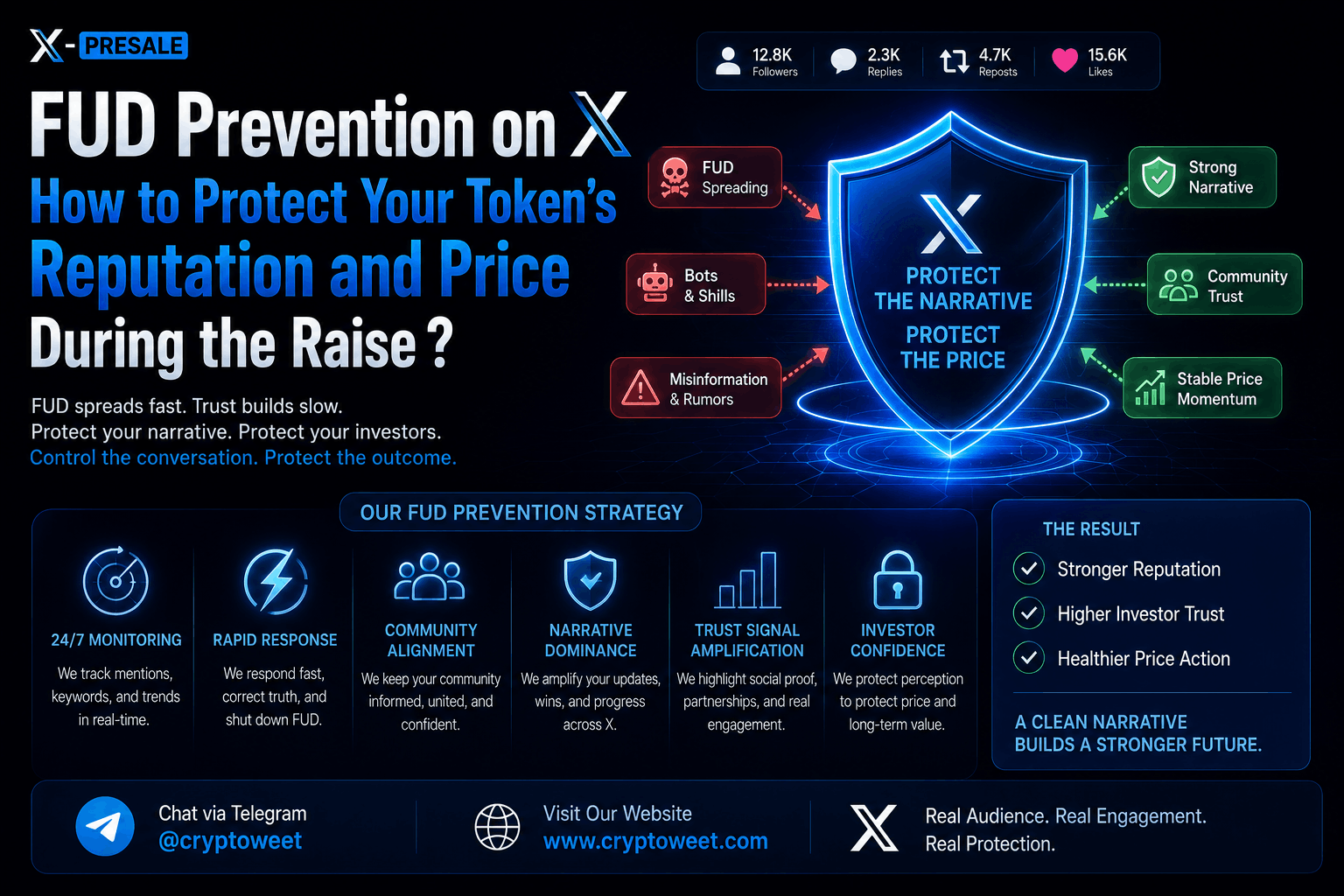
The speed of information flow in Web3 creates a fragile environment where perception changes faster than fundamentals. A project can spend weeks building trust, only to see it weakened within hours due to fear uncertainty doubt crypto narratives spreading across X.
Unlike traditional markets, crypto operates in a highly reactive environment. Investors monitor social channels constantly, and decisions are often influenced by real time sentiment rather than long term analysis. This makes crypto FUD management essential for maintaining momentum.
Trust is the primary currency during fundraising. When trust is stable, users are willing to allocate capital. When trust is shaken, hesitation increases, and conversion rates drop. This is why token reputation management is directly linked to funding outcomes.
Another critical factor is amplification. Negative information spreads faster than positive updates. Controversial posts, accusations, or doubts trigger engagement, which increases visibility. This creates a feedback loop where negative social signals crypto gain traction quickly.
Price expectations are also affected. Even before a token is publicly traded, perceived risk influences valuation assumptions. If FUD spreads, participants may delay contributions or reduce allocation size.
The combination of speed, amplification, and psychological impact makes FUD one of the most dangerous threats during fundraising. Preventing it requires proactive systems rather than reactive responses.
Understanding FUD in Crypto Markets
To effectively implement prevent FUD crypto strategies, it is necessary to understand the structure of FUD itself. In Web3, FUD is not just misinformation. It is any narrative that introduces doubt, reduces confidence, or creates uncertainty about a project.
There are multiple types of FUD, each with different origins and impacts.
Organic FUD emerges naturally from community concerns. Users may question tokenomics, roadmap feasibility, or team credibility. While not malicious, it can still spread rapidly if left unaddressed.
Competitor driven FUD is more strategic. Competing projects or aligned communities may attempt to weaken perception by highlighting risks or spreading negative narratives.
Influencer triggered FUD carries significant weight. When recognized figures express doubt, their audience often adopts the same perspective. This amplifies rumor spread dynamics dramatically.
Internal miscommunication is another common source. Inconsistent messaging, unclear updates, or delayed announcements can create confusion that evolves into FUD.
The way FUD spreads on X follows predictable patterns. A single post gains traction, replies amplify the narrative, and quote tweets introduce additional interpretations. As engagement increases, visibility expands, accelerating the spread.
Crypto markets are particularly vulnerable because information asymmetry is high. Most participants lack complete data, so they rely on visible signals to make decisions. This makes social listening crypto and early detection critical.
Understanding these dynamics allows projects to design targeted FUD response strategy systems rather than applying generic solutions.
The Impact of FUD on Token Reputation and Price
The consequences of FUD extend beyond temporary sentiment shifts. They directly affect token reputation management, funding efficiency, and long term brand perception.
The first impact is trust erosion. Once doubts are introduced, users begin to question the project’s credibility. Even if the information is inaccurate, the perception of risk increases.
Investor hesitation follows. Potential contributors delay decisions, waiting for clarity. This slows down fundraising momentum and reduces conversion rates.
Existing participants may reconsider their involvement. This leads to reduced engagement and weaker crypto community engagement, which further amplifies negative perception.
Panic selling behavior becomes relevant when tokens are already tradable or when expectations of future value decline. Users anticipate lower prices and adjust their actions accordingly.
Liquidity perception is also affected. If FUD suggests instability, participants may assume that liquidity will be weak, reducing confidence in future trading conditions.
Another critical factor is long term brand damage. Even after FUD is addressed, residual doubt may remain. This affects future campaigns, partnerships, and overall crypto brand perception.
These impacts highlight why protect token price strategies must include strong FUD control Web3 systems. Preventing perception collapse is more efficient than attempting recovery after damage occurs.
Investor Psychology During FUD Events
Understanding investor psychology crypto is essential for managing FUD effectively. Reactions are driven by emotional and cognitive shortcuts rather than purely rational analysis.
Fear amplification loops are one of the most powerful mechanisms. When users see negative information, they interpret it as a warning. This triggers defensive thinking, leading to further attention on negative signals.
Herd behavior accelerates the process. Individuals observe how others react and adjust their own behavior accordingly. If multiple users express concern, it creates a perception of consensus.
Information asymmetry increases uncertainty. Most participants do not have access to complete data, so they rely on visible signals. This makes negative social signals crypto highly influential.
Trust collapse dynamics occur when multiple doubts accumulate. A single issue may not be significant, but combined signals create a stronger perception of risk.
Another important factor is loss aversion. Users are more sensitive to potential losses than gains. This means that negative narratives have a stronger impact than positive updates.
During fundraising, these psychological factors directly affect conversion. Users who might have contributed hesitate or withdraw entirely.
Effective crypto crisis management must account for these behaviors, focusing on perception and emotional response rather than just factual correction.
Early Detection Systems for FUD
Preventing FUD requires early identification. Once narratives gain traction, they become significantly harder to control. This makes social listening crypto and monitoring systems essential.
Projects need to track sentiment across multiple channels, including X, Discord, and community forums. Monitoring tools can identify spikes in negative mentions, keyword frequency, and engagement patterns.
Sentiment analysis helps quantify perception. By evaluating the ratio of positive to negative interactions, teams can detect shifts before they escalate.
Keyword tracking is another important component. Monitoring terms related to risk, scams, or concerns allows early identification of emerging narratives.
Anomaly detection focuses on sudden changes. Unexpected increases in negative replies or unusual influencer mentions often indicate the start of a FUD wave.
Key signals to monitor include:
• Sudden increase in negative replies
• Unusual activity from influential accounts
• Rapid spread of specific narratives
• Changes in community tone
• Increased questioning or skepticism
Early detection enables faster response, reducing the impact of FUD. Without these systems, projects operate reactively, which significantly lowers effectiveness.
Narrative Control: The First Line of Defense
Once FUD is detected, controlling the narrative becomes the priority. Twitter narrative control determines whether negative signals expand or are contained.
The first principle is proactivity. Projects should communicate before speculation fills the gap. Silence creates uncertainty, which allows FUD to grow.
Consistency is critical. Messaging must remain aligned across all channels. Conflicting statements create confusion and weaken credibility.
Clarity reduces misinterpretation. Complex explanations should be simplified to ensure that audiences understand the message quickly.
Timing also plays a major role. Delayed responses allow narratives to solidify. Quick but accurate communication limits spread.
Transparency strengthens trust signals Web3. Providing clear information, including potential risks, builds credibility even during negative situations.
Narrative framing influences perception. Presenting challenges as part of a broader development process reduces panic and maintains confidence.
Effective reputation signals management ensures that positive narratives remain dominant, even when negative information appears.
Strategic FUD Response Framework
Responding to FUD requires structured decision making rather than emotional reactions. Not all situations require the same approach.
The first decision is whether to respond or ignore. Minor comments may not require attention, while widespread narratives demand immediate action.
Speed must be balanced with accuracy. Responding quickly is important, but incorrect information can worsen the situation.
Tone is another critical factor. Defensive or aggressive responses damage credibility. Professional, calm communication maintains trust.
Centralized communication ensures consistency. Multiple voices delivering different messages create confusion.
Decentralized support from the community can amplify responses. Encouraging informed discussions helps distribute accurate information.
A strong FUD response strategy integrates these elements into a cohesive system that adapts to different scenarios.
Community as a Defense Mechanism
Communities play a crucial role in FUD control Web3. A strong, engaged community can counter negative narratives organically.
Loyal supporters often defend projects when they feel aligned with the vision. This creates decentralized protection that extends beyond official communication.
Ambassador programs strengthen this effect. Active members who understand the project can respond to concerns within their networks.
Organic defense narratives emerge when communities are informed and engaged. These narratives carry more credibility than official statements alone.
Trust loops develop over time. Consistent positive interactions build loyalty, making communities more resilient to external negativity.
Building a strong community before crises occur is essential. Reactive efforts are less effective without existing engagement.
Community driven defense systems enhance crypto reputation management and reduce reliance on centralized responses.
Content Strategy During Crisis
Content plays a key role in managing perception during FUD events. Strategic communication can stabilize sentiment and reinforce trust.
Transparency posts address concerns directly. Clear explanations reduce uncertainty and provide context.
FAQ threads organize information. Answering common questions in a structured format improves clarity.
Myth busting content counters misinformation. Presenting facts in a simple format helps correct narratives.
Proof based communication increases credibility. Sharing data, progress updates, and verifiable information strengthens trust.
Consistency ensures visibility. Regular updates prevent information gaps that allow FUD to grow.
Effective content strategy transforms crypto crisis management into an opportunity to reinforce credibility and strengthen relationships.
Maintaining Price Stability During FUD
During a FUD event, perception does not just affect reputation. It directly impacts expectations around value, which is why price stability crypto must be actively managed even before a token is publicly traded. In fundraising phases, price is psychological. It exists as an expectation of future value rather than a current market reality. When fear uncertainty doubt crypto narratives spread, that expectation weakens, and with it, contribution confidence.
The first layer of protect token price strategy is communication around fundamentals. Projects must continuously reinforce utility, roadmap progress, and long term vision. When users understand the underlying value, they are less reactive to short term narratives.
Liquidity perception is another critical factor. Even if liquidity is not yet deployed, communicating plans clearly reduces uncertainty. Users need to feel that exit options will exist and that the market will be supported.
Whale confidence signals also play a role. When larger participants remain active or continue engaging, it signals stability. This reduces panic and counters negative assumptions.
Avoiding panic triggers is essential. Sudden changes in communication tone, disappearing updates, or defensive reactions amplify fear. Consistency and calm messaging stabilize sentiment.
Reinforcing community strength helps maintain confidence. Active crypto community engagement signals that interest remains strong despite external narratives.
Price stability is not controlled directly. It is influenced through perception, trust, and visible confidence. Managing these elements ensures that token reputation management remains intact even under pressure.
Common Mistakes That Amplify FUD
While many teams attempt crypto FUD management, their actions often unintentionally strengthen the very narratives they aim to control. Understanding these mistakes is critical for effective FUD control Web3.
Silence is one of the most damaging responses. When projects do not communicate, users fill the gap with speculation. This accelerates rumor spread dynamics and amplifies uncertainty.
Defensive aggression is equally harmful. Responding emotionally or attacking critics reduces credibility. It shifts focus from facts to conflict, which increases engagement around negative narratives.
Inconsistent messaging creates confusion. If different team members provide conflicting information, trust erodes quickly. Consistency is essential for maintaining reputation signals.
Deleting criticism is another mistake. Attempting to hide negative feedback often backfires, as it signals lack of transparency. Communities value openness, even during difficult situations.
Overreaction can also amplify FUD. Addressing minor issues with excessive urgency may give them more importance than they deserve.
Ignoring valid concerns weakens trust. Not all criticism is malicious. Addressing legitimate questions strengthens credibility and reduces uncertainty.
Avoiding these mistakes ensures that prevent FUD crypto strategies remain effective and do not unintentionally escalate the situation.
Ethical Crisis Management and Long Term Trust
Sustainable crypto crisis management is built on ethical principles. Short term suppression of FUD may provide temporary relief, but long term success depends on trust.
Transparency is the foundation of trust signals Web3. Projects that communicate openly build stronger relationships with their community. This includes sharing both progress and challenges.
Accountability strengthens credibility. Acknowledging mistakes rather than avoiding them demonstrates professionalism and integrity.
Honesty reduces speculation. Clear, accurate information prevents the spread of misinformation and supports informed decision making.
Consistency reinforces trust over time. Regular communication creates familiarity, which reduces uncertainty during crisis events.
Value driven engagement ensures that interactions remain meaningful. Providing insights, updates, and education keeps the community aligned with the project’s vision.
Ethical growth aligns with decentralized principles. Communities expect openness and authenticity, and projects that meet these expectations are more resilient to FUD.
Long term crypto brand perception is shaped by how projects handle difficult moments. Ethical frameworks ensure that reputation strengthens rather than weakens under pressure.
Professional Infrastructure for FUD Prevention and Reputation Protection
Most projects approach FUD as a reactive problem. They wait until negative narratives appear before taking action. This approach is fundamentally flawed because by the time FUD is visible, perception has already started shifting.
Effective FUD Prevention on X requires proactive systems that establish strong social validation signals before any crisis occurs. Without this foundation, even accurate responses struggle to gain traction because audiences evaluate credibility before accepting information.
The challenge lies in scale and consistency. Maintaining crypto community engagement, monitoring sentiment, controlling narratives, and responding in real time requires structured infrastructure. Internal teams often lack the resources to manage all these layers simultaneously.
Professional systems integrate multiple components:
• Continuous social listening crypto and sentiment tracking
• Structured communication pipelines for rapid response
• Engagement engineering to maintain visible activity
• Community management frameworks that support organic defense
• Data driven optimization for ongoing improvement
These systems transform FUD prevention from a reactive task into a controlled process. Instead of chasing narratives, projects shape them.
The 1000 Foundation: Building Pre-FUD Immunity
Before a crisis happens, perception is already forming. This is why The 1000 Foundation functions as a pre FUD shield rather than a recovery tool.
The concept focuses on establishing baseline credibility that influences how audiences interpret information. When a project already displays strong engagement, active discussions, and visible community support, negative narratives encounter resistance.
The foundation includes:
• 1,000 real crypto aligned followers who create immediate legitimacy
• 1,000 distributed engagement signals that establish activity history
• 1,000 authentic replies and discussions that demonstrate real interaction
These are not superficial metrics. They are social validation signals that shape first impressions. When users encounter a project with visible engagement, they assume that others have already evaluated and trusted it.
This changes how FUD is processed. Instead of accepting negative narratives immediately, users question them. Existing engagement acts as counter evidence.
The effect extends to algorithmic behavior. Content with existing engagement is more likely to be distributed, allowing positive narratives to compete effectively against negative ones.
This creates a defensive loop:
Strong signals → higher trust → reduced susceptibility to FUD → stable perception → sustained engagement.
CryptoWeet integrates The 1000 Foundation into broader token reputation management systems. By building credibility before crises occur, projects reduce the probability and impact of FUD events.
Instead of reacting to threats, they operate from a position of strength.
Conclusion
FUD Prevention on X is not about controlling every narrative. It is about controlling perception, trust, and visibility in an environment where information spreads rapidly and emotions drive decisions.
FUD impacts more than sentiment. It affects token reputation management, reduces Web3 fundraising ROI, and destabilizes price stability crypto expectations. Projects that ignore this reality risk losing momentum at critical stages.
Effective crypto FUD management combines early detection, narrative control, community strength, and structured response systems. It requires understanding investor psychology crypto, anticipating panic selling behavior, and maintaining consistent trust signals Web3.
The difference between projects that collapse under pressure and those that remain stable lies in preparation. Building strong foundations before crises occur ensures resilience when challenges arise.
For teams seeking to protect reputation, maintain momentum, and secure successful fundraising outcomes, investing in professional infrastructure provides a clear advantage. Systems like The 1000 Foundation transform perception into a defensive asset, allowing projects to withstand FUD and continue growing with confidence.
In Web3, trust is fragile but powerful. Those who protect it effectively turn potential threats into opportunities for stronger credibility and long term success.