
The debate around organic vs paid crypto Twitter growth has become one of the most important strategic decisions for Web3 teams. Every crypto project wants visibility, but visibility alone does not create trust, and trust is the foundation of investor confidence. Many teams rush into paid promotion, influencer deals, and aggressive advertising campaigns expecting rapid traction, only to discover that inflated numbers rarely convert into long term supporters. At the same time, relying purely on organic reach without a structured strategy can slow momentum, allowing competitors to dominate the narrative and capture market attention.
This guide explores how crypto Twitter growth strategy decisions influence token marketing strategy, investor trust crypto marketing, and overall ecosystem credibility. Instead of promoting hype driven tactics, this article explains how organic crypto marketing and paid crypto promotion serve different purposes in crypto social media marketing. You will learn when to prioritize authentic crypto community growth, when to invest in acceleration campaigns, and how to balance both for sustainable results. By understanding growth sustainability, marketing ROI, audience targeting, and reputation management, Web3 teams can scale visibility without sacrificing credibility.
Why Crypto Twitter Growth Strategy Determines Token Success?
A well designed crypto twitter growth strategy shapes how the market perceives your project long before investors read your whitepaper or test your product. On crypto Twitter, visibility functions as social validation. When users see consistent engagement, meaningful discussions, and steady audience expansion, they associate the project with legitimacy. In contrast, erratic spikes, artificial interactions, or low quality engagement raise immediate skepticism. This psychological filtering process affects retail traders, venture funds, ecosystem partners, and media outlets.
The influence extends beyond perception. Platform algorithms evaluate interaction patterns to determine which accounts deserve broader distribution. Algorithm trust signals rely on engagement quality, conversation depth, and network credibility rather than raw follower counts. Projects that focus on vanity metrics may experience short visibility bursts, but they struggle to maintain feed presence. Sustainable web3 social growth strategy depends on maintaining alignment between audience behavior and algorithm expectations.
Token performance also correlates with social credibility. During launch phases, potential investors often check a project’s Twitter activity to assess community strength. A healthy comment section, genuine discussions, and balanced sentiment indicate real interest. Conversely, repetitive shilling, bot like replies, or engagement pods create red flags. These signals influence buying decisions and long term holding behavior.
Another critical factor is competitive positioning. Crypto narratives evolve rapidly. Projects competing in the same niche fight for attention within limited time windows. A weak growth framework reduces the ability to control narrative flow. Strong positioning supported by strategic growth enables teams to dominate conversations during product launches, ecosystem updates, and partnership announcements.
Ultimately, growth strategy determines whether marketing investments translate into durable community assets or disappear after temporary hype cycles. Projects that align growth with credibility infrastructure establish investor confidence, algorithmic trust, and brand authority simultaneously.
What is Organic Crypto Twitter Growth?
Organic crypto twitter growth refers to audience expansion driven by authentic content, community interaction, and natural distribution rather than paid amplification. It relies on value creation instead of visibility purchases. When a project educates users, shares transparent updates, participates in ecosystem discussions, and builds relationships, followers join voluntarily. This voluntary participation produces stronger engagement quality and improves long term retention.
Organic reach operates through behavioral resonance. Users engage with content that aligns with their interests, investment thesis, or technical curiosity. As engagement accumulates, platform algorithms interpret the content as relevant, expanding distribution across related networks. This creates a compounding exposure cycle where high quality posts generate sustained impressions without direct advertising spend.
One defining characteristic of organic crypto marketing is audience authenticity. Followers gained organically tend to have genuine interest in blockchain technology, token utility, or ecosystem development. These audiences are more likely to participate in governance, test products, provide feedback, and advocate for the project. Their interactions generate meaningful social proof rather than superficial metrics.
Organic growth also strengthens reputation management web3 efforts. Because interactions originate from voluntary participation, sentiment trends reflect real community perception. This transparency helps teams detect narrative risks early and adjust communication strategies accordingly.
However, organic strategies require patience and consistent effort. Content systems must operate continuously. Educational threads, ecosystem insights, data breakdowns, and narrative storytelling demand research and planning. Teams lacking structured content workflows may struggle to maintain visibility.
Organic growth advantages include:
• Higher engagement authenticity
• Stronger investor trust signals
• Sustainable audience retention
• Better algorithm compatibility
• Improved brand authority web3
Limitations include slower scaling speed and heavy reliance on content quality. Projects must invest in expertise and communication systems to maintain momentum.
What is Paid Crypto Twitter Growth?
Paid crypto promotion involves investing capital to accelerate visibility through advertising systems, influencer partnerships, sponsored placements, and professional marketing campaigns. Unlike organic strategies, paid growth purchases reach directly. This approach is common during token launches, NFT mint events, exchange listings, and major announcements when rapid awareness is necessary.
Paid campaigns function through targeted exposure. Advertising tools allow projects to define audience segments based on interests, location, or behavioral patterns. Influencer collaborations leverage established audiences to introduce projects to new communities. Sponsored threads and paid promotions generate immediate impressions, expanding reach beyond organic network limits.
One advantage of paid advertising campaigns is speed. Projects can generate large impression volumes within short windows, which is valuable during competitive narrative battles. Rapid exposure can help secure media coverage, attract partnership inquiries, and increase token visibility during launch periods.
Another benefit is audience targeting precision. Well optimized campaigns can focus on traders, developers, NFT collectors, or DeFi users depending on project niche. This targeted approach improves cost efficiency marketing and reduces wasted impressions.
However, paid growth presents significant risks. Engagement quality often varies. Users exposed through ads may interact briefly without genuine interest, leading to shallow metrics. Excessive sponsored content may create skepticism, especially among experienced crypto audiences who value authenticity.
Overdependence on paid promotion also weakens social proof crypto signals. If organic conversation remains minimal while promotional impressions surge, audiences may perceive manipulation. This perception damages ecosystem credibility and undermines investor confidence.
Paid growth advantages include:
• Immediate reach expansion
• Strategic visibility during launches
• Precise audience targeting crypto
• Accelerated brand awareness
Limitations include high costs, variable engagement authenticity, and potential reputation risks if used excessively.
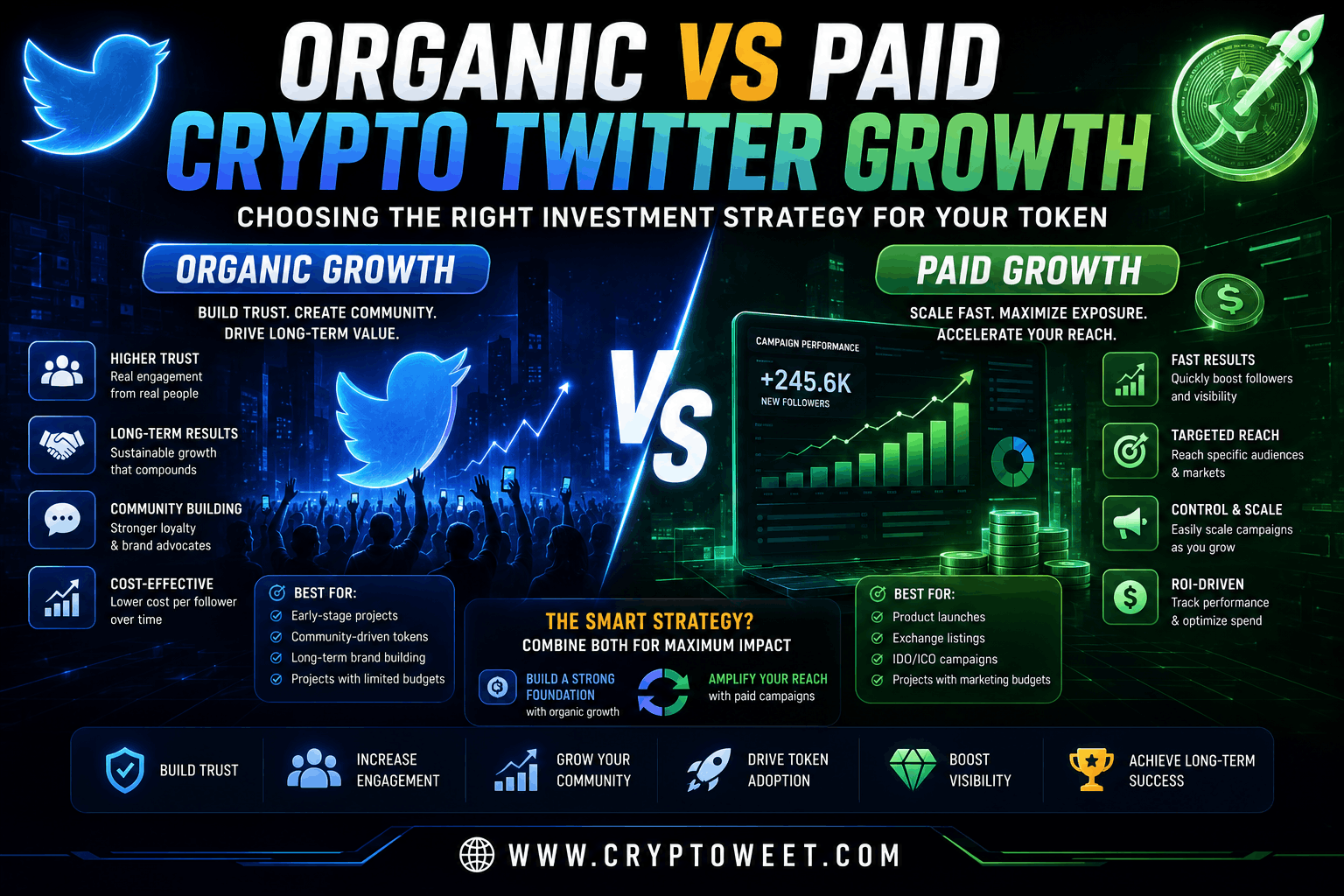
Organic vs Paid Growth: Core Differences That Impact ROI
Understanding organic vs paid crypto twitter growth requires examining how each approach influences return on investment across multiple dimensions. ROI in crypto social media marketing cannot be measured solely through impression counts. Instead, it depends on audience behavior quality, trust formation, and conversion efficiency.
Audience quality represents the most significant difference. Organic followers join due to interest alignment, making them more receptive to updates and more likely to become long term supporters. Paid audiences may include users outside the project’s niche, reducing conversion probability. This disparity affects cost efficiency over time.
Engagement authenticity also differs. Organic interactions emerge naturally, producing meaningful discussions and deeper community bonds. Paid exposure may increase surface interactions without generating sustained conversations. Algorithms interpret authentic engagement more favorably, improving distribution stability.
Investor perception plays a decisive role. Experienced investors evaluate engagement patterns to detect artificial growth. Projects with natural expansion and consistent communication appear more trustworthy than those with sudden promotional spikes. Credibility influences funding opportunities and partnership negotiations.
Scalability varies between approaches. Paid campaigns scale rapidly but require continuous funding. Organic growth compounds gradually but maintains momentum even with limited budgets once content systems mature.
Risk profiles diverge significantly. Excessive paid promotion may trigger audience skepticism and algorithmic scrutiny. Organic growth carries lower reputational risk but demands disciplined content execution.
Key ROI impact differences include:
• Organic growth supports long term community building
• Paid growth supports short term exposure objectives
• Organic engagement improves conversion quality
• Paid reach improves immediate visibility
• Organic signals strengthen algorithm trust
• Paid signals require careful management to avoid credibility damage
Projects optimizing ROI often combine both methods strategically rather than choosing extremes.
When Organic Growth is the Better Strategy for Crypto Projects?
Organic strategies excel during foundational stages when credibility and trust matter more than rapid exposure. Early phase projects benefit from establishing strong crypto community growth through educational content, transparent communication, and ecosystem participation. Building a loyal base of supporters creates resilience against market volatility.
Projects with limited marketing budgets also benefit from organic approaches. Instead of allocating capital to expensive campaigns, teams can invest in research driven threads, development updates, and community discussions. This approach maximizes knowledge assets while minimizing financial risk.
Long term oriented ecosystems should prioritize organic systems. Decentralized communities thrive when participants feel involved rather than marketed to. Organic engagement fosters emotional investment, encouraging members to advocate for the project voluntarily.
Thought leadership development relies heavily on organic presence. Projects that publish technical insights, ecosystem analysis, and data backed perspectives gradually become trusted information sources. This authority cannot be purchased through advertisements.
Organic growth is also suitable when targeting niche technical audiences. Developers, governance participants, and protocol researchers respond more positively to expertise demonstration than promotional campaigns.
Situations favoring organic strategies include:
• Foundation building phases
• Budget constrained teams
• Long term credibility goals
• Technical audience targeting
• Authority positioning objectives
While slower, organic growth establishes durable trust infrastructure supporting sustainable expansion.
When Paid Growth is the Better Investment Strategy?
Paid strategies become valuable when timing and exposure speed outweigh gradual credibility building. Token launches, NFT mint windows, and major ecosystem announcements often require rapid visibility. During these moments, delayed exposure can result in missed opportunities and competitive disadvantages.
Projects entering saturated niches may also require paid promotion to penetrate attention barriers. Established competitors with large communities dominate organic conversations, making it difficult for new entrants to gain traction without visibility boosts.
Paid growth benefits projects with flexible marketing budgets seeking rapid user acquisition crypto. Well managed campaigns can drive traffic to documentation, whitelist registrations, and community channels.
Another appropriate scenario involves narrative defense. When misinformation spreads, rapid promotional amplification can help projects present accurate information quickly.
However, effectiveness depends on strategic alignment. Paid campaigns must complement strong messaging and positioning frameworks. Without credibility infrastructure, promotional exposure may fail to convert.
Paid growth works best for:
• Launch campaigns
• Competitive attention battles
• Rapid awareness requirements
• Strategic narrative amplification
• Budget flexible expansion plans
When executed responsibly, paid strategies accelerate growth momentum while supporting broader marketing objectives.
Hybrid Growth Models: Combining Organic Trust with Paid Acceleration
Hybrid models integrate organic crypto marketing foundations with selective paid amplification. This balanced approach maximizes strengths while minimizing weaknesses. Organic systems establish credibility, while paid campaigns accelerate exposure during strategic windows.
The hybrid approach recognizes that trust and visibility must evolve together. Organic engagement ensures authenticity, while paid promotion expands audience reach. When new users encounter strong community signals after exposure, conversion probability increases significantly.
Budget allocation becomes more efficient under hybrid systems. Instead of continuous ad spending, projects invest in targeted campaigns supporting high impact announcements. Organic content maintains baseline visibility between promotional bursts.
Hybrid models also support narrative control. Organic discussions sustain community interest, while paid campaigns amplify critical updates to broader audiences. This synergy strengthens reputation management web3 strategies.
Successful hybrid implementation requires strategic coordination between content teams and marketing operations. Messaging consistency ensures paid audiences receive the same value signals as organic followers.
Benefits of hybrid systems include:
• Balanced trust and visibility
• Improved marketing ROI crypto
• Reduced reputational risk
• Sustained engagement cycles
• Strategic resource allocation
Hybrid growth reflects a mature understanding of web3 audience behavior and algorithmic dynamics.
Reputation Risks of Overusing Paid Crypto Promotion
While paid crypto promotion can accelerate exposure, overreliance introduces serious reputation vulnerabilities that many Web3 teams underestimate. Crypto audiences are highly sensitive to authenticity. Unlike traditional consumer markets, Web3 communities value transparency, technical merit, and genuine participation. When promotional activity appears excessive, audiences quickly associate the project with artificial hype rather than real innovation.
One major risk is audience skepticism. If users repeatedly encounter sponsored posts, influencer shills, or aggressive advertising, they may question whether visibility reflects genuine community interest. Suspicion grows when engagement patterns appear inconsistent with follower size. For example, large impression volumes with minimal conversation depth signal inflated reach rather than authentic engagement.
Another concern involves engagement quality deterioration. Paid campaigns often attract passive viewers who interact briefly without developing long term interest. These shallow interactions reduce overall engagement ratios, weakening algorithm trust signals. As platform systems detect declining interaction quality, organic visibility may decrease despite continued ad spending.
Reputation damage also affects investor perception. Sophisticated investors evaluate communication patterns to detect manipulation risks. Projects that rely heavily on paid amplification without parallel organic discussion may appear unsustainable. This perception influences funding decisions, partnership negotiations, and ecosystem collaborations.
Overpromotion can also distort community sentiment. Genuine supporters may feel overwhelmed by constant marketing, leading to disengagement. Healthy communities require balanced communication that includes education, updates, and dialogue rather than continuous promotional messaging.
Excessive paid promotion risks include:
• Perceived artificial growth
• Declining engagement authenticity
• Reduced algorithmic distribution
• Investor trust erosion
• Community fatigue
• Short lived hype cycles
Responsible paid usage requires strategic moderation, transparent communication, and strong organic foundations that maintain credibility.
Budget Allocation Framework for Crypto Twitter Marketing
Effective crypto twitter growth strategy depends not only on choosing between organic and paid methods but also on allocating resources intelligently. Marketing budgets in Web3 environments must balance visibility goals with credibility preservation. Without a structured framework, projects may overspend on paid exposure while neglecting long term crypto community growth systems.
Budget planning should consider growth stage maturity. Early stage projects benefit from prioritizing organic systems such as content development, community engagement, and brand positioning. Investing in research driven threads, educational posts, and ecosystem conversations builds trust infrastructure that supports later expansion.
Growth stage projects can gradually integrate paid campaigns. At this phase, organic credibility already exists, so promotional exposure amplifies rather than compensates for weak foundations. Paid investments should focus on milestone announcements, partnerships, and strategic visibility windows.
Mature ecosystems often operate hybrid systems with balanced allocation. Organic engagement sustains community relationships while paid campaigns maintain market dominance during competitive periods.
A simplified allocation logic:
Early Stage
• Majority organic content systems
• Minimal paid testing campaigns
• Focus on credibility signals
Growth Stage
• Balanced organic and paid strategies
• Paid used for key announcements
• Investment in influencer collaborations
Mature Stage
• Hybrid infrastructure with strategic paid scaling
• Organic systems sustain engagement depth
• Paid campaigns defend narrative leadership
ROI evaluation should consider conversion metrics rather than impression counts. Cost per meaningful engagement, follower authenticity, and conversion to token holders provide more accurate performance indicators.
Structured budget allocation ensures growth sustainability, protects reputation management efforts, and improves marketing efficiency across ecosystem life cycles.
Metrics That Matter: Measuring Organic vs Paid Performance
Accurate performance measurement distinguishes strategic growth from vanity metrics. In crypto social media marketing, surface indicators like raw impressions or follower counts rarely reflect ecosystem health. Instead, teams must evaluate metrics aligned with investor trust crypto marketing and community strength.
Engagement rate per follower represents a primary quality signal. High ratios indicate that content resonates with audiences rather than attracting passive viewers. Organic strategies typically produce stronger engagement consistency, while paid campaigns may create temporary spikes.
Conversation depth reveals community authenticity. Threads containing meaningful discussions, questions, and technical insights signal real interest. Superficial comments often suggest promotional exposure without genuine participation.
Follower authenticity score evaluates audience quality. Organic followers usually share niche interests aligned with blockchain topics. Paid campaigns may attract broader but less relevant audiences, reducing conversion efficiency.
Conversion metrics provide direct ROI insights. Tracking how many social participants join Discord servers, governance platforms, or product interfaces measures marketing effectiveness beyond visibility.
Additional valuable indicators include:
• Profile conversion rate from impressions
• Authority mentions by reputable accounts
• Community retention over time
• Sentiment trends across discussions
• Click through to documentation and updates
Data interpretation must consider growth method context. Organic systems may show gradual improvement patterns, while paid campaigns produce short bursts. Long term ecosystem value depends on sustained engagement quality rather than temporary exposure peaks.
Measurement discipline enables teams to refine strategies, reallocate budgets, and maintain alignment with credibility objectives.
Building Investor Trust Through Authentic Growth Signals
Trust functions as the primary currency of Web3 ecosystems. Investors, partners, and users evaluate social signals to determine project reliability. Authentic crypto audience building creates psychological assurance that a project possesses real community backing rather than manufactured popularity.
One core trust signal involves interaction consistency. When engagement grows steadily over time, audiences perceive development stability. Sudden spikes without supporting context may suggest artificial amplification. Consistency reflects operational discipline and transparent communication.
Another factor is participation diversity. Organic communities contain varied user types including developers, analysts, enthusiasts, and contributors. Diverse participation indicates broad ecosystem interest. Homogeneous engagement patterns often imply promotional clustering.
Content quality also influences trust perception. Educational materials, technical insights, and transparent updates demonstrate expertise. Promotional messaging without informational value reduces credibility.
Authentic growth signals strengthen social proof crypto perception. When potential investors observe organic discussions, thoughtful questions, and peer recommendations, confidence increases. These organic endorsements function as decentralized validation mechanisms.
Trust building also affects algorithm behavior. Platforms prioritize content generating meaningful interactions. Authentic engagement improves feed visibility, reinforcing growth cycles.
Key investor trust signals include:
• Consistent engagement patterns
• Meaningful conversation depth
• Diverse participant profiles
• Educational content presence
• Balanced promotional frequency
Projects focusing on authenticity strengthen reputation resilience, improve funding prospects, and establish long term authority within the Web3 landscape.
Professional Growth Infrastructure for Sustainable Crypto Expansion
Even the best organic vs paid crypto twitter growth strategy can underperform without a strong credibility foundation. Projects often invest heavily in content systems or advertising campaigns but struggle to convert visibility into trust. This gap emerges when social proof remains weak, engagement appears inconsistent, or early audiences lack authenticity. Sustainable expansion requires infrastructure that supports credibility before scaling exposure.
CryptoWeet provides professional growth infrastructure designed specifically for Web3 ecosystems seeking stable and authentic expansion. Rather than selling artificial metrics, the focus is on building foundational trust signals that strengthen both organic systems and paid campaigns.
A core component is The 1000 Foundation, a structured credibility layer helping projects establish their first authentic market presence. This foundation includes:
• 1,000 genuine crypto aligned followers with real interest in blockchain ecosystems
• 1,000 distributed likes and views strategically allocated across important posts to reinforce visibility signals
• 1,000 authentic replies and discussion interactions that stimulate natural conversation flows
These elements work together to enhance investor trust signals, improve perceived authority, and strengthen algorithm evaluation of engagement authenticity. When new users discover a project supported by active discussion and consistent interaction patterns, credibility perception increases significantly.
Strong foundations also amplify marketing efficiency. Organic content benefits from improved engagement momentum, while paid campaigns achieve higher conversion rates because audiences encounter visible social proof. This integration reduces reputational risk and enhances marketing ROI.
For projects seeking sustainable crypto expansion, combining strategic growth planning with credibility infrastructure ensures that visibility translates into lasting community assets rather than temporary hype.
Conclusion
There is no universal formula for organic vs paid crypto twitter growth. Each project operates within unique budget constraints, ecosystem maturity levels, and competitive environments. Organic strategies provide authenticity, sustainable engagement, and long term community strength. Paid strategies offer rapid exposure, strategic targeting, and accelerated visibility during critical phases.
The most effective crypto twitter growth strategy aligns method selection with project objectives. Early stage teams benefit from credibility focused organic systems. Growth stage projects gain advantage from hybrid structures that combine trust building with promotional acceleration. Mature ecosystems maintain dominance through balanced infrastructure that protects reputation while expanding reach.
Sustainable success depends on credibility first expansion. Visibility without trust produces fragile hype cycles, while authentic engagement builds durable ecosystems capable of weathering market volatility.
Projects seeking structured support can strengthen their growth journey through professional infrastructure such as CryptoWeet and The 1000 Foundation, ensuring that every stage of expansion rests on genuine community trust.
By aligning growth strategy with credibility architecture, Web3 teams transform social presence into lasting ecosystem value.